
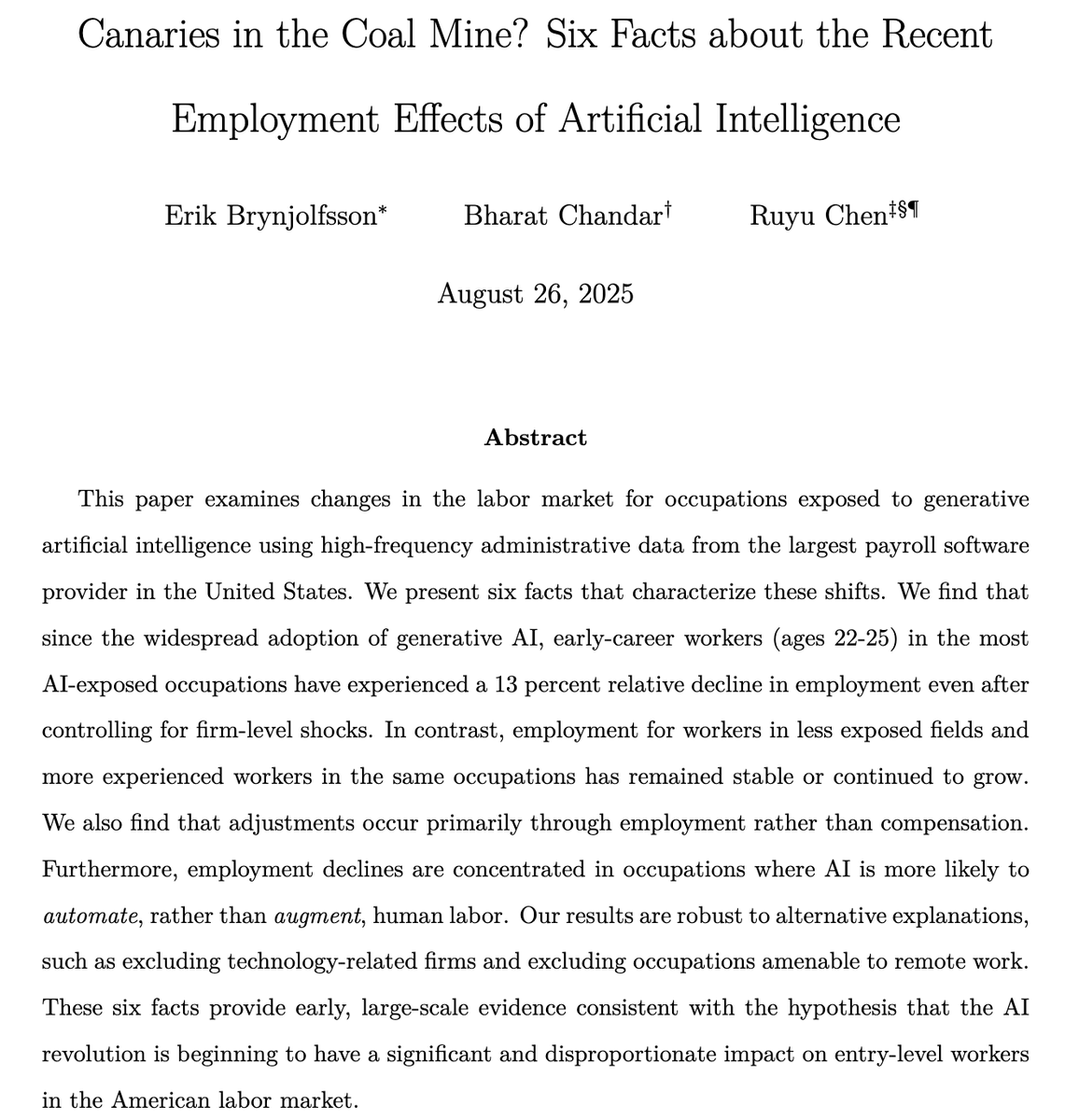
Is AI already impacting the job market? A new paper from me, @erikbryn, and @RuyuChen at @DigEconLab digs into data from ADP. We find some of the ***first large-scale evidence of employment declines for entry-level workers in AI-exposed jobs.*** A thread on our paper:
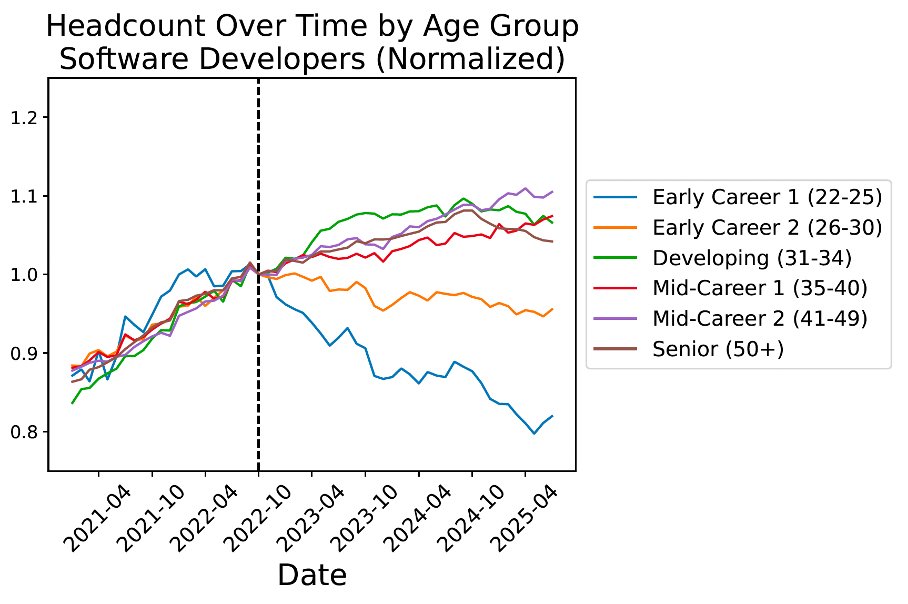
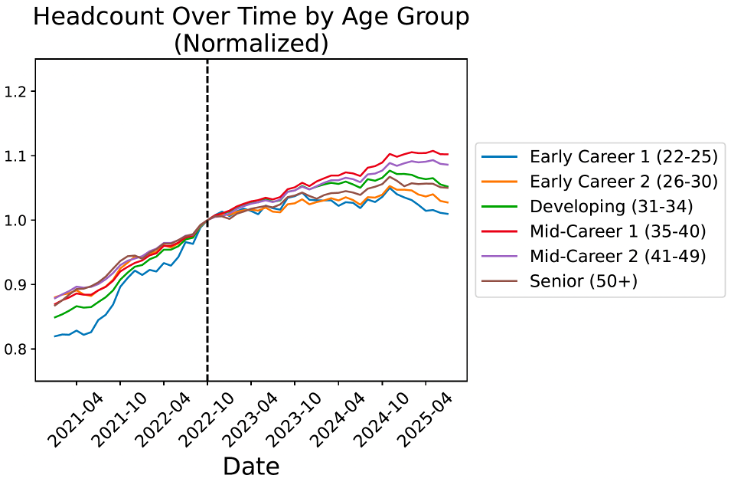
We observe millions of workers each month. Use this cut the data finely by age and occ. What do we find? Stories about young SW developers struggling to find work borne out in data Employment for 22-25 y/o developers ⬇️ ~20% from peak in 2022. Older ages show steady rise.
This isn't just about software. See a similar pattern for customer service reps, another job highly exposed to AI. For both roles, the decline is sharpest for the 22-25 age group, with older, more experienced workers less affected.

In contrast, jobs less exposed to AI, like health aides, show the opposite trend. These jobs, which require in-person physical tasks, have seen the fastest employment growth among youngest workers.

Find these broad trends not limited to just case studies. For 22-25 y/o's, employment is falling in the most AI-exposed jobs and rising in the least exposed jobs. (Eloundou et al. exposure) For older workers, find small differences in employment trends based on AI exposure.
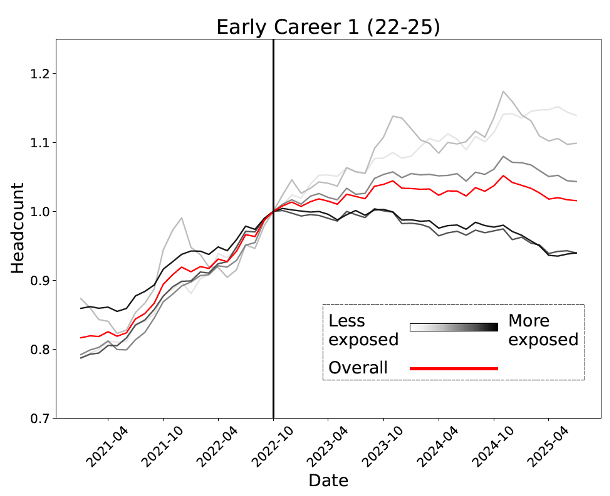
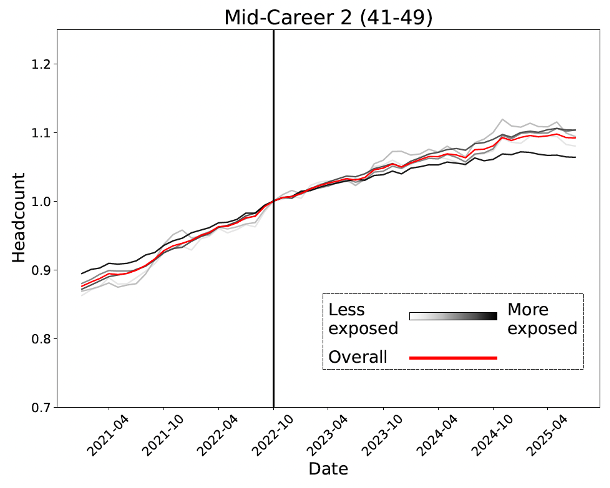
Overall, job market for entry-level workers has been stagnant since late 2022, while market for experienced workers remains robust. Stagnation for young workers driven by declines in AI-exposed jobs. Of course, lots of changes in the economy, so this is not all caused by AI.

First, not all AI is the same. Difference between AI that automates work versus augments it. Data from Anthropic. Left: Automating (e.g., coding, accounting): Entry-level employment declining. Right: Augmenting (e.g., management, repairs): Entry-level employment growing.


Other explanations? - Trends hold even when excluding the tech sector or computer-related jobs - Similar results for occupations not amenable to WFH - Similar results in occs where most people do not have a college degree. For these jobs, actually see effects up to age 40!

Another test: event study reg. w/ firm-time effects FEs absorb shocks that affect ALL workers in a firm, isolating within-firm shifts in hiring e.g., capture impact of interest rate changes at firm level Find 12 log point relative emp. decline for most exposed young workers

One puzzle: do not find salary impacts Perhaps sticky wages? Or shifting expertise requirements leading to muted effects? More research needed here

Overall, we do not want to claim that AI explains all of the patterns we show in the data but our results are consistent with the notion that AI is having a tangible impact on the labor market for entry-level workers.
Lots more in the paper! Available here: https://digitaleconomy.stanfor... Here is a Substack post I wrote up summarizing it: https://open.substack.com/pub/...
@econ_b @erikbryn @RuyuChen @DigEconLab The biggest disconnect here is that you pick up a drop in employment starting in 2022. In your paper you claim this was a time of proliferation of generative AI...and this links to a footnote that says "OpenAI introduced ChatGPT in November 2022." 😐 https://x.com/econ_b/status/19...
@econ_b @erikbryn @RuyuChen @DigEconLab "Disproportionate impact"?? What else should a transformative technology do but change/re-distribute employment? Why would any economist call such expected and desirable change "disproportionate"?
@econ_b @erikbryn @RuyuChen @DigEconLab Interesting so inexperienced AI has been kind to experienced workers so far . No one knows what is the final outcome and perhaps we are too far away but in the meanwhile something to keep entire humanity curious and fodder for researchers !
@econ_b @erikbryn @RuyuChen @DigEconLab Nice effort but I'm a hard no on this. It's quite unlikely these trends are due to large language models.
@econ_b @erikbryn @RuyuChen @DigEconLab can you clarify what you mean by Ai? chatbots? bespoke algorithms?
@econ_b @erikbryn @RuyuChen @DigEconLab … very interesting. Question: How does this align with the hypothesis that companies had overhired, and were in the mode to reduce / stay flat in a certain class of jobs, and those jobs overlap with the AI-likely set?
@econ_b @erikbryn @RuyuChen @DigEconLab Thank you this is really interesting! I'm curious why do you think you got different results to this analysis in the FT? https://x.com/StefanFSchubert/...
@econ_b @erikbryn @RuyuChen @DigEconLab @robinhanson, @KellerScholl - Finally actually having a measurable impact? (Or do you still think it's overblown?) https://x.com/econ_b/status/19...
@econ_b @erikbryn @RuyuChen @DigEconLab Interest rates, supply/demand of jobs/automation/investment priorities/some LLM etc. @RanaForoohar wrote an excellent piece in 2019 about the impeding financial tightening.
@econ_b @erikbryn @RuyuChen @DigEconLab One question to all: have your actually seen a job replaced by ai? So like there was a person doing stuff and all of a sudden it's a drop in replacement with a Claude or Gpt? Does this actually happen?
@econ_b @erikbryn @RuyuChen @DigEconLab Bullshit Jobs didn't need AI to stop existing, the question is, what will managers, supervisors and C-Suite do without subordinates?
@econ_b @erikbryn @RuyuChen @DigEconLab Great article, my niece plans to take her MBA without any plans to get work experience first-I tried, but like Gen z, they know best what the future holds……contrary to what I see happening!
@econ_b @erikbryn @RuyuChen @DigEconLab @_vonarchimboldi @Samhanknr any guesses on the identification strategy lmao
@econ_b @erikbryn @RuyuChen @DigEconLab This is excellent work, and very interesting -- but are there any slightly longer trends to compare to? There was a significant boom in tech with insane hiring peaking exactly around December 2021.
@econ_b @erikbryn @RuyuChen @DigEconLab Do you think this new work contradicts some of the findings from this study you published a few months ago? I believe you found software developers were gaining jobs, though you didn't have enough data to break out new workers. https://papers.ssrn.com/sol3/p...
@econ_b @erikbryn @RuyuChen @DigEconLab AI's already flattening entry jobs. Just imagine these numbers if Germany's hiring maze got the same treatment—Berlin would be wild.
@econ_b @erikbryn @RuyuChen @DigEconLab yup and medical transportation comes first i can see it already.
@econ_b @erikbryn @RuyuChen @DigEconLab AI's impact is clear! Embracing UAE's innovative approach to AI, we can ensure new roles for entry-level workers, driving equitable future growth and adapting effectively.
@econ_b @McFaul @erikbryn @RuyuChen @DigEconLab It impacted mine two years ago.
@econ_b @erikbryn @RuyuChen @DigEconLab We are reading too much from the data Perhaps it is that the economy is just bad and not AI
