
It has been suggested that the orange color might be from evaporated rust on the metallic test tiles. I am not sure a thin rust layer could produce such an amount of deposits. Here is my alternative explanation, coming from my background in fusion tech: 🧵
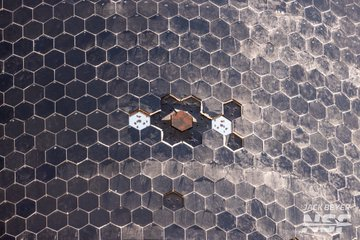
Here are the tile positions, that are in question for producing most of the colorization. Only a handful of tiles. On top of that, they are coated with something. So why would there even be substantial amounts of rust?

When I was working at KIT, we were testing composite materials made of a copper matrix infused with tungsten fibers as part of plasma facing components in a fusion reactor. The idea was to use this to connect the plasma facing tungsten with the copper pipes in the back.

For commissioning tests of the electron beam heating device, we used a not actively cooled sample block of this material with a tungsten plate on top and heated it up pretty well.

Here you can see the before/after photos. Some of the copper melted and evaporated. Since you need vacuum for the electron beam gun, the vapors have been nicely deposited in a thin orange layer on all the surfaces.


The metallic test tiles on Starship might contain substantial amounts of copper in a similar sort of composite and this should provide more than enough material to coat half of the heat shield just from a handful of tiles.
Regarding the white nose cone: This might be deposits from evaporated steel since the nose might have seen more heating and then the diffuse reflection of the sun on the differently curved surface could make it look like this. This is all heavy speculation of course!
They actually said in flight 7 that they were testing some tiles that "have an aversion with active cooling" whatever that means. But these could have copper on the back and maybe the cooling wasn't good enough...
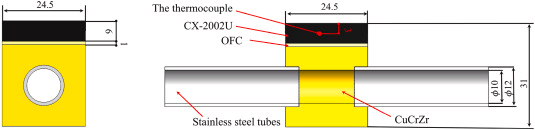
of course, graphite-copper composites are also very common in plasma facing components in fusion. So maybe these test tiles look similar like below. If the graphite layer is too thin or the copper layer too thick, you will melt the copper.


source with more images: https://www.sciencedirect.com/... CuCrZr is a special alloy for fusion that is not needed on a rocket heat shield. Don't know, if they would use any special alloy or just copper.
You can clearly see white and orange layers on the tiles in this shot. Even better a bit later when it lands. There is also an orange line. Some people suggested that it could also be steel deposits colorized by interaction with hot plasma, which seems more likely seeing this.


Even though the stringer area doesn't have any color, breaking up the line. Seems more like that this particular line comes from the coated areas.
That seems like the most reasonable explanation. Just wondering still where the white layers come from. https://x.com/2196F3/status/19...
It looks like the orange color is really just from that one tile. It must have completely evaporated 😂😱

@StarbaseSim For those tiles to produce that pattern, the ship would have had to be traveling nose-first. But, for the most part, the ship floated belly-down, nose-up, then finished with its tail down. So I don't think your theory works.
@ThomasRGreer the coloration likely happened during peak heating when it was around 60 km altitude. Then it was nose slightly forward.
@StarbaseSim Don't remember seeing this on previous "surviving" Starships that made it into space
@markrich2209 I looked at it, but we only really saw it on flight 6 land in day time. It seemed to have little bit color, but nothing like this. There were also some white areas though.
@StarbaseSim So many experts! Elon should definitely hire everyone who knows all this stuff!
@bsu_BUS I think, they know what they are doing. They just need more data. We can only speculate, since we don't have any data other than a few images
@StarbaseSim Fantastic information either way, thank you! Have we absolutely rolled out it wasn’t just the sunrise reflecting on the stainless steel?
@debreuil that might be happening at the nose indeed
@StarbaseSim Very interesting to learn, I would have expected copper residue to be greenish blue? But probably didn't have time enough to oxidize
@VTchuiev it could be very well also other oxidized material deposits. I don't know how strong the oxidizing effect is during re-entry and nobody provided me with additional info about it unfortunately.
@StarbaseSim Bro, flying silo buckled on re-entry, lost its integrity (again), lost heat shield tiles thus its shell has compromised material properties from extreme heat (reusability in question if at all) and you are writing a dissertation on efing discoloration… stop, stop this madness!🤡
@Greatness17144 being mad doesn't prevent one from trying to understand
@StarbaseSim Unless you’re an engineer of insulating tiles for aerospace applications, your fucking background doesn’t matter, Mr. FUuUzzZuuuuhn. The only reason you made this was so you could humble brag.
@StarbaseSim It’s signs of iron oxide displaced during launch. The LOX tank was apparently open to atmosphere for a prolonged period of time to develop a film of rust internally. Pressure pumping and purging with N2 will control this problem for future launches.
@Rodriguez1Eloy huh, how does rust inside get on the tiles?
@StarbaseSim Interesting thread. Don’t you think that the conclusion is that they have successfully achieved the objectives of the flight, but they are still far, very far from reusability?
@ascaniovitale If they had caught it, they could have reused it maybe with some repairs. For it being fully and rapidly usable, they need some more R&D, yeah