
The moral circles study gave two versions of its circle task: - One with a limited number of moral units, and thus moral allocation was zero-sum - One where participants had unlimited moral units to distribute however they liked Replot thread🧵 Everyone, zero-sum first.
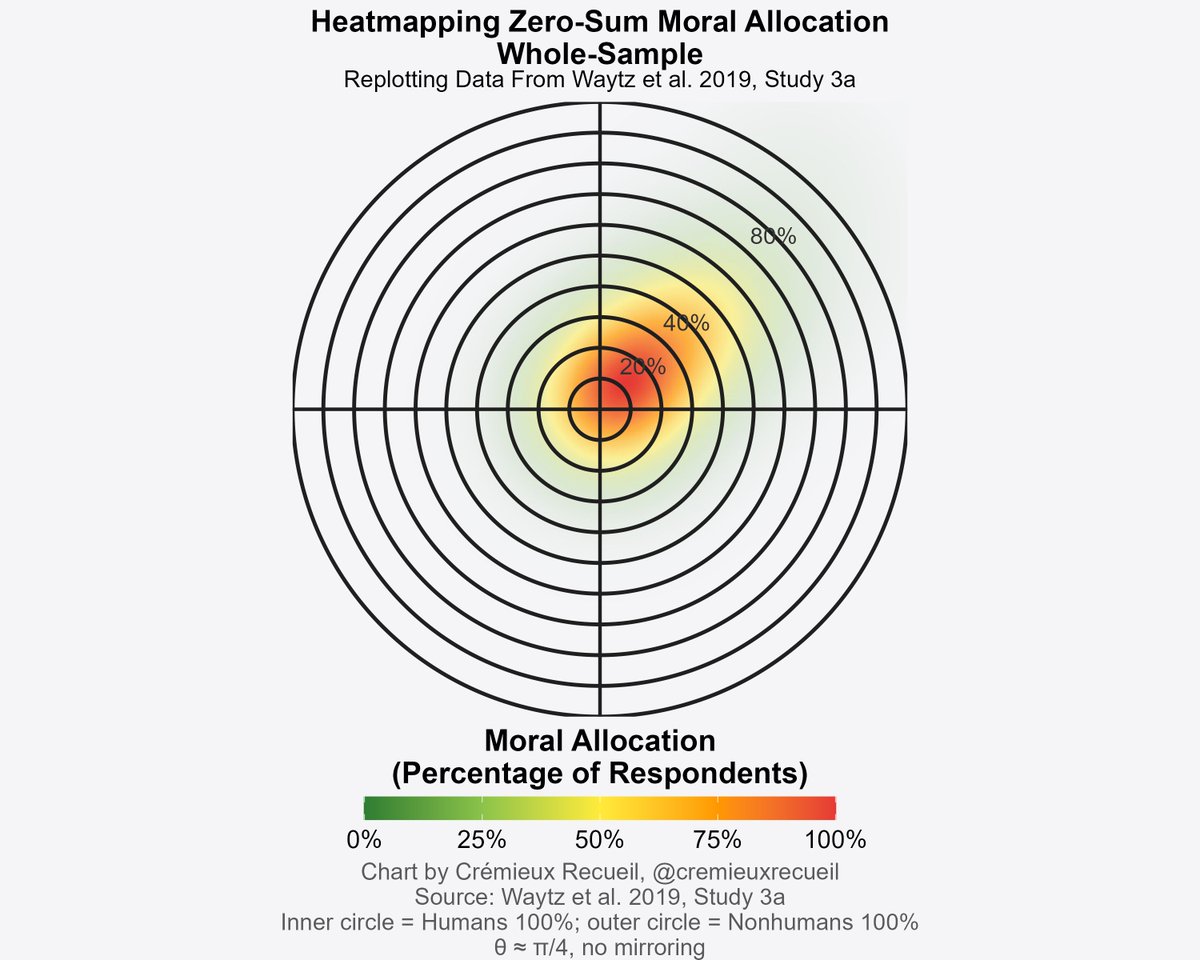
The authors provided values on concern for humans versus nonhumans, and the results had to be scaled to be proportional. Each allocation proportion is treated as a radial coordinate. To give it spread, we assign an angular coordinate θ = π/4 to tilt it like the original. Cons:
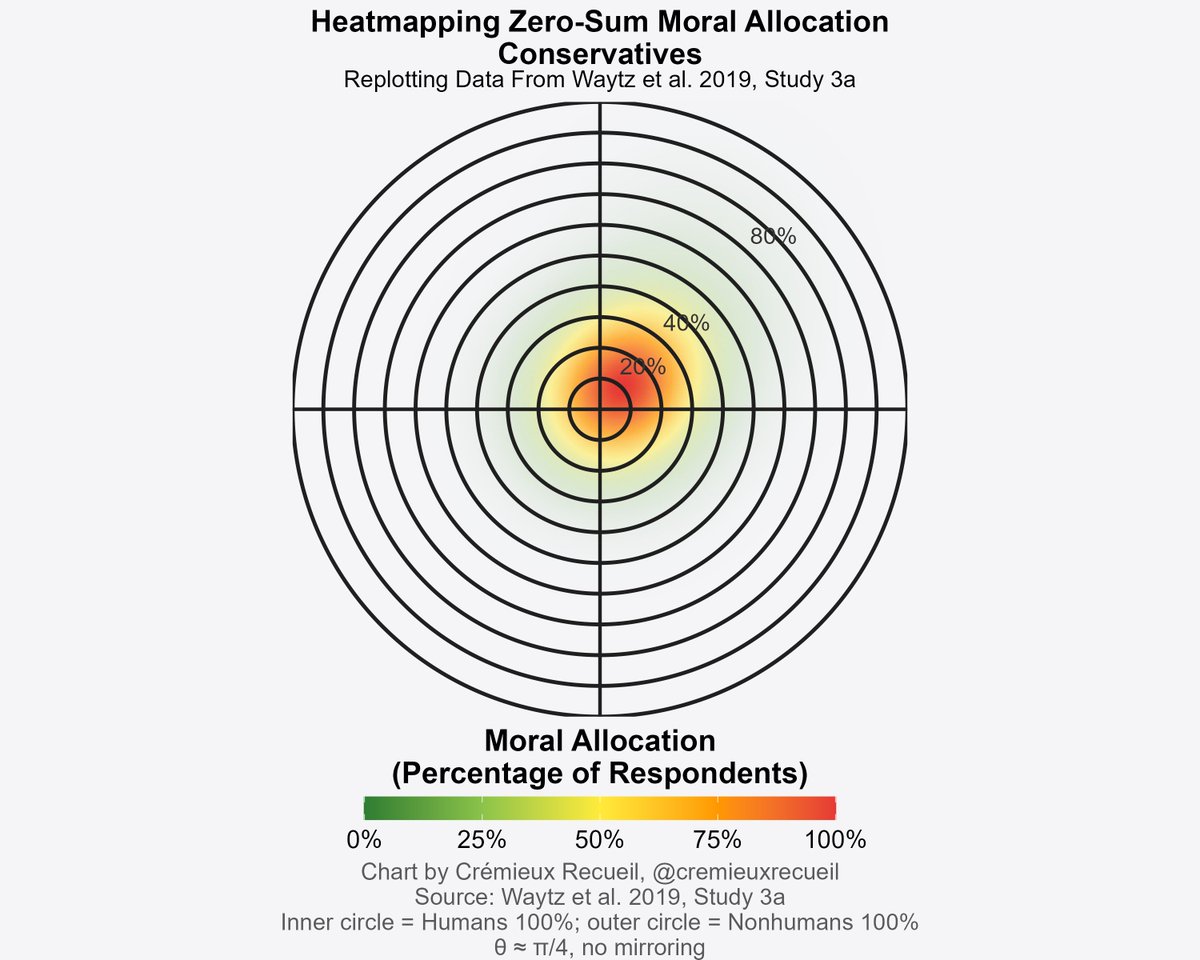
To get some space on this, we add 10 degrees of Gaussian spread to give the cloud thickness. Thus, each participant becomes a point (x = radial coordinate, r * cosθ, y = r * sinθ). Did you notice conservatives being very human-focused? Here are moderates:
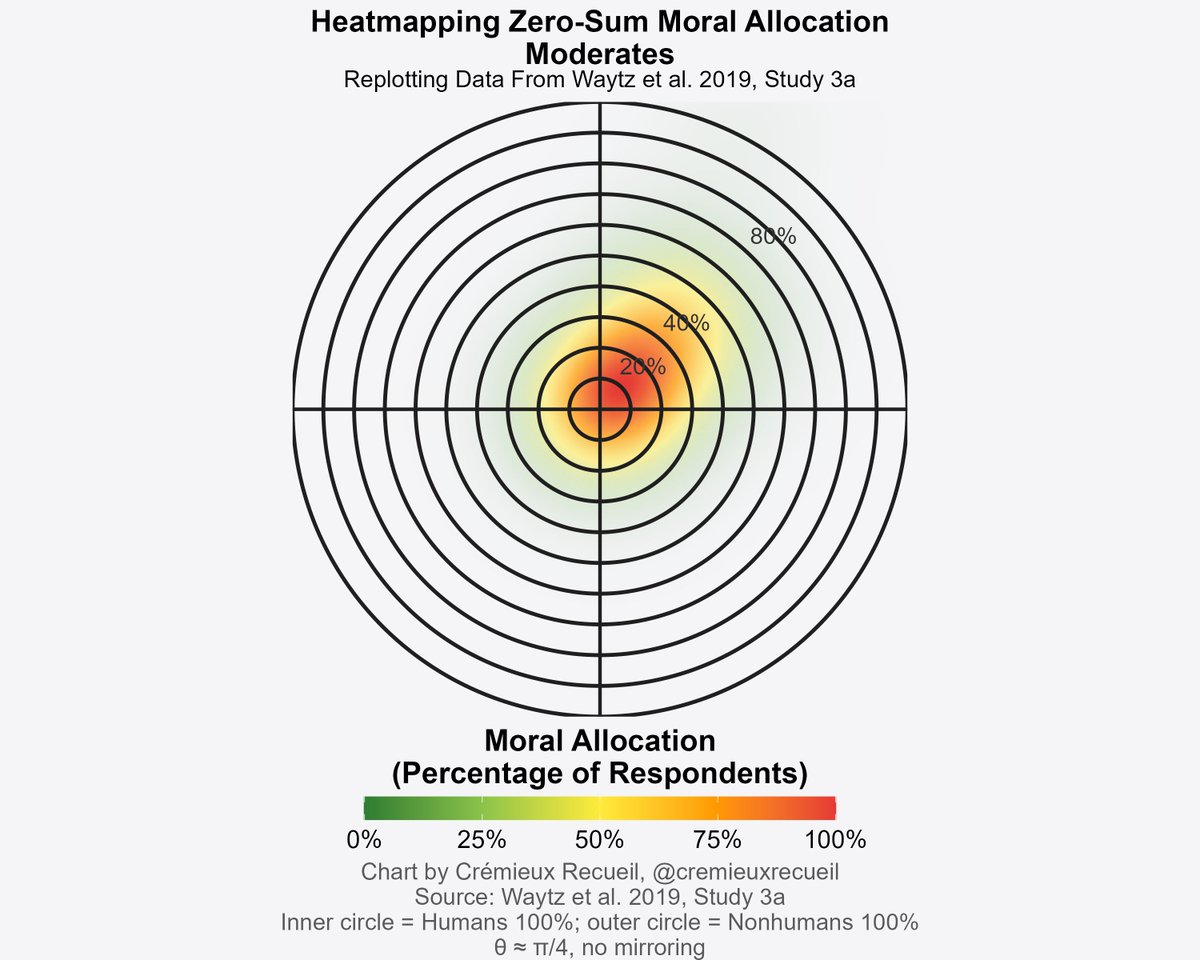
Mods spread out a bit more. The authors wrote: "the more liberal people were, the more they allocated equally to humans and nonhumans. The further to the right on the ideological spectrum people were, the more likely they were to morally prioritize humans over nonhumans." Libs:

"Although research suggests that people indeed do distribute empathy and moral concern in a zero-sum fashion [the zero-sum] feature of Study 3a imposes an artificial constraint." So now, let's look at the heatmap with unlimited moral units to distribute to humans and nonhumans.

With those x's and y's in hand, we use 2D kernel density estimation to make the points a continuous density surface. First up, look at conservatives. Compared to when moral allocation was limited, they've spread out a bit.

Next we have moderates. Do note that, in this exercise, liberals and conservatives put down similar total allocations: "Liberals and conservatives did not differ such that political ideology was not significantly correlated with total allocation to all targets."

Methodologically, this preserves the true radial positions of participants and mimics the visual style of the published figures. I used a constant bandwidth so that the group sample sizes wouldn't matter. Finally, we have liberals.

Overall, the picture is exactly this for study 3a, where being more conservative predicts reporting more human-centric moral priorities. The most liberal individuals didn't favor humans over nonhumans at all, choosing instead to give them equal moral weight.
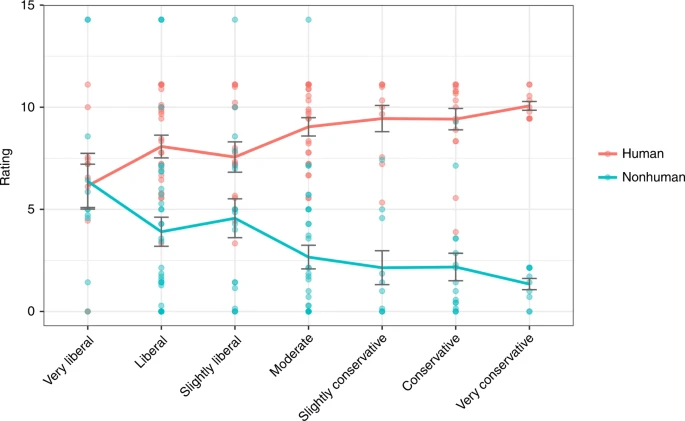
For study 3b, with its unlimited units, every group reported clearly human-centric morality, with conservatives reporting being even more pro-human. This does not seem like a picture where moral concern is as lopsided as people have interpreted the original heatmap to suggest.

Instead, it seems more like a case where liberals in the limited moral unit scenario noted their moral concern for nonhumans and conservatives did so less often. And when given unlimited moral units, liberals did the same, but also noted they still give more weight to humans.
The first result just doesn't make for a good heat map because it exaggerates the accurate finding that conservatives are more parochial, focused on humans, and liberals are more universalist, but still primarily focused on humans.
Anyway, this study has been discussed to death. The wording is unclear and I doubt the groups interpreted prompts the same, at least one of the authors stated they regretted the whole thing, no one has (seemingly even bothered to?) replicated the findings, etc.
Some have interpreted the original heatmap as showing that liberals are just more concerned with everything than conservatives. The similar total allocations in 3b do not support that. The authors' conclusion stands, in that the study showed differences in moral priorities.

But does anyone really believe these instruments are valid for the conclusions people want to make with them? Does anyone really believe that liberals are accurately reporting their moral concern in 3a? Or that total moral concern is really equal between groups? I don't.
Anyway, the source is here: https://www.nature.com/article... Given all the results in the study and the findings in the literature before this study, I'd say re-mapping allocations brought me closer to believing the original heatmap meme interpretation's sign but not its magnitude.
This thread led to someone giving me all the raw data for these studies, no more 0-100% human-centric dichotomization, just raw plotting. Similar results, heatmap meme supported. https://x.com/cremieuxrecueil/...
As I predicted, the instruments were not valid. Everyone can go home now. https://x.com/cremieuxrecueil/...
@williameijer The wording of the question is such that you pick the spot that you believe corresponds to the outer limit of your moral circle, inclusive of what's below. It's not as informative as the infinite-sum result.
@cremieuxrecueil Here's a plot of the zero-sum allocation version. (Note some of these cohorts have <10 participants, and several people put all points into the outermost rung, which is probably why a chart like this wasn't included in the original study.)

@paulcritchlow Where's that data from?
@cremieuxrecueil Is there any age weighting or parents vs non parents grouping data? A lot of liberals I know have changed their minds about circle of concern considerably post-kids or as they’ve gotten older and stopped believing everyone is equal or good.
@Adam43659561027 No, the data is abysmally sparse. If it were better, I would test for measurement invariance. Alas....
@cremieuxrecueil I think it's a lot easier to see the differences once you look at *relative* values across each sub-group: https://x.com/JouleBlade/statu...
@JouleBlade Which data is this?
@cremieuxrecueil I don’t understand why if you are given unlimited moral units you wouldn’t just allocate an infinite amount to every ring basically. Am I misunderstanding something?
@skincancer4 For virtually everyone, that would be dishonest, because that is not an accurate depiction of how much moral weight they give to different things.
@cremieuxrecueil @threadreaderapp unroll
@cremieuxrecueil But WHY a CIRCLE? Someone wanted to be really creative with their new diagram software, because this clearly are a one dimensional data.