
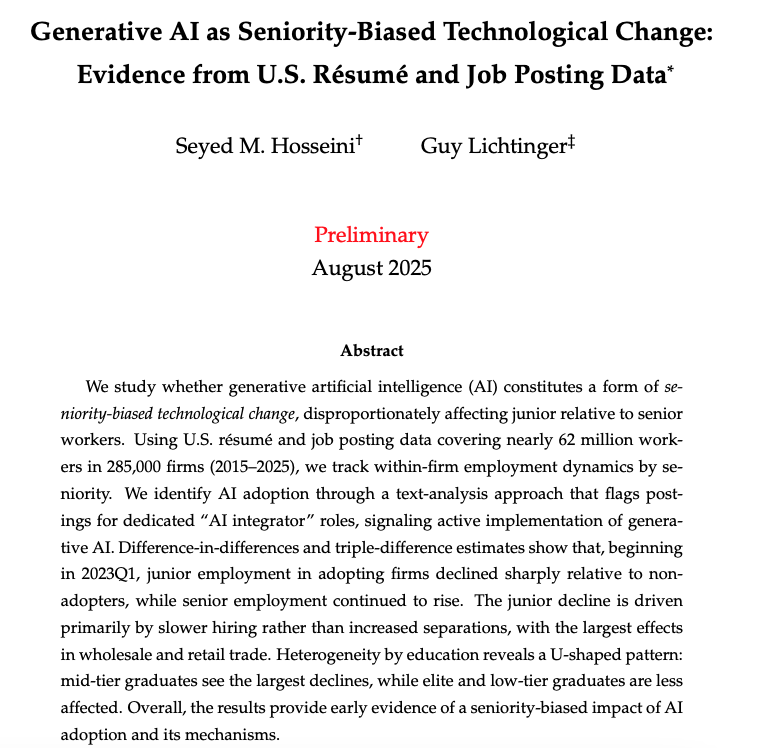
🚨1/9 In a new WP, @LichtingerGuy and I use detailed LinkedIn résumé + job-posting data on ~285k U.S. firms (2015–2025) to study a debated question: how does generative AI adoption affect entry-level employment?
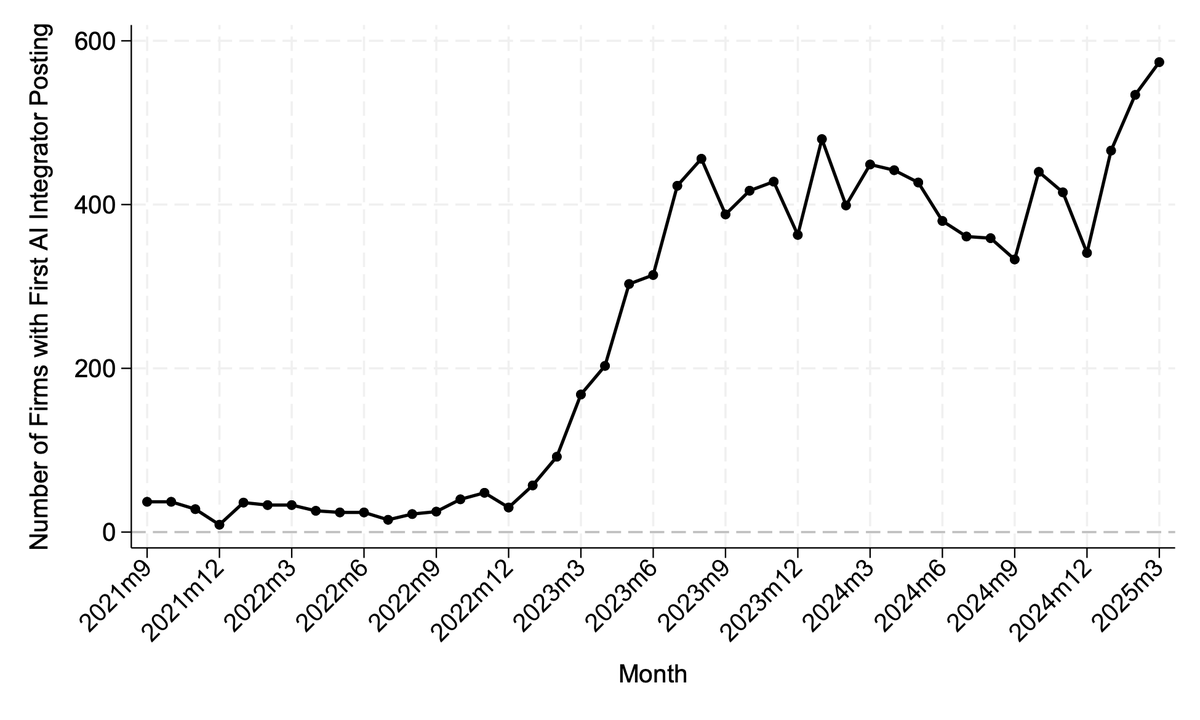
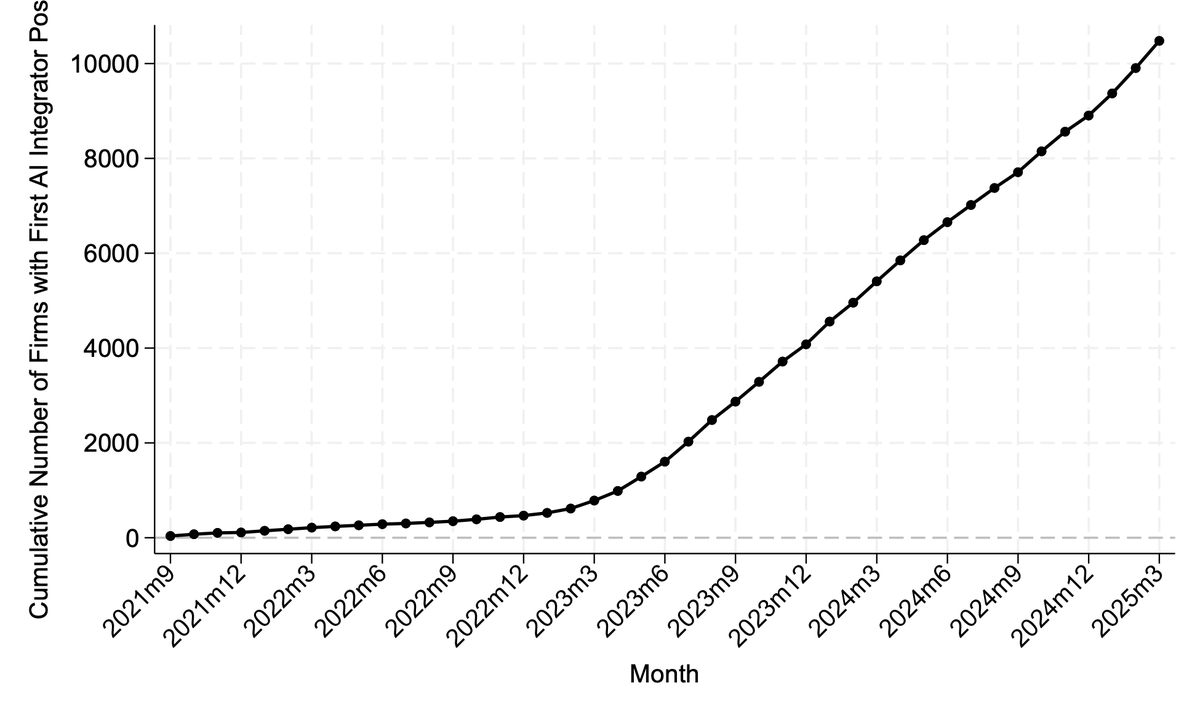
2/9 We identify adoption from job postings explicitly recruiting AI integrators (e.g. “we need someone to put genAI in our workflow!”). A firm is an adopter if it posts ≥1 such role. We find ~10.6k adopting firms (~3.7%), with a sharp takeoff beginning in 2023Q1.
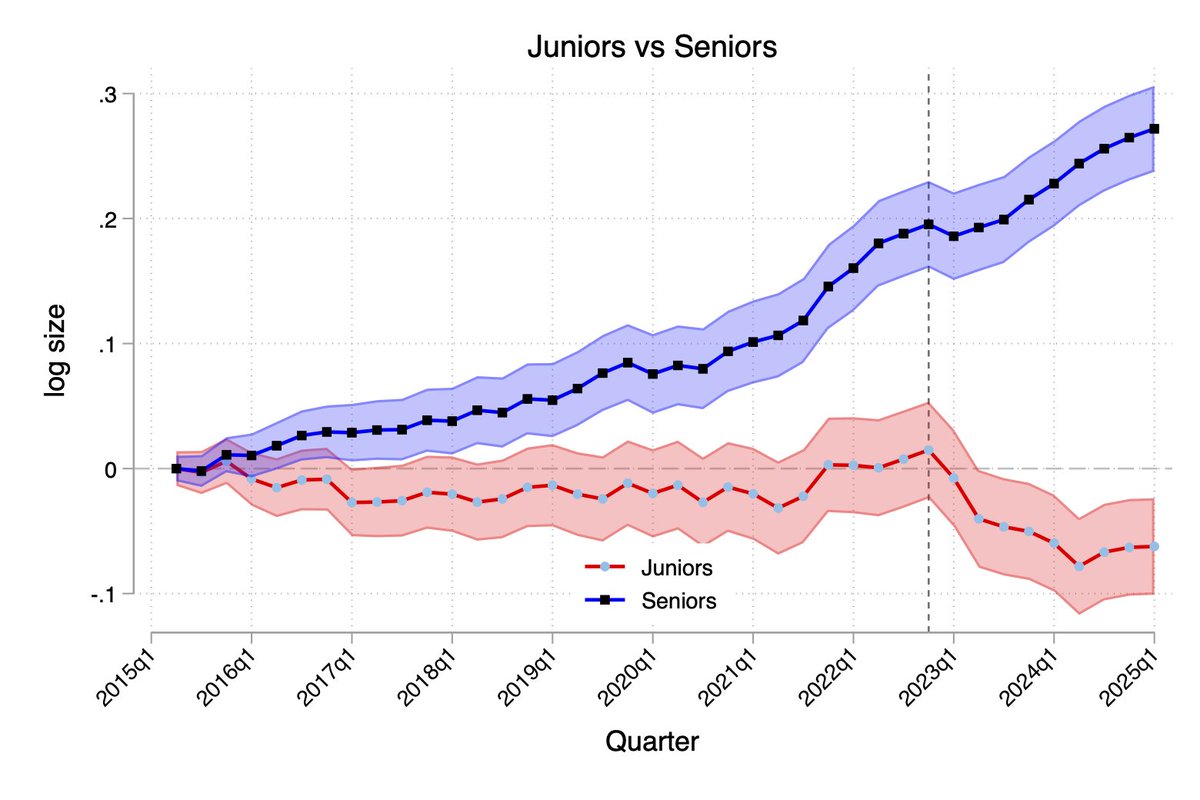
3/9 In the aggregate, before 2022 juniors and seniors move in lockstep. Starting mid-2022, seniors keep rising while juniors flatten, then decline.

4/9 We then estimate a diff-in-diff specification using our measure of AI adoption. The results show flat pre-trends for juniors through 2022Q4. From 2023Q1, junior emp at adopters falls about 7.7%, while seniors continue their pre-existing rise.
5/9 Also, we implement a triple-difference design: comparing juniors vs seniors within the same firm and quarter, and find the same patterns: relative junior employment at adopters drops by ~12% post-2023Q1.

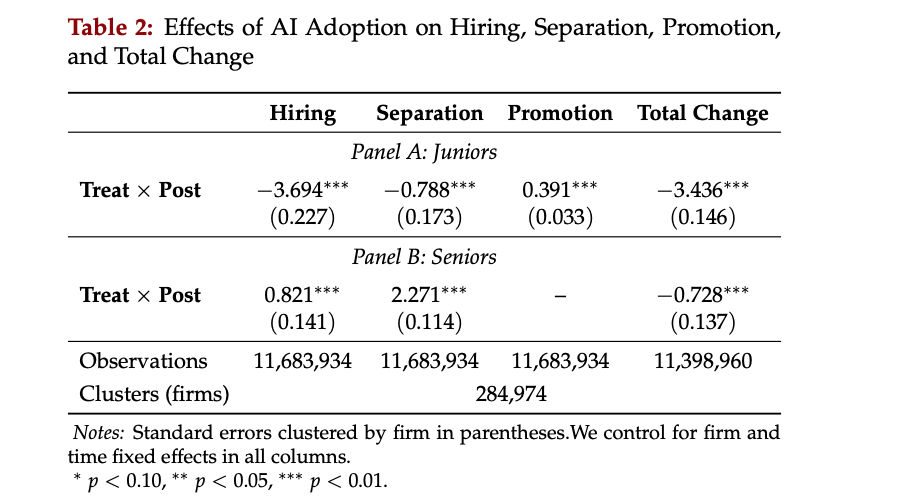
6/9 Is this about separations or hiring? Our data allows us to answer this question. The decline comes almost entirely from reduced hiring, not layoffs. After 2023Q1, adopters hire 3.7 fewer juniors per quarter; separations edge down slightly; promotions of incumbent juniors rise
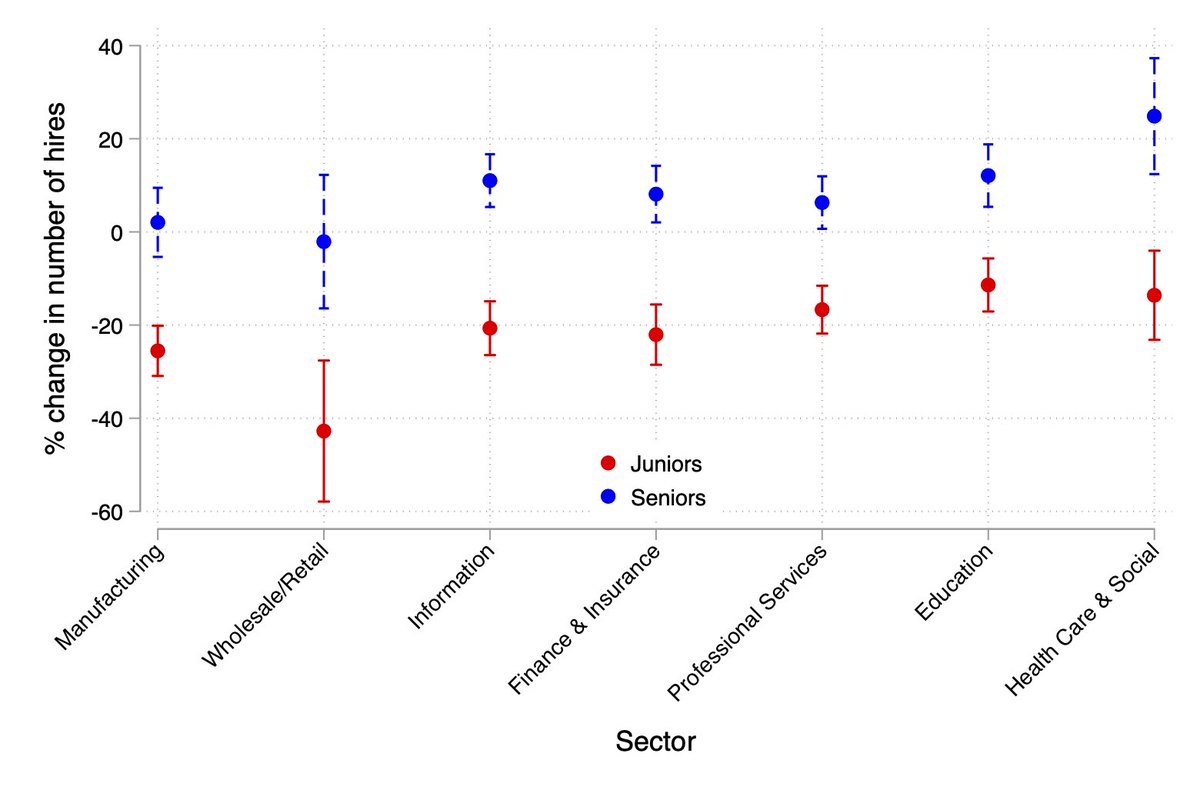
7/9 This isn’t only an IT story. The largest cuts in junior hiring occur in wholesale/retail (~40% vs baseline). Information and professional services also see notable but smaller declines. Senior hiring is flat or slightly positive.
8/9 We also look at education. Using an LLM to tier schools (1=elite … 5=lowest), we find a U-shape: the steepest declines is coming from juniors from tier 2–3 schools; tiers 1 and 4 are smaller; tier 5 is near zero.

9/9 Thank you so much for reading the thread! Please see the draft for more results and discussions. We are looking forward to all comments and feedback! https://papers.ssrn.com/sol3/p...
@SeyedMH98 @LichtingerGuy The timeline casts doubt on the idea that AI is to blame. ChatGPT was first released in late 2022 and early models were nowhere near good enough to replace workers. So something else must explain the drop off in hiring younger workers that started around that time.
@SeyedMH98 @LichtingerGuy I cannot read the paper now, but are we sure it's GenAI fault? Until gpt-4 genAI was near useless and even after that I'm quite skeptic it was so impactfull so early. Could be a general services sector slowing down?
@SeyedMH98 @LichtingerGuy Fire 👏👏
@SeyedMH98 @LichtingerGuy Looks like awesome stuff!
@SeyedMH98 @LichtingerGuy This makes sense. AI's favoring experienced talent while juniors get squeezed. What's the long-term outlook for new grads?
@SeyedMH98 @LichtingerGuy Great paper. I struggle to understand the logic behind such dynamic: Juniors should be more likely to be skilled in AI vs seniors, so if a firm is pushing AI adoption, it should have an incentive in hiring people whose skill set includes a greater understanding of AI. 1/2
@SeyedMH98 @LichtingerGuy Your paper should factor in the upper left graphic regarding the actuals on US population.

@SeyedMH98 @LichtingerGuy I think junior developers have an advantage here. They are easier to train and adapt more quickly to coding with AI in this new landscape, while seniors might have to unlearn existing skills & habits The main thing to ensure is that the junior has a strong foundational knowledge
@SeyedMH98 @LichtingerGuy I believe companies navigating rising interest rates and an uncertain tax environment in the US to allow for future hiring was the culprit. Add in the remote work phenomenon and questions about effective new hire training. The effects of this reality were shared globally.
@SeyedMH98 @LichtingerGuy and I have a question,in your paper, you divided universities into five different levels, but you only divided jobs into two levels: junior and senior at last. Why? I guess that if you also divided jobs into five levels, the results might be more interesting.
@SeyedMH98 @LichtingerGuy I think the number of people who have read this paper in China might be more than in the United States,thank you for your excellent work.
@SeyedMH98 @LichtingerGuy @erikbryn I think this is linked to your study as well
@SeyedMH98 @LichtingerGuy So far, this article has received one hundred ninety thousand views on the WeChat public platform,which is one of the biggest social media in China. More than thirty-two thousand people have shared the article, and over two thousand people have asked for the original paper.
@SeyedMH98 @LichtingerGuy hi,I am Chris Hu, a technology writer from China,Two weeks ago, I saw your classmate ShaoYu Zhen introduce this research paper on Facebook. I found it very valuable, so I wrote a long article to introduce your research in China。
@SeyedMH98 @LichtingerGuy Interest rates.