
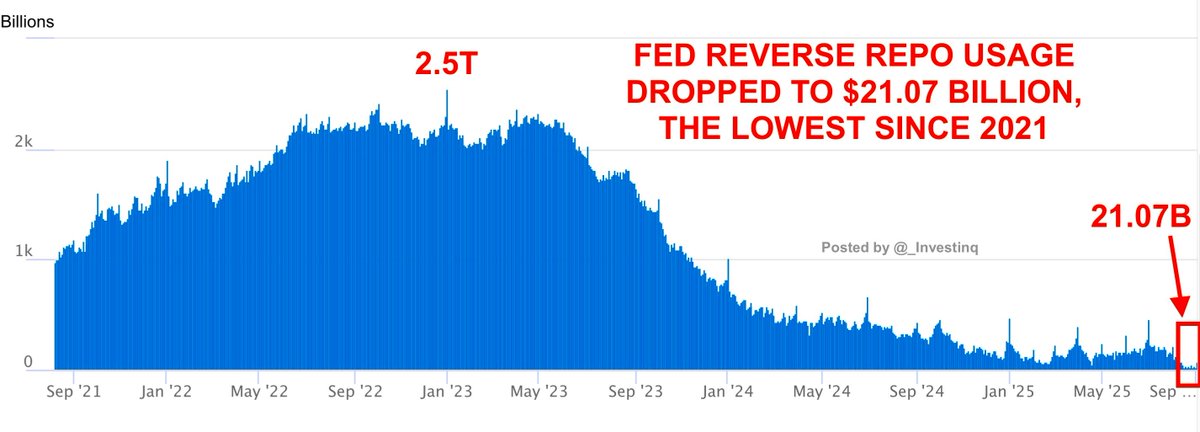
The Fed’s Reverse Repo Facility is on life support. The Reverse Repo once held $2.5T daily, now just $21.07B. That 99% wipeout could reshape markets for years. (a thread)
What’s the Reverse Repo Facility (RRP)?It’s the Fed’s overnight parking lot for cash. Money funds, banks, and government-sponsored entities lend dollars to the Fed, get Treasuries as collateral, and earn a small return. It keeps short-term rates from crashing when money is
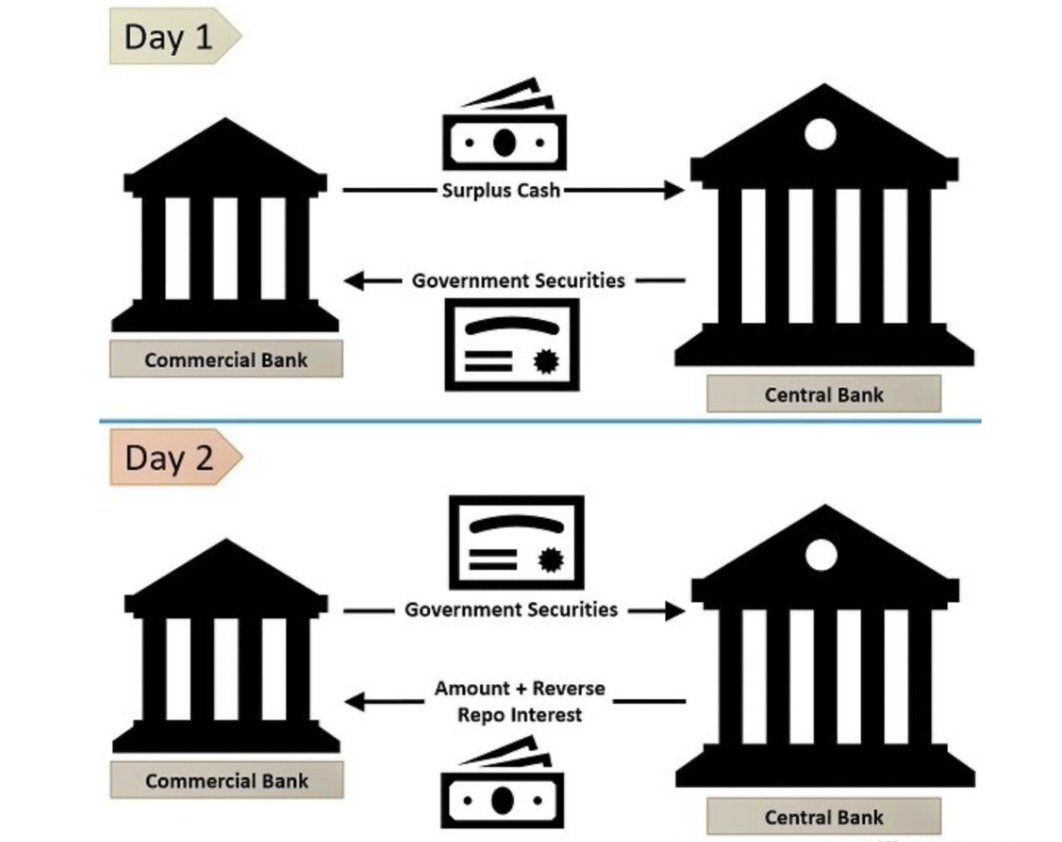
Why does it matter? Because the RRP rate acts as a floor under borrowing costs. If the Fed pays 4.25% guaranteed, no one lends at 3%. It’s like Uncle Sam saying: “Why accept less when I’ll guarantee you more?” It keeps overnight rates stable.
Who uses it? Mostly money market funds, giant pools of cash used by households and corporations. Also banks and GSEs. Instead of keeping cash in deposits that pay little, they park it at the Fed. Seventeen participants did exactly that on Sept 2, 2025.

From 2020–22, balances surged. COVID stimulus + QE flooded the system with cash. Banks didn’t want deposits. Treasury bill issuance was constrained by debt ceiling fights so trillions piled into the Fed’s RRP.
At the 2022 peak, $2.5T per day sat in the RRP. It became a sponge soaking up excess liquidity, a warehouse for cash with no other safe home. But the most important signal isn’t when RRP rises. It’s when it falls.

Fast forward: usage has collapsed. From $460B in June 2025 → $21.066B by Sept 2. That’s a 95% decline in just three months, and a 99% collapse from the 2022 peak. The sponge is basically gone.

Even month-end volatility shows it. On Aug 29, balances spiked $46B as dealers trimmed balance sheets. Days later, those dollars drained right back out. The trend is down and accelerating.
Why? Reason #1: Treasury bills pay more. By mid-2025, 3-month bills yielded ~4.35%. RRP paid only 4.25%. Money funds always chase the best deal. They ditched the Fed for T-bills.
Reason #2: A flood of bill issuance. Treasury has been issuing hundreds of billions in new short-term bills since the debt ceiling lifted in July. MMFs with $7.4T in assets absorbed them all. That cash used to sit at the Fed. Now it funds Uncle Sam.

Reason #3: Treasury General Account (TGA). This is the government’s checking account at the Fed. When Treasury rebuilds it, money leaves banks and funds. JPMorgan warns reserves now carry the burden as RRP balances vanish.
Reason #4: Quantitative Tightening (QT). Since 2023, the Fed’s balance sheet has shrunk from $9T → $6.62T. Every month, Treasuries + mortgages roll off without replacement. Less cash in the system = less available for RRP.

So here’s where we stand: The RRP has collapsed to just $21B across 17 users. That’s essentially nothing for a facility that once absorbed trillions. Any extra demand for cash now hits bank reserves directly.
Bank reserves are deposits that commercial banks hold at the Fed. Think of them as the system’s shock absorbers. When reserves are high, bumps don’t matter. When reserves are thin, potholes cause accidents, repo spikes, failed auctions, liquidity stress.
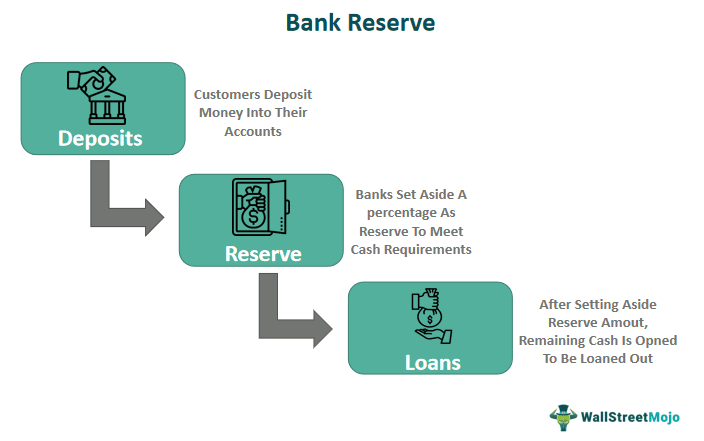
Where are reserves now? Around $3.3T. That’s well above the ~$1.3T level that caused the September 2019 repo panic. But Goldman warns reserves could still fall below $3T even with “funding relief.”

At this pace, reserves could slip toward $3T within months. Fed Governor Christopher Waller says $2.7T is safe. Analysts like ING say closer to $3T is the real danger zone. Either way, the cushion is shrinking fast.
History shows the risk. In 2019, the Fed let reserves fall too far. Overnight repo rates spiked to over 7%. The Fed was forced to inject emergency liquidity and halt QT. It was a plumbing problem with massive market impact.

Now, conditions are tougher: Rates are higher. Treasury auctions are bigger. Global markets are shakier. And unlike in 2019, the RRP buffer is essentially gone.
So is the collapse good or bad? Optimists: Good — cash is at work in T-bills and repos, not idle at the Fed. Pessimists: Bad — without the RRP, the U.S. has lost its shock absorber. Stress could hit faster and harder.
Treasury auctions now rely directly on MMFs. With no RRP buffer, their inflows go straight into bills. Good: $7.5T of MMF assets stand ready. Bad: no spare cushion if demand falters, which could weaken auction strength.

But that creates fragility. Without a $2.5T sponge, the system runs entirely on real-time cash flows. That’s efficient when calm. But in stress, markets can break suddenly. Liquidity shocks hit without a cushion.
The big picture: The RRP swelled during COVID when cash had no home. Now QT, bill issuance, and TGA rebuilds have drained it. We’ve gone from a $2.5T cushion → $21B in just three years.
The Fed insists reserves are still “abundant.” But with RRP gone, every tax week, Treasury auction, and quarter-end is now a stress test. Markets don’t ignore thin liquidity for long, they punish it.
Liquidity is like oxygen in financial markets. Nobody notices it when it’s plentiful but the second it runs out, panic sets in instantly. That’s why the collapse of the RRP matters far more than most people realize.
If you found these insights valuable: Sign up for my FREE newsletter! https://thestockmarket.news
@_Investinq It’s funny in 2019 we had the repo crisis and within 90 days we had COVID, giving them a reason to print trillions and send liquidity to every corner of the globe right? 🤔
@anthonywlicausi Exactly, 2019’s repo blow-up was the first spark, and COVID just gave the Fed the perfect cover to flood the system. Trillions poured in almost overnight, and the RRP became the warehouse for all that excess. Now with that buffer gone, the question is what excuse they’ll have
@_Investinq Good thread! Only thing I’d add is Fed now has a shock absorber on the other side of the FFR band, the Standing Repo Facility. A repeat of September 2019 can’t really happen again since that’s already in place and ready to go. I’m not worried and neither is the Fed at the
@fejau_inc That’s a solid point,, the SRF does give the Fed a safety valve but the trade-off is timing: the SRF steps in after the cracks appear, not before. The RRP was preventative, the SRF is reactive. So sure, we may not see a 2019-style blindside, but stress can still surface fast once
@_Investinq The fed doesn‘t need the RRP to borrow money. If they ever need it as shock absorber the can just raise the repo rate like that: 🫰So not that much to see here. In a sovereign debt crisis the fed shouldn’t compete with the national debt for liquidity.
@ue2ber Fair point, the Fed doesn’t need the RRP, and you’re right they can always tweak repo rates if stress pops up. But the difference is timing. RRP was a passive buffer that absorbed cash automatically. Without it, the Fed has to be more reactive, stepping in only after cracks
@_Investinq The Fed is on life support. Pull the plug.
@_Investinq Seems to me that this is just reflecting a trend shift of investors seeking better returns and optionality in shorter duration (curve steepening is a testament to investors buyer striking duration). At the same time this can help meet Bessent’s refunding needs as folks move to
@RickCabanes That’s fair and you’re right, money moving into bills is healthier than trillions parked at the Fed. But the risk isn’t today’s shift, it’s tomorrow’s cushion. When reserves slide closer to that $2.7–3T “line in the sand” Waller and Barclays flagged, the system has no shock