
how to rewire your brain to learn AI fast:
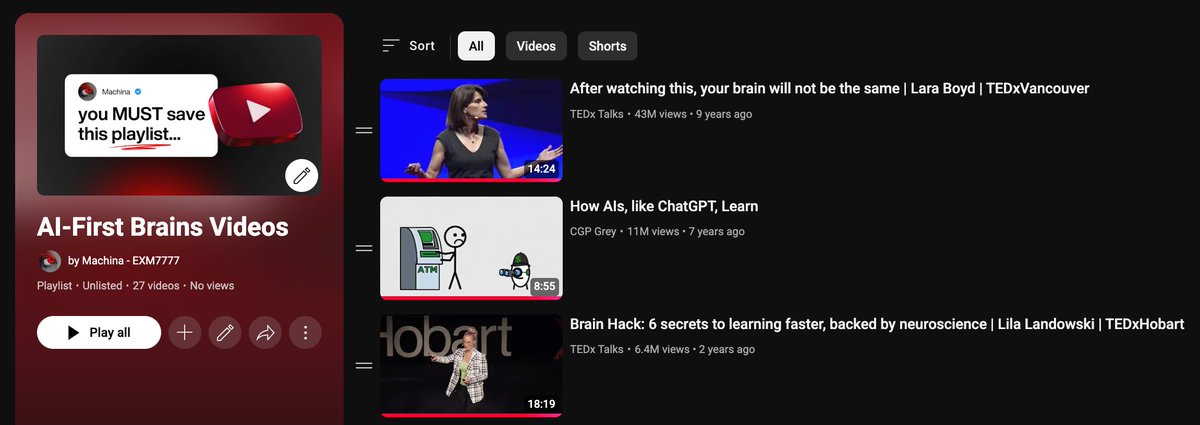
before we get into the SAUCE... i'm sharing with you a youtube playlist to get more advanced about this topic, you can find it here: http://t.me/aifirstbrain now let's get into the thread
most people think learning complex tech is for "young brains only" neuroscience destroyed this myth... your adult brain is actually better at learning AI than a teenager's brain here's the biological blueprint nobody's teaching you:
the secret to all of that is neuroplasticity... your brain has 86 billion neurons making trillions of connections every time you struggle with a prompt or debug code, you're literally rewiring these connections but here's what most people get wrong: they think learning should
rule #1: your brain only rewires under these conditions: - focused attention (not background noise) - friction (struggle signals importance) - reflection (mental digestion) - sleep (the biological save button) skip any of these and you're successfully wasting your efforts
let's start with FOCUS... neuroplasticity only engages when you're paying attention that podcast playing while you "learn" AI is legit useless your brain thinks: "this isn't important enough to rewire for" you need LASER level focus
here's how focus actually works: when you concentrate deeply on learning GPT prompts, your brain releases acetylcholine this chemical tells your neurons: "PAY ATTENTION - this matters" without it, you're just wasting time here's the focus protocol that changed everything for
the 90-minute deep focus protocol: 1. phone in another room (not silent - GONE) 2. single AI concept only (no multitasking) 3. active engagement (building, testing, failing) 4. 20-minute break after why 90 minutes? that's your brain's natural attention cycle...
but focus alone won't rewire your brain... you need FRICTION here's the counterintuitive truth: when learning AI feels hard, your brain flags it as "survival important" that frustration debugging your automation? that's dopamine + norepinephrine telling your neurons to adapt
the friction principle EVERYONE is missing: your brain evolved to preserve energy if something feels effortless, it thinks: "why waste energy rewiring for this?" but when you struggle with prompt engineering... your nervous system goes: "this human needs this skill to survive"
here's how to engineer productive friction: DON'T: re-reading AI tutorials (passive) DO: building broken automations (active struggle) DON'T: watching prompt videos (comfortable) DO: testing prompts that fail (uncomfortable) your brain measures effort, not hours...
quick prompt for you: "analyze my last failed AI project and identify exactly where I gave up vs. where I should have pushed through the friction" the answer reveals your rewiring opportunities... but friction is only step 2...
step 3: REFLECTION this is where you usually lose 50% of your learning gains... after struggling with AI concepts, you need "mental digestion time" - thinking back through problems - replaying solutions in your mind - letting your brain wander over the material skip this and
here's the reflection protocol that 10x'd my AI learning: after each practice session: - 10-minute mental replay (what worked/failed) - evening walk thinking about concepts - weekend "connection sessions" (how does this link to other knowledge) your brain needs processing
but this is where the magic happens: SLEEP i'm not talking "rest time"... this is literally when your brain physically rewires during deep sleep + REM: - weak connections get stronger - strong connections get reinforced - new neural pathways get built all-nighters destroy
here's the sleep optimization schedule that unlocks neuroplasticity: - 7-9 hours (non-negotiable) - consistent sleep schedule - no screens 1 hour before bed - cool room your brain consolidates AI learning during sleep cycles 3-5... sacrifice sleep and you'll sacrifice rewiring
now for the advanced techniques... ACTIVE RECALL this is your brain's debugging system: instead of re-reading prompt guides -> test yourself without looking instead of watching tutorials again -> explain concepts out loud instead of hoping you remember -> force retrieval
do this: 1. learn new AI concept 2. close all materials 3. write everything you remember 4. check what you missed 5. focus ONLY on the gaps your brain strengthens circuits through retrieval attempts... even wrong answers build stronger connections
here's a prompt to test your AI knowledge: "explain [AI concept you just learned] to a 10-year-old, using only analogies from cooking" if you can't do this simply, you don't really understand it yet... but there's one more neuroplasticity hack:
VISUALIZATION your brain often can't tell the difference between: - actually coding an AI solution - vividly imagining coding an AI solution athletes use this, musicians use this... you can use this for prompt engineering
the visualization protocol: after practicing AI skills: 1. close your eyes 2. mentally walk through the exact steps 3. visualize debugging problems 4. imagine successful outcomes 5. feel the satisfaction of working solutions this is not something i've done before but worth
but here's what accelerates everything... REAL PROJECTS your brain evolved to learn from messy, unpredictable environments watching tutorials is sterile learning while building actual AI solutions is RICH learning the statistics of real-world problems trigger deeper
why real projects rewire your brain faster: - multiple senses engaged (visual, auditory, kinesthetic) - stakes matter (failure has consequences) - feedback is immediate (code works or breaks) - novelty is constant (every project is different) tutorial brain vs. builder brain is
the project progression that guarantees rewiring: week 1: build something that barely works week 2: break it and fix it 3 times week 3: optimize it for real use week 4: teach someone else to use it each stage creates different neural pathways...
TIMING matters for neuroplasticity... neuromodulators (brain chemicals that enable rewiring) surge during: - novelty (new AI concepts) - effort (struggling with prompts) - feedback (seeing results) > practice without stakes and you'll get weak rewiring > deadlines + challenges
here's why most AI learning fails: no urgency -> no neuromodulator release -> no rewiring your brain thinks: "this human doesn't actually need this skill" but add a deadline, a project, a challenge... suddenly your nervous system prioritizes building those circuits
the final multiplier: MEANING your brain encodes what feels significant... connect AI learning to: - future-proofing your career - building tools that save time - contributing to bigger vision - solving problems you care about meaning tells your brain: "don't discard this -
practical meaning-making prompt: "write down exactly how mastering AI will change your life in 12 months - be specific about daily activities, work outcomes, and personal freedom" when your nervous system perceives importance, it elevates wiring priority...
the complete neuroplasticity stack for AI learning: 1. 90-min focused sessions (acetylcholine) 2. embrace friction (dopamine + norepinephrine) 3. reflect after learning (circuit stabilization) 4. prioritize sleep (physical rewiring) 5. test yourself (active recall) 6. visualize
your brain isn't a hard drive storing AI information... it's a living network that reshapes itself based on attention, effort, and experience you might get frustrated while learning new complex skills, but that's not failure, it's your body telling you that rewiring is
one final prompt for maximum impact: "identify the hardest AI concept I'm avoiding, then commit to 90 minutes of focused struggle with it tomorrow" your brain is waiting for you to signal: "this matters" the rewiring starts now
@EXM7777 here before 1 mill
@VibeMarketer_ he knows
@EXM7777 will this help if im 30 iq
@tyler_agg especially if you're 30iq
@EXM7777 Very good advice
@vasumanmoza appreciated coming from you..