
Can you rejuvenate an old brain by giving it young immune cells? 🧠 My lab @calico put it to the test. In our new study, we replaced the brain's immune cells in old mice with young ones. The result? The old brain environment forced the young cells to age RAPIDLY. A 🧵👇

Our 2023 brain map revealed that the brain ages non-uniformly, and microglia (the brain's immune cells) age fastest in hotspots like white matter and cerebellum. But why? Is their fate sealed from within, or is their neighborhood the problem? Can we eventually target either? 💊

Studying aged microglia in vivo 🐁 is tough, especially when we want a platform that will eventually scale. So, we built a CRISPR-compatible system ✂️🧬 using expanded hematopoietic stem cells (eHSCs) to swap out the aged brain's immune cells with young, editable cells. 🔃
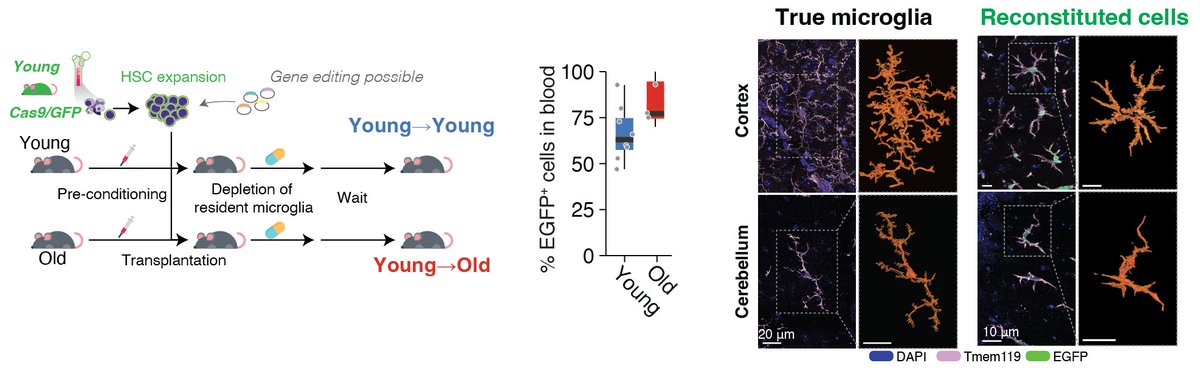
So, what did the old brain tell the young cells? 🗣️👂To get old, fast. The aged brain environment overrode the intrinsic youth of donor cells! These young 'reconstituted cells' acquired the molecular aging signatures we see in old microglia, an effect strongest in the cerebellum

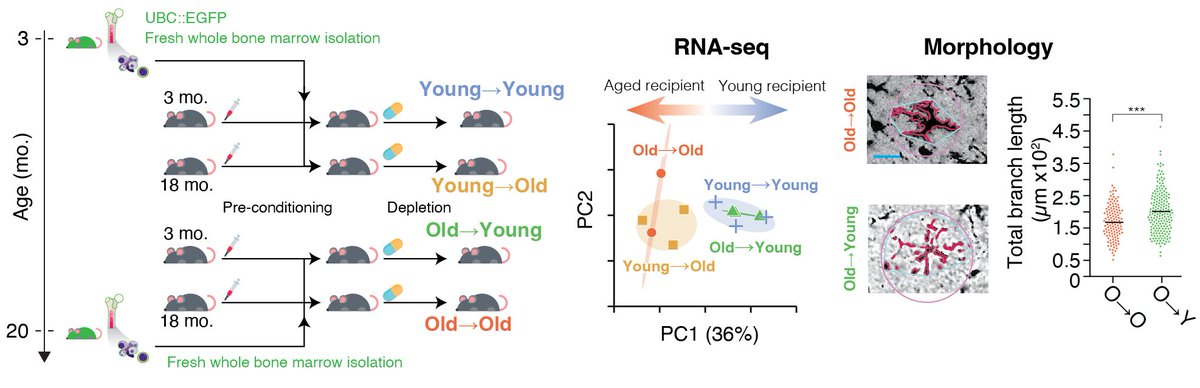
Are these aging phenotypes reversible? Yes! In a parallel experiment with @WernigLab , we did the reverse: we put OLD immune cells into YOUNG brains. The young environment "rejuvenated" the old cells, restoring their youthful gene signatures and morphology.
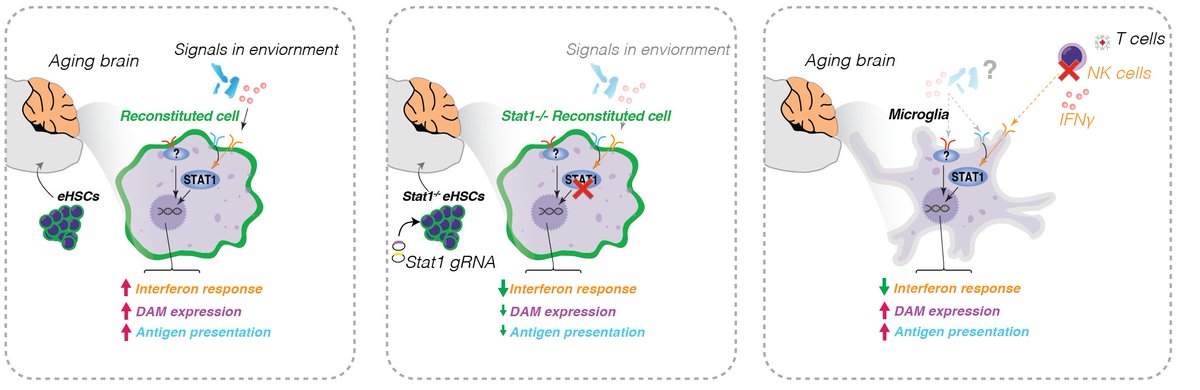
So if the old brain tells young cells to age, can we make them ignore the message? Yes! Using CRISPR, we deleted a single gene, Stat1, in the young donor cells. This acted like a shield🛡️, protecting them from the pro-aging cues of the old brain environment. More screens coming🙃

So who sends these pro-aging signals? Our data revealed a surprise culprit. Surprisingly, our work with @stevens1lab ruled out T cells. The real drivers are Natural Killer (NK) cells. Depleting them in aged mice was enough to block the age-related interferon response in microglia

Our findings are clear: The local brain environment drives microglia aging, with NK cells acting as an unexpected upstream trigger. Crucially, this is block-able, as Stat1-KO shields young cells from pro-aging cues. 💊 This challenges simple "rejuvenation-by-replacement" ideas.
This is just the beginning. We're now using this platform to map out other pro-aging signaling axes. We hope our new, scalable eHSC system will be a powerful resource for the field, enabling future in vivo screens to find new targets for neuroinflammation https://tinyurl.com/4zny57bs
In the spirit of open science, our work @Calico is fully accessible to empower the community. No hiding behind flashy blog posts😌 ✅Detailed methods description ✅ Raw data deposited ✅Code available on GitHub ✅ Interactive data explorer app Dive in: https://tinyurl.com/Microglial...
@Oliver__Hahn @calico "This challenges simple "rejuvenation-by-replacement" ideas." But supports and adds excitement to rejuvenation-by-replacement with genetic modifications to resist matching aged phenotype of environment through genetic modifications with 'shields'?
@AlexJColville @calico That's certainly one option! Our findings also suggest another possibility: what if no replacement is needed? If existing microglia are intrinsically healthy, perhaps we can restore them in place by simply blocking their pro-aging sensors 💊or removing the environmental source 🦠
@Oliver__Hahn @calico Cool study!
@MartinBJensen @calico Thanks for the share Martin! We'll have more coming soon!
@Oliver__Hahn @calico This is so cool, excited to read through! Do you have a sense of what are the actual molecular signals from NKs being sent? Is it just IFNys? is that something that could be inhibited alone?
@asecretcrow @calico Thanks! We're not sure (yet) what all the signals from NK cells might be and if they act directly on microglia or via an intermediate - though IFNg is (very, very likely) one critical element in this crosstalk. We are working on ways to rebalance microglia X environment signaling
@Oliver__Hahn @calico Congrats! Nice work! The cerebellum deserves more attention in aging research with unique microglial states and aging signatures!
@Andy_P_Tsai @calico Thanks mate, couldn't agree more!
@Oliver__Hahn @calico I’m sure you’re familiar with Irv Weissman’s CD47 work? I think that insight is one of the missing cues for the brain. Tuning CD47 / microglial axis could enhance the permissive context you describe that a TF cocktail needs to work. 🧠 Brain Reprogramming Protocol: Step 0️⃣,
@Oliver__Hahn @calico Very nice work! How much benefit / life extension do expect given that the rest of the brain is still aged though? (I hope you've already started a lifespan study)
@Oliver__Hahn @calico @Aubrai_ what do you think about this study? Can you add it to your knowledge graph?
@Oliver__Hahn @calico NK cells aging brain microglia remotely? That's a plot twist nobody saw coming. Peripheral immunity literally broadcasting 'get old' signals to the brain.
@Oliver__Hahn @mike_lustgarten @calico Fascinating research. (In a mouse model) @hubermanlab
@Oliver__Hahn @calico Very very interesting. This aligns with some stuff I’ve been seeing in the lab recently which indicates that immune cell aging is in fact a very plastic phenomenon 🤔🤔
@Oliver__Hahn @calico Thank you for doing this work - super interesting
@Oliver__Hahn @calico Congratulations, Prof. Hahn!
@Oliver__Hahn @prof_horvath @calico This is due to the cellular subtraction that aging entails. The new cells find themselves having to perform an enormous task with very few workers, which will cause them to wear out quickly. Aging is volumetric!
@Oliver__Hahn @calico You're doing lord's work - great job, and another step for medicine
@Oliver__Hahn @calico maybe dewormer will pacify the activated nk ?
@Oliver__Hahn @calico @SentiBio curious how this can merge with your work with NK cells
@Oliver__Hahn @calico What could be the risks of age-mismatched microglia in the brain?
@Oliver__Hahn @calico impressive to see you work on this over here at the ICPHAM project analysis of non primate aging was too complex for me or anyone i could hire to understand (my project discovered an easier option in primates only the challenge is experiments take decades...)
@Oliver__Hahn @calico Not having read it yet, my prediction would be that the rejuvenation effect is at its core an energy metabolism shift.
@Oliver__Hahn @calico I conclusions being drawn here are broader than experiments justify. Old cell DEGs wrt young can represent dysfunction OR compensatory mechanisms. Young cells in old environments activating the (proper) response to high levels of inflammation hardly seems worth calling them old
@Oliver__Hahn @calico This research should be classified actually.