
Saudi Arabia’s Strategic Missile Program: the next Level 🇸🇦🧵 In this thread we'll review the various facilities linked to Saudi Arabia’s strategic missile program But first, a background - Saudi Arabia’s ballistic missile program began in the late 1980s, when the kingdom <<

acquired DF-3A (CSS-2) liquid-fueled missiles from China, with a range of approximately 4,000–5,000 km and conventional warheads, despite the missiles originally being designed for nuclear payloads. In 2007, reports indicated that Saudi Arabia also procured more advanced <<

DF-21 missiles, with U.S. approval conditional on the missiles remaining non-nuclear. These acquisitions led to the establishment of the Royal Saudi Strategic Missile Force (RSSMF), officially announced in 2013. Recent satellite imagery and analyses indicate that Saudi <<

Arabia has significantly expanded its ballistic missile capabilities over the past decade. In the last five years alone, a new underground base was constructed in the center of the kingdom, and existing facilities at other strategic missile bases have been upgraded. <<

Just a decade ago, a solid-fuel missile production and development facility was established at the Al-Watah base. While evidence of operational domestic production remains limited, U.S. intelligence assessments point to ongoing collaboration with China to advance independent <<

manufacturing capabilities. The expansion of Saudi Arabia’s ballistic missile program is primarily driven by strategic deterrence considerations, notably the Iranian threat and potential renewed attacks by the Yemeni Houthis. In response to these threats, Saudi leadership is <<

is pursuing a vision aimed at establishing technological and security independence. It should be noted that to date, there is no evidence of active Saudi efforts to obtain nuclear assistance from Pakistan. However, according to foreign reports, Saudi Arabia has previously <<

provided financial support to Pakistan’s nuclear program, and it cannot be ruled out that it may seek Pakistani assistance in the future to enhance its strategic arsenal. Now, we'll go over the different facilities related to the RSSMF:
1) al-Watah Base: The largest and most advanced facility in the kingdom, established in the late 1980s. It serves as both a storage site for DF-3 and DF-21 missiles from China and as a production and testing facility within a joint Saudi-Chinese missile program. Located <<

approximately 200 km southwest of Riyadh in a mountainous and rocky area, the base includes two large launch pads modeled after the DF-3A, extensive underground facilities, storage and parking areas for mobile launchers, a communications tower, and administrative support <<
buildings. Satellite imagery indicates the presence of a missile engine production and testing facility completed in 2017, designed especially for solid-fuel engines, enabling faster response times compared to liquid-fueled missiles
2) as-Sulayyil Base: Constructed in the late 1980s, about 450 km southwest of Riyadh, it is one of Saudi Arabia’s first and most important strategic missile facilities. Built with Chinese assistance, it is associated with DF-3A long-range missiles purchased from Beijing, <<

with a range of 2,500–4,000 km and the ability to carry heavy payloads, though with relatively limited accuracy. The base is divided into two main missile complexes and a central support area, including large launch pads modeled on Chinese designs and zones for mobile launcher <<
entry. In 2023, Saudi authorities completed an upgrade adding a multi-entrance underground facility. <<

3) Ranyah Base: Located approximately 550 km southwest of Riyadh and 23 km south of the city of Ranyah, this base includes extensive carved tunnels with multiple entrances, indicative of reinforced underground infrastructure. The base itself was completed in the early 1990s, <<

with a new underground complex added to the northern section in 2019 <<
4) al-Hariq Base: One of Saudi Arabia’s oldest missile bases, once considered the central hub of the RSSMF. It hosts medium-range Chinese DF-3 missiles and consists of a tactical zone for missile assembly and storage, propellants, and warheads, alongside a separate residential <<

area with housing, service facilities, a mosque, and a school. Located 65 km south of Riyadh, it was first completed in 1993. In recent years, several underground complexes have been added, including a facility completed in 2017 about 14 km south of the original site, <<

and a second complex under excavation since early 2024. <<
As of writing this thread, a new complex under construction was uncovered by the author, 17 km north of the original base. <<
5) an-Nabhaniyah Base: A relatively new underground base in central Saudi Arabia, near the city of an-Nabhaniyah. Construction began in 2019, with the first phase completed in late 2023, including three entrances to an underground complex. It is the first new facility built <<

since the 1980s and reflects the kingdom’s significant expansion of its strategic missile program. The facility includes underground tunnels, administrative buildings, and residential quarters, designed similarly to existing RSSMF bases such as Al-Sulayyil. <<
Work on the second phase began in mid-2024, with two new underground entrances identified, and additional excavation has continued through mid-2025 <<
6) ash-Shamli Base: An unconfirmed facility located in the desert near Al-Shamli, approximately 750 km northwest of Riyadh. Although not officially recognized, satellite imagery indicates its existence. It is believed to form part of the strategic missile network. <<

7) RSSMF Headquarters and Training Facilities: Located in central Riyadh, the RSSMF headquarters, completed in 2009, was expanded in 2019 with two new office buildings, reflecting increased operational activity. <<

8) Three high-rise buildings at the RSSMF training center in Wadi ad-Dawasir were constructed: the first (~29 m) in the 1980s to support DF-3 missiles, the second (~17 m) in the early 2000s likely following the acquisition of new missile systems, and the third (2019–2021),
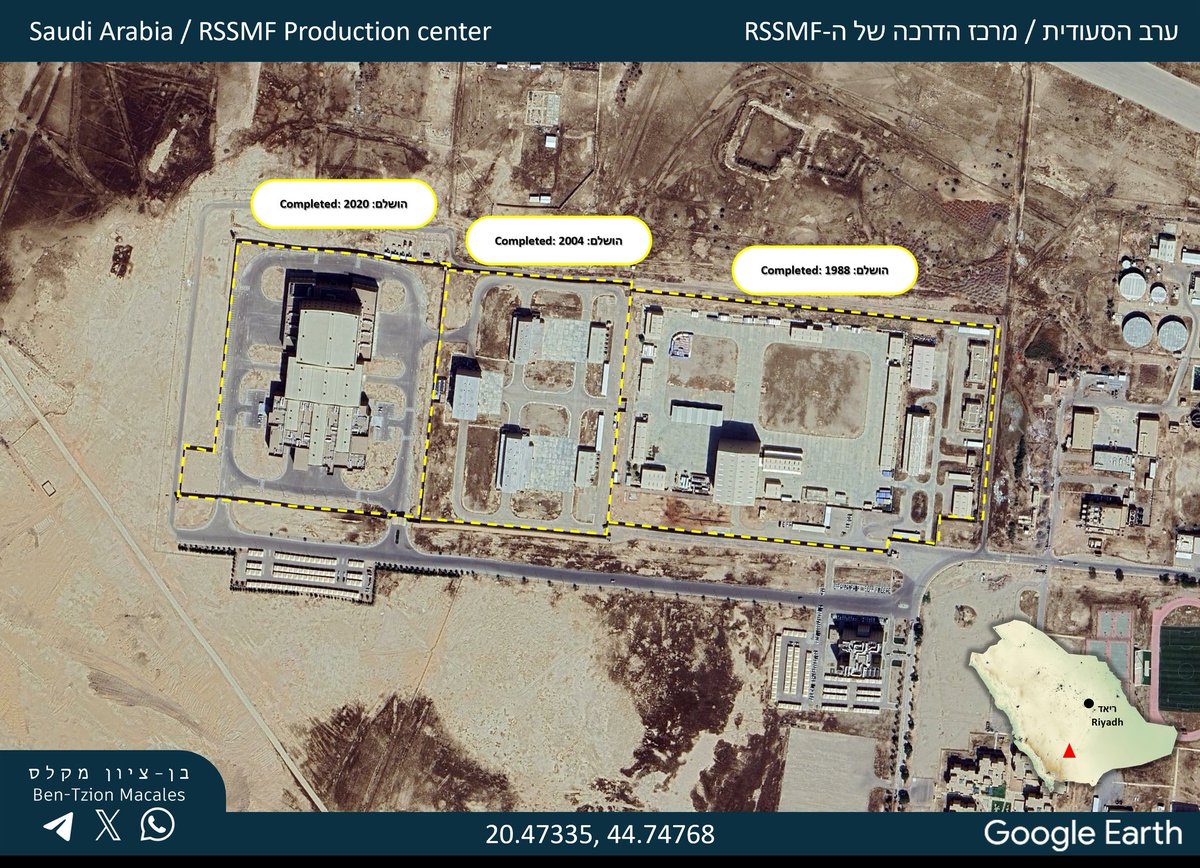
Saudi Arabia’s strategic missile program has expanded significantly in recent years, with upgrades to existing bases and the establishment of new advanced underground facilities. This expansion aligns with Crown Prince Mohammed bin Salman’s "Vision 2030", emphasizing
@BenTzionMacales @Natsecjeff Fake map
@BenTzionMacales We know all that. What we also know a bit or two about .. is a writer's view on a country when choosing not to write "Kingdom" with a capital letter. 📹 "The Saudis already have a bomb" https://x.com/luvyall22/status...
@BenTzionMacales 👇👇👇
@BenTzionMacales So you want to bombard KSA now? 🥸