
Kakin is one of the most fascinating pieces of worldbuilding — a living hierarchy, a pragmatic fusion of caste & class, individualism & collectivism, built to turn ambition, chaos, & sacrifice into fuel for the nation’s prosperity &its royal family Kakin Society a thread: #hxh🧵
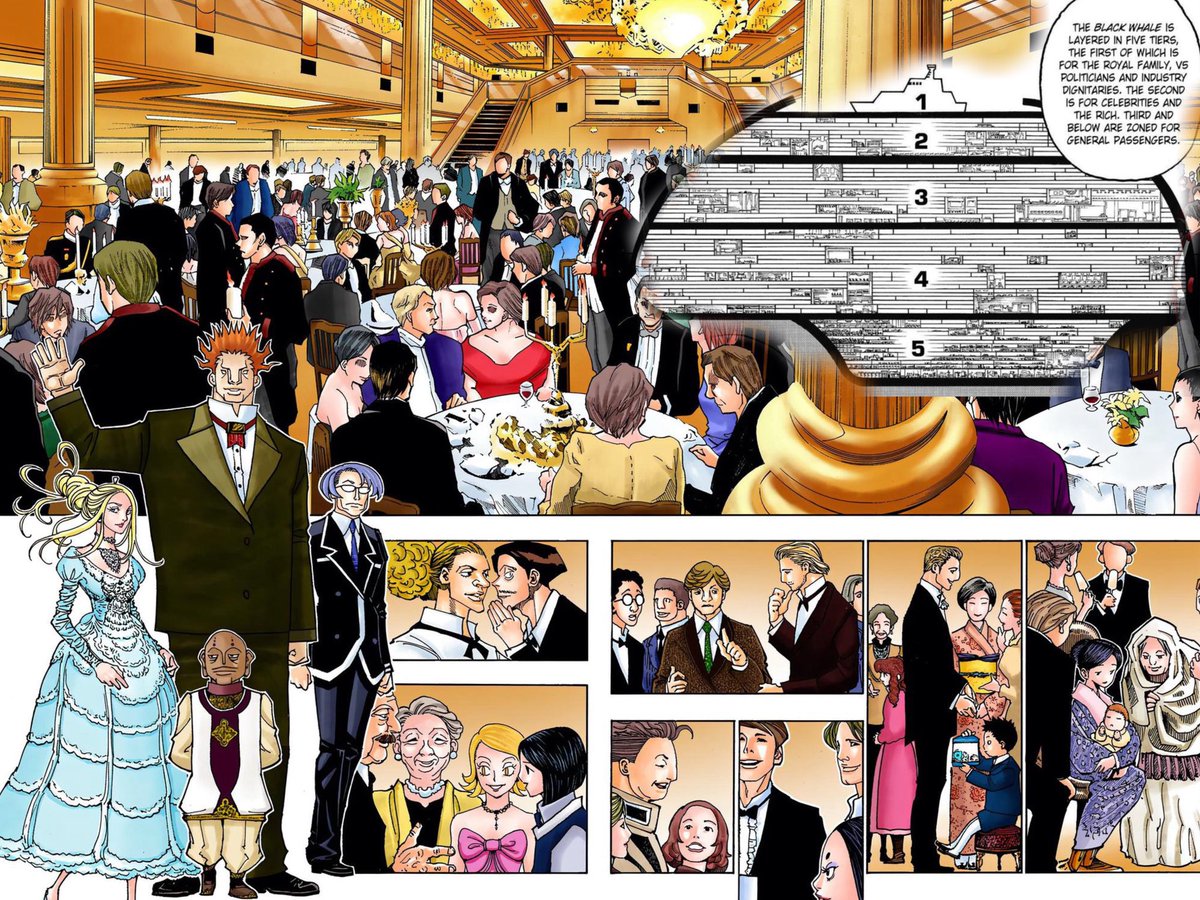
Kakin’s unique social model is built on a fusion of two social orders — the flexibility of a class system and the immutability of a caste system. It is, in a sense, a Hegelian synthesis of birth and choice, fate and destiny.


The Hui Gou Rou royal family, led by the King, is inseparable from Kakin, the architects of the nation itself. They are the ones who instill and embody Hegel’s dialectic, weaving it into the fabric of Kakin’s society — a key to understanding the Nation as a whole


A constant process where: Thesis — an existing order, custom, or belief. & Antithesis — the force that challenges or contradicts it.

Engage in conflict and from their collision emerges a Synthesis — a resolution that not only overcomes the conflict but preserves what is useful in both sides, elevating to new heights
This sublation, the simultaneous overcoming and preservation is the essence of Kakin’s pragmatism & adaptability. Every crisis becomes an opportunity to refine and strengthen their system.


Thus Kakin is a society built on constant dialectic: its thesis is the fixed order of caste, its antithesis is the disruptive force of class mobility, and its synthesis is a hierarchy that is stable yet adaptive harsh but efficient.


A caste system (thesis) offers social hierarchy and continuity by fixing status at birth predetermining their opportunities, their jobs and ultimately their fate but at the cost of stagnation, wasted potential, systemic dehumanisation & oppression.


A class system (antithesis) divides people by wealth, occupation, & education, rewarding merit & fostering both group identity & individual ambition. It allows for some mobility, but its flaws are clear concentrating power at the top & breeding resentment among those left behind


Kakin forges these two into something uniquely its own (synthesis). As Some roles are assigned at birth and cannot be escaped, a predetermined destiny that cannot be altered

Those born into the fixed caste hierarchy include, The Princes, the 2nd track fakers, (the carnival orphans who are sorted as either 2nd track fakers, or as “Flesh” and lastly the have nots From top to bottom each have their own predetermined fate with different restrictions


Other roles are chosen, taken up by those who volunteer for military service, the judiciary, the royal guard, or regular jobs or even the sanctioned mafia underworld These are avenues that reward ambition & merit providing personal choice into service to the nation.


But whether chosen or assigned, every role must be fulfilled to the utmost, everyone a performer on Kakin’s great stage, rewarded or discarded based on how well they play their part.

And this system doesn’t just dictate behavior it also shapes identity & psychology too.. Those born into privilege, like the princes, grow up with a heightened sense of independence and individuality, cultivated to see themselves as unique contenders for the throne.


By contrast, those at the bottom emphasize collectivism and mutual reliance, forging interdependent bonds as a survival mechanism. Here, the needs of the group take priority over individual desires and shared goals outweigh personal ambition.


High-status groups cultivate individualism to reinforce prestige, while low-status groups deepen collectivism to resist marginalization This collective awareness can either stabilize the system through mutual support or ignite rebellion when conditions become unbearable.


Rather than challenge the system outright, they first focus on supporting — or bickering with — one another, reinforcing their own collective identity. In theory, this stabilizes the social order and lowers the chances of a successful rebellion.


But if rebellion does come, that is also accounted for in kakin’s grand design. This tension between individualism & collectivism becomes part of Kakin’s dialectic: the thesis of individualism & the antithesis of collectivism producing a unique synthesis for the kingdom to evolve


This fusion of class & caste, tensions of individualism & collectivism is deliberate, a sublation that preserves the hierarchy of caste while taking the ambition & mobility of class. The result is a system that is neither “just” nor “equal,” but one that pragmatically functions


Heavily skewed in favor of the royal family because they have made themselves inseparable from Kakin’s survival. From the First King in the age of warlords to its present superpower status, For the royals, their prosperity is Kakin’s prosperity, thus instrumental to its rise


preserving the nation means preserving the bloodline that sustains it. Thus the hierarchy holds both royals and Have-Nots in place, ensuring a permanent upper class to rule and a permanent underclass to bear the kingdom’s burdens.
It channels ambition upward through strictly controlled meritocratic avenues, fuelling competition and excellence, ensuring that only the most capable rise to power. forging talent into instruments of the crown rather than threats to it.


It discards customs that no longer serve the nation and adapts to modern realities, uniting the underworld shadow economy to the throne & ruling it in secret even rewriting its own political structure, so long as the monarchy endures.


At the heart of it all lies classism that’s not just enforced, but deeply internalized. Wealth, merit, birth, and proximity to the royal family define a person’s value, ensuring the hierarchy is not only obeyed but accepted as natural law.


Kakin is not perfect, far from it. The gap between the wealthy and the poor is immense, but this disparity is also by design. Kakin converts the existence of inequality & its threat into a stabilizing force, using it as both a warning and an incentive


Inequality thus becomes one of its engines, a tool of governance a living reminder to everyone of their circumstances, the cost of failure and the rewards of obedience, loyalty & merit
At the heart of this lies Kakin’s rigid but delicate idea of balance, that perspective that wealth, power, and resources are limited & should be limited, and therefore must be distributed selectively by those who have


The more people who claim a share, the smaller the portion for those who already have. Therefore their system ensures that many must go without so that those at the top can continue to thrive.


To Kakin, this is not injustice it is balance. Inequality is a mechanism of stability a tool of social order, a way of preserving their status qou


Their idea of balance is a carefully maintained imbalance while keeping the nation focused on its greater purpose: survival, expansion & transcendence & the national cause: to unify the world under kakin


All of this breeds a hunger for survival, luxury, power & success, a hunger that Kakin promises to satisfy and give hope to its people.. By opening Pandora’s box & Leading its nation to the ultimate taboo
