
I had no idea it was this lopsided. I imagined there would be an obvious cap, something like no more than 10% from any one country

First: All systems will eventually be gamed. Therefore, it is wise good to shakeup systems from time to time. Never make rules so rigid that you can't adjust them with new information. Avoid people in love with systematic incumbency. https://x.com/apokolokyntosis/...
Wit that said it is possible that one group got good at gaming the system. That could be anything from nepotism to simply a natural buildout of infrastructure due to frequency and sheer population. I would caution assigning too much blame.
Is the purpose of H1B talent, or cost savings? This seems like one of the main contentions yet the law makes it clear that the point of it is talent, and "prevailing wage" suggests it was explicitly *not* for cost savings
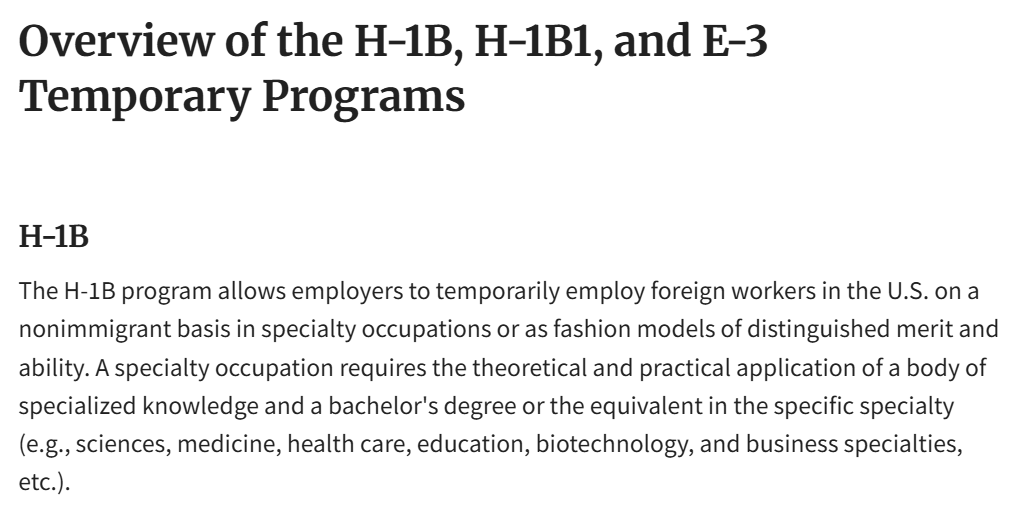
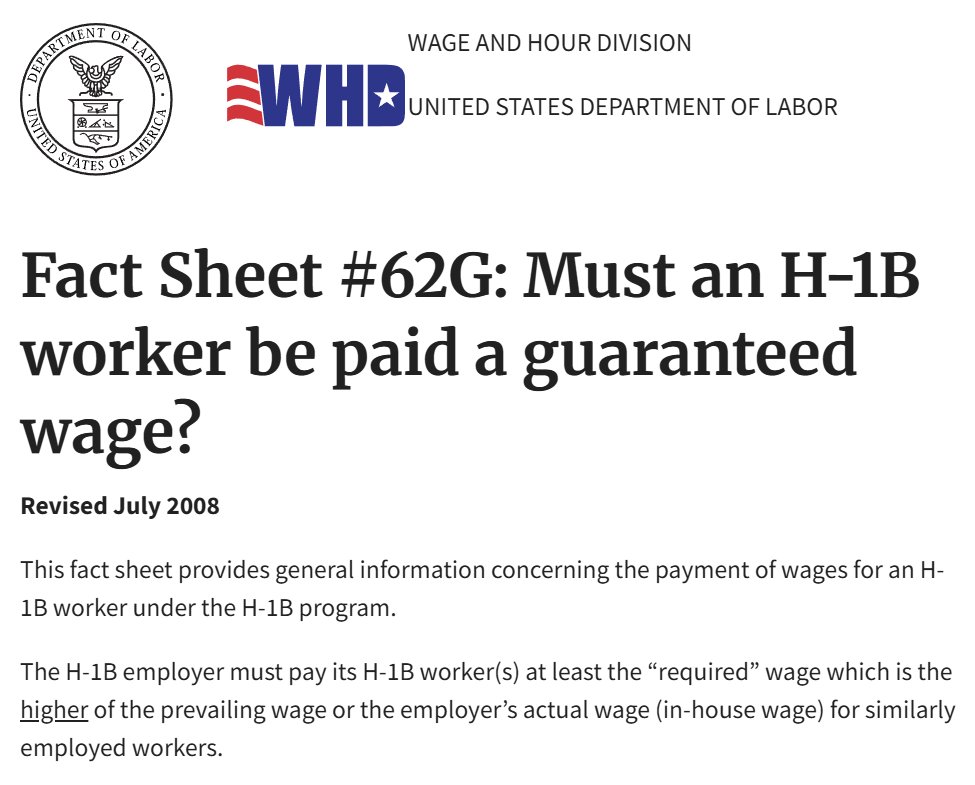
If its for talent, is it in our best interest to get some % of people from every country? You could argue no: talent is not evenly distributed But you could perhaps more easily argue that talent is not concentrated 73% in just 1 country, either, even if its a big country.
Anyway if we have something systematic it may be good to shake up on principle. If its explicitly not for cost savings, jiggling the cost is an OK angle. The law was written when "bachelors or higher in specific specialty" was probably hard to game. Well, try gaming $100,000.
as the computer scientist John McCarthy once said, if it doesn't work, we can always try something else (like a 10% cap per country)
haha, Nobels are at least slightly harder to game than "bachelors or equivalent". For now! https://x.com/loobah_l/status/...
oh that's right the US already sets per-country limits on green cards. why aren't we doing it with H-1Bs for the same reason? despite that India is also the 2nd highest greencard issued country https://x.com/typeclonghouse/s...

For already having the per-country cap, I also had no idea green cards were this lopsided...
ah there are supposed to be about 11,270 green cards per country - but the per-country cap does not exist for "immediate relatives" all systems
Some of these tweets I should have reread before I hit send
gonna start saying "wisegood" though
@simonsarris Casual observation from silicon valley: At the elite companies hiring high on the talent curve, roughly equal numbers of south and east asians and many eastern europeans. But there seem to exist mediocre companies that are overwhelmingly one ethnic group.
@simonsarris They literally have an entire industry pipeline for it Schools, fake credentialing companies, middleman contracting firms, and nepotistic hiring management stateside People hugely underestimate how corrupt they are
@simonsarris 74% of H1-B go to India. 12% of H1-B go to China It’s functionally an India visa. As for a cap… there is a green card cap that limits the number that get issued per year. Because of the crazy high number of Indian nationals here on work visa.. the cap has resulted in a
@simonsarris If you break it down by Indian state most H-1B visas are issued to people in south India, a region of just ~250M people. H-1Bs being the 'global' best is simply nonsense. This visa distribution pattern is not possible without intense and unceasing ethnic bigotry during hiring.
@simonsarris it's partially because people from other countries get greencards faster so arent on h1bs for as long while indians are stuck in a greencard loop
@simonsarris It has been increasingly insane since ~2010. When I was working on one of my Masters degrees (in a tech field), 65% of the graduate students in my program were from India. None of them had an undergraduate degree in the field, nor any related fields. Most of them had nursing
@simonsarris There must be other forces at work. Did the rest of the world just stop applying for them? Or did the number of Indian applications simply skyrocket?
@simonsarris there’s a per-country cap like that on the green cards, no more than 7% per country, but not on these visas - and that creates the problem, where they get stuck in a backlog for 10 years on this temp status.
@simonsarris How can people not understand this. To get off h1b you need a green card. The green card queue is per country. The bigger the queue the longer you're a slave. Big corporations want decade long retention despite low pay and bad working conditions. Understand it.
@simonsarris Should a cap per country include an adjustment for population size? A common criticism of the green card is that the cap makes it far easier for citizens of small countries to get access.
@simonsarris At the same time, there are lots of Europeans in US engineering graduate schools who run into a brick wall trying to get US visas and get sent home It's clear that the disparity is intentional
@simonsarris Once they get management roles the "need" for more H1Bs, specifically from India, exponentially increases.
@simonsarris That would have been Pre-Hart-Celler
@simonsarris @HarmlessYardDog Nope. I think it was Johnson (after Kennedy) who undid that For long time we had hard caps by nation, and then he basically opened floodgates
@simonsarris I’m curious how this happened. Why did ‘Rest of world’ fall off so hard against India. Is it just that the existence of the program became much more widely known in India that it caused a huge surge in applications?
@simonsarris India is very poor (but juuuust rich enough for international plane tickets), very young, and at least nominally English speaking. And huge. Yuge even. Oh and low trust. It really is a perfect storm.
@simonsarris Now look at the top companies in India by market cap , and see how many are just h1b pipelines (Tata, Infosys, etc).
@simonsarris Big population with decent English and we only get the best of them
@simonsarris it's because of outsourcing firms having developed hiring pipelines
@simonsarris I don't like to crassly stereotype. But if three quarters are coming from the country most synonymous with scams, then perhaps this visa is being scammed

@simonsarris 1- Most techies from other countries are not interested in coming to US 2- India has large domestic IT industry which creates large number of techies 3- India not able to absorb elite tech talent due to lack of FAANG type corps 4- Lack of research labs(Europe & east Asia have)
@simonsarris US politicians of both parties sold out American knowledge workers for decades. I’m shocked nobody’s naming and shaming.
@simonsarris Investigate hiring managers for racial discrimination against non-Indians