
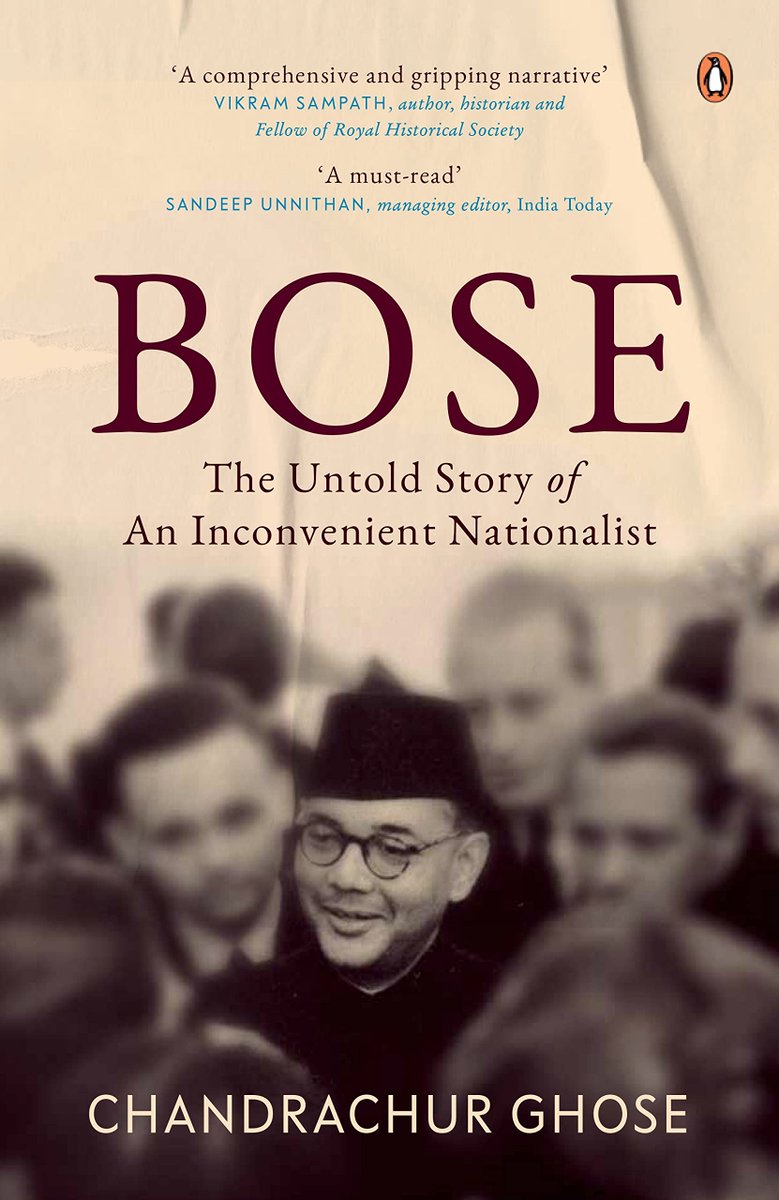
Subhas Chandra Bose’s life is well covered in this 2022 biography by @chandrachurg, ‘Bose – The Untold Story of An Inconveinent Nationalist’. Some interesting excerpts: (1/29)
(1928): “Subhas explained.. how insulting the setting up of the (Simon) Commission had been would become clear if second Indians were sent to England to pass a judgement on whether the British were capable of self-government.” 2/29
“He also mentioned that there were two ways to obtain Swaraj – either by an armed uprising, or by means of an economic blockade. Since armed uprising was impossible for an unarmed nation, the latter was the only course open to the country.” 3/29
(1938) “Subhas emphasized that India had no enmity towards the British people. Having won freedom, there was ‘no reason why we should not enter in the most cordial relations’ with them.” 4/29
“In a free India, it was important to ensure the continuity of the Congress, because only an organization that won freedom for the country could ensure its reconstruction… the first task of the national government would be.. drawing up a comprehensive plan for reconstruction.”
“The free country, Subhas outlined, would be a multi-party democratic one, with a strong central government, ensuring local and cultural autonomy at the same time… a common language which ideally should be a mixture of Hindi and Urdu..” 6/29
(1939) “Minoo Masani: “ Nehru… When faced with a difficult choice, he would be non-aligned! Subhas Babu was quite cynical towards such an attitude and told us that Nehru was an opportunist who thought about his own position first and then about everything else.” 7/29
(Bose in a letter to Nehru): “You have charged me further with not clarifying my policy in national and international affairs. I think I have a policy, whether that policy be right or wrong… May I now ask what your policy is?” 8/29
“If we follow the present piecemeal, tinkering and nibbling policy, suspending the popular struggle in every other state, it will take us 250 years to obtain civil liberty and responsible government in the states. And after that we shall think of our Swaraj!” 9/29
"Foreign policy is a realistic affair to be determined largely from the point of view of a nation’s self-interest… what is your foreign policy, pray? Frothy sentiments & pious platitudes do not make foreign policy..” 10/29
(1939) “Gandhi had made his views clear… when he placed non-violence above the country’s independence.. “I cannot emphasize my belief more forcibly than by saying that I personally would not purchase my own country’s freedom by violence even if such a thing were a possibility.”
(Bose’s plans when he reached Germany in 1941): “he wants to set up an Indian government in Germany, visualizing as a model the Polish, etc, governments in exile. To form his government, he expects certain promises from the Axis Powers, which he wants to formulate in detail.”
“Besides propaganda actions the program furthermore includes the instigation of uprisings in India. As a final objective he has in mind the entry by the Axis Powers into India.." 13/29
"The Anglo-Indian army consisted of only 300,000 men, of which at most 70,000 were Englishmen. The major portion of the Indian elements was willing to defect at any time. An army of 100,000 men with modern equipment would be adequate to free India from English." 14/29
(1942) Nehru: “Hitler and Japan must go to hell. I shall fight them to the end and this is my policy. I shall fight Mr Subhas Bose and his party along with Japan if he comes to India. Mr Bose acted very wrongly through in good faith.” 15/29
“An agreement was reached between Berlin and Tokyo and mid-January 1943, on the arrangements for Subhas’s journey… a German U-180 submarine would carry Subhas halfway to Madagascar, where he would move to a Japanese U-boat I-29.” 16/29
(after 1945): “The mass upheaval of support for the INA soldiers and the adulation of Subhas compelled many leaders to change their wartime attitudes.. Jawaharlal, who led the Congress’ diatribe against Subhas.. mentioned him specially during his independence speech in 1947.”
“’Jai Hind’ was adopted as the national salutation, and Tagore’s ‘Jana Gana Mana’, which was selected by Subhas as India’s national anthem, received Jawaharlal’s approval. Subhas became ‘Netaji’ for all leaders, including Gandhi and Jawaharlal.” 18/29
“It was easy to misrepresent, lampoon and reduce Subhas to the image of a Nazi sympathizer with an authoritarian ambitions by the Western press, but that was not the case in India.” 19/29
“The formulation adopted by the Congress very early on was that of a brave but misguided patriot who fell from the high pedestal of the Gandhian soul of modern India.” 20/29
“Thus, in deference to his popularity, important occasions were celebrated and commemorative postal stamps were issued, but always calibrated with the caution that he would not take the centre stage or deflect the continued spotlight on the Nehru-Gandhi family.” 21/29
“Subhas’s associates and family members continued to be spied upon by the central and the state governments until the 1970s… The intelligence files, many of which deal with the search for a ‘dead Subhas’… are yet to be made public.” 22/29
(Bose about Gandhi’s plans for individual civil disobedience in 1940) “It is neither cooperation nor mass struggle. It pleases nobody and will lead us nowhere. And this campaign has nothing to do with Swaraj.” 23/29
“It can only bluff a certain section of our countrymen who are gullible into thinking that something effective is being done by Gandhiji… This latest phase of Gandhism with its sanctimonious hypocrisy… is sickening to a degree.” 24/29
“One is forced to wonder which is a greater menace to India’s political future – the British bureaucracy or the Gandhian hierarchy. Idealism that is devoid of realism and whose only content is a frothy sentimentalism… can never be fruitful of results.” 25/29
“Gandhism will land free India in a ditch – if free India is sought to be rebuilt on Gandhian, non-violent principles. India will then be offering a standing invitation to all predatory powers.” 26/29
“Gandhi’s epoch in India’s history came to an end in 1939. He has imparted political consciousness to the Indian masses... But he stands pledged to non-violence and passive resistance. With such methods you can never expel the British from India and can never win independence.”
Nehru in 1960: “It is true, I did let Subhas down. I did it because I had realized that, at that stage, whatever one’s views might be about the way India should develop, Gandhi was India. Anything which weakened Gandhi, weakened India.” 28/29
“So I subordinated myself to Gandhi, although I was in agreement with what Subhas was trying to do. I suppose it is right to say that I let him down. India had to become before either of us.” 29/29