
disclaimer: everything in this post is much better explained in the book by carver [1, chapter 7]. I just outline how I construct the signals of different trading rules, because I will later show the correlation between signals and forward returns for crypto

panel 1: shows the forecast of the trading rule emac(8, 32) for BTCUSDT. it is basically (fast ema - slow ema) / vol forecast. dividing by vol fc has the advantage that fcs can be compared across coins. the sign of the fc indicates if we are long (+) or short (-) the coin.
panel 2: the avg abs fc value indicates if the fc is above average → leads to a position larger than usual, recall the post below which maps fc to required position risk. I scale the raw fc to have an avg abs value of 0.5. I use 0.5 because I map the scaled forecast to a
panel 3: I cap large signal values to -1 or 1 (carver suggests to cap the scaled fc to two times the avg abs value such that position size is capped. [3] suggests alternatives like tanh or x*exp(-x**2), the latter would size down the position for very large forecasts. I keep it
next post shows the forecast scalars for historical top 20 coins and we check how robustness across coins references: [1] rob carver - systematic trading [2] https://qoppac.blogspot.com/20... [3] https://x.com/macrocephalopod/...
@noalphadecay Nice. Curious how things will look with the portfolio of coins and all the carverite trading rules. I guess you will go to intraday due to the limited daily data?
@PeakoQuant I won’t go intraday, just daily freq and do my best with the given sample size
@noalphadecay oh hello another carver enthusiast
@noalphadecay Carver mentioned = good tweet. Easy as that 👍
@noalphadecay banger
Having edge in the (midprice*forecast*scaling*) part is where most of the money is and then getting spread rights also helps. midprice as edge is just being very fast to update from market data forecast is usually just how you bake in actual short term edge into your quotes
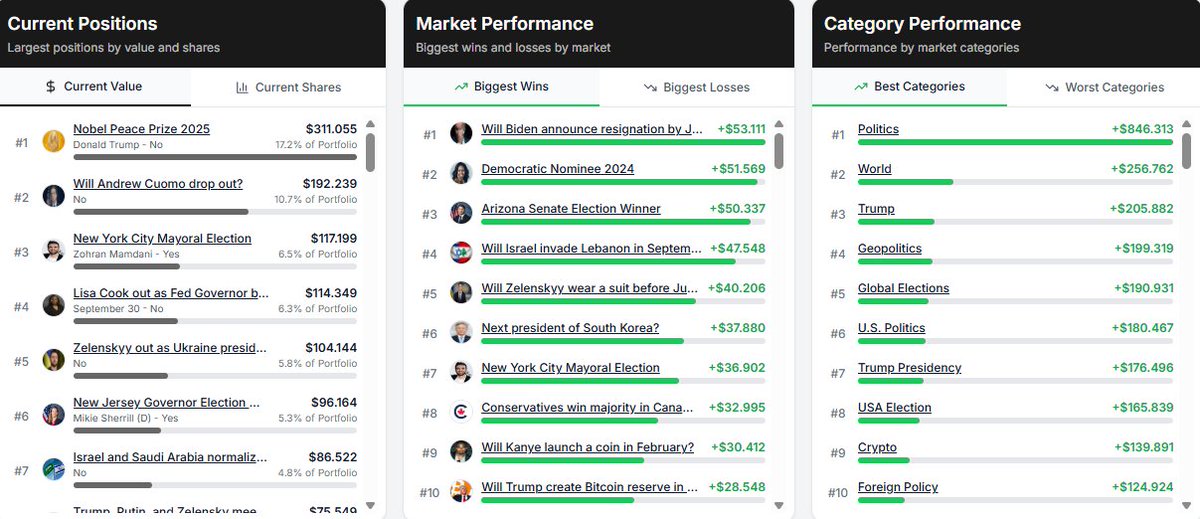
scottilicious He made a total profit of $1,135,257. Win rate: 84.3% Wallet address: 0x000d257d2dc7616feaef4ae0f14600fdf50a758e His secret: Macro/geo “nothing happens” bias; takes medium-odds swings when flow spikes; loads up near-certainty outcomes (~$0.96–$1.00) on events

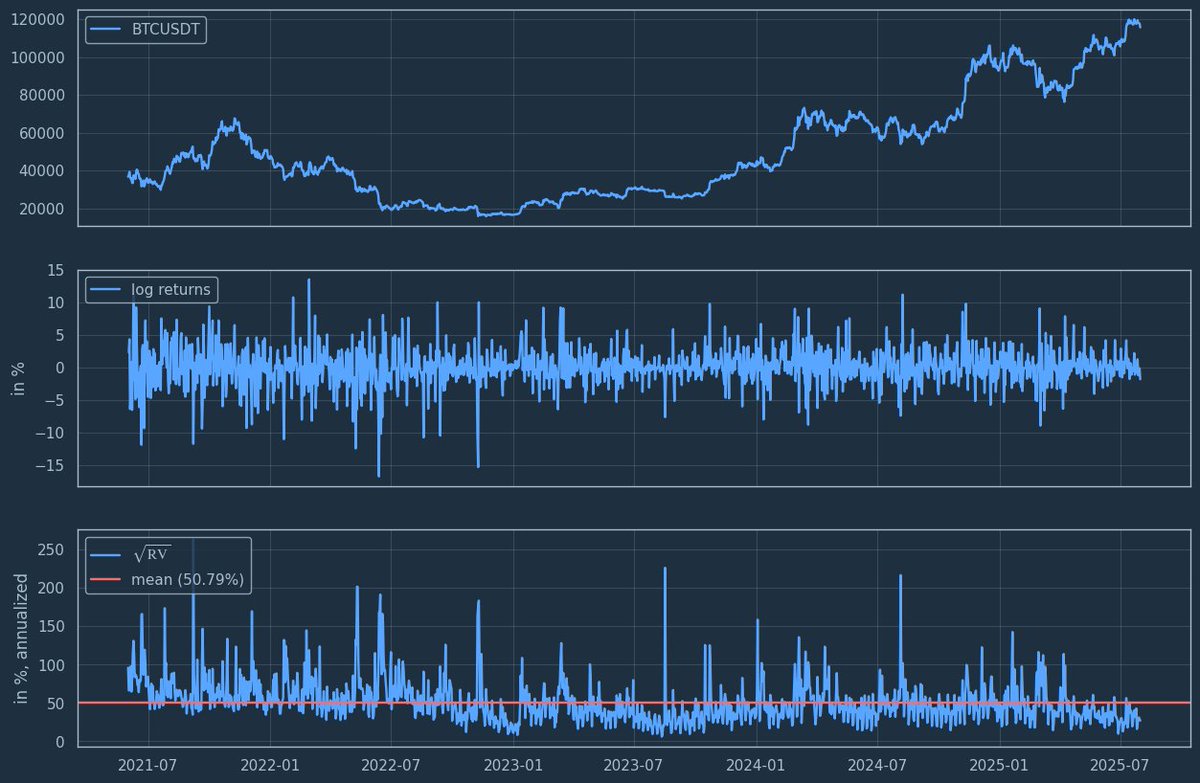
for position sizing, we need a volatility forecast for tomorrow. If predicted vol > our target vol, we cut exposure. classic approaches use EMA vol [1], or a blend with a long-term anchor (Carver-style). but how good are these estimators compared to a benchmark model? panel 3:
I asked ChatGPT to design an intro course in quantitative research for new hires. It's clearly influenced by questions I asked it in the past. But it still feels way too scattershot and formulaic, like a second-hand-information-based course. Anyway, comments welcome: 1. what