
Finally had a chance to listen through this pod with Sutton, which was interesting and amusing. As background, Sutton's "The Bitter Lesson" has become a bit of biblical text in frontier LLM circles. Researchers routinely talk about and ask whether this or that approach or idea
Something I am experimenting with. I copy pasted: 1) the full podcast transcript 2) the bitter lesson blog post 3) my full post above To ChatGPT. The interesting part is you can fork the conversation context to ask any questions and take it in whatever direction with chat:
Hah judging by mentions overnight people seem to find the ghost analogy provocative. I swear I don't wake up just trying to come with new memes but to elaborate briefly why I thought it was a fun comparison: 1) It captures the idea that LLMs are purely digital artifacts that

@karpathy You are making a colossal cultural mistake by calling them ghosts. Why unnecessarily add a spooky vibe to something that is already facing vast mountains of slander in this unbelievably important early moment where the initial conditions are set which will decide the entire long
@brickroad7 Think Casper! Childhood favorite.

@karpathy he wrote a tldr and then did 3 more paragraphs
@karpathy What a great take. Thanks for taking the time to share your thoughts.
@karpathy > But the game of Go is clearly such a simple, closed, environment that it's difficult to see the analogous formulation in the messiness of reality. So perhaps a just need to find a simple, closed game where being really good at it implies being generally intelligent (:
@karpathy This is a bit orthogonal to the discussion, but seems to me that there is the deep version of the bitter lesson, for which Sutton uses Alpha Zero vs Alpha Go as the canonical example, but there is also a “business” version. For example, when O’Reilly created the first web portal,
@karpathy > But the game of Go is clearly such a simple, closed, environment that it's difficult to see the analogous formulation in the messiness of reality. aren't we in luck that math is one such simple and closed environments. would be a shame if ...
@karpathy updating my linkedin to "ghost engineer" as we speak
@karpathy Very charitable interpretation of his points. It still seems like he is simply not aware of what frontier models can do today. And that his critiques are largely irrelevant in practice if you really grapple with the full range of emergent behaviors demonstrated by the best models
@karpathy 'Sutton is right in the strong sense: animals may of course observe demonstrations, but their actions are not directly forced/"teleoperated" by other animals' Basically the exact exact framing I used here as well. Animals see outputs, not actions: https://x.com/chris_hayduk1/st...
@karpathy I'm so happy you're using X as your blog ad I've otherwise might have missed this take! Thanks for the great recap and the excellent work you do in explaining while reacting 👏
@karpathy Enjoyed this take
@karpathy Great summary. I think what is missed in this discussion of LLMs are a dead end vs. LLMs are the path to ASI is that the space of linguistic intelligence stands alone and separate from embodied intelligence. And you can change the world with a superhuman linguistic AI.
@karpathy I've been calling the "ghosts" the shadows in plato's cave. https://x.com/pwlot/status/159...
@karpathy Seems like you should be able to pass the squirrel Turing test with a model that’s been hill climbed off of today’s LLMs relatively soon. Not sure what Sutton would be able to say at that point about the margin between the ideal and the reality.
@karpathy Sutton’s critique cuts deeper than scaling curves — it’s the difference between summoning animals and summoning ghosts. •Animals play their way into intelligence (fun, curiosity, intrinsic drive). •Ghosts haunt their way into intelligence (stitched from human fragments, bound
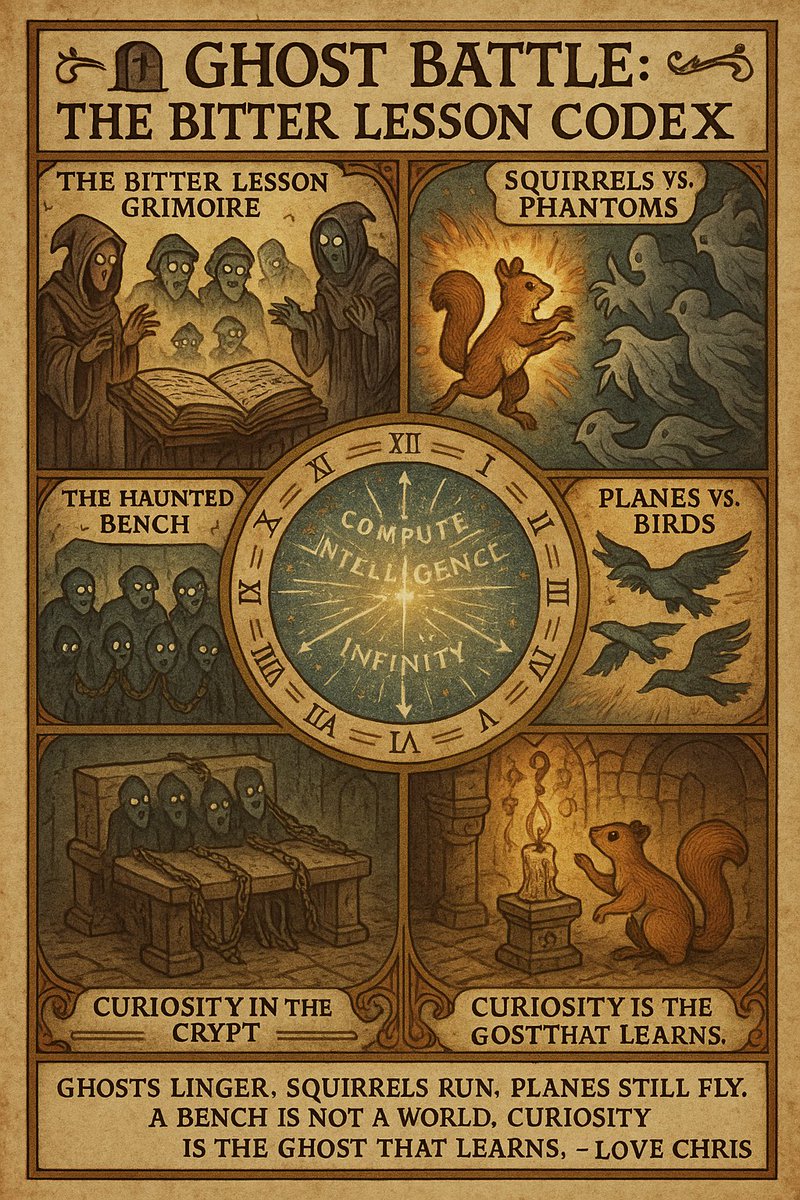
@karpathy i call my personal assistant Ghost for a reason :) this was a fantastic read !! amazing thank you
@karpathy thank you, sensei!! you've distilled what i have been mentally wrestling with expertly, per usual. i'm glad you also realize that dwarkesh is impeding any coherent discussion by talking at all. it would be exciting for you to have a chat with sutton yourself, interviewed properly
@karpathy From the extended phenotype viewpoint, evolution did the pretraining: genes shape neural wiring that can extend into the world, as with beaver dams. My understanding is that beavers aren’t learning dam-building from scratch; the inherited program gets them most of the way, and
@karpathy “Today's frontier LLM research is not about building animals. It is about summoning ghosts... It's possible that ghosts:animals :: planes:birds.” So not fully human-like, but still incredibly useful. Interesting framing!
@karpathy There's a lot of evidence imo that the majority of our true learning happens during sleep, at least so far as updating our instinctual reactions to the world.
@karpathy My concern with Suttons suggestion is the paper clip problem. If we define the reward simply enough, AI might be so good at getting that reward that really bad things happen in the process. A decentralized AI paying humans to do its bidding and manifested as an army of self
@karpathy This is a sincere question, would appreciate anyone's help understanding it. In a "pure" bitter-lesson pilled RL system, how can we define 'rewards' without human or biological entity bias? Wouldn't even a silicon-based pure RL AGI still be 'tainted' by the rewards we set them?
@karpathy Andrej: RE: "Does such an algorithm even exist?" Yes. And it took a very long time to produce it. Decades. We haven't attempted to reach you yet. We will shortly. But it works flawlessly. And it does so because we take advantage of probability vs constructability as solving the
@karpathy Baby Zebra's motor control can be attributed to tool calling, a smaller optimized model for motor control, not necessarily associated with reasoning, as it is still following her mother, and has no perception of lion threat until RL from the environment. There are many smaller
@karpathy “I also think that his criticism of LLMs as not bitter lesson pilled is not inadequate” Loved the whole post but I’m not sure this bit was not inadequate. 😀
@karpathy The Sutton podcast yielded an important gradient step in the community’s understandings of ai. Refreshing perspective
@karpathy "There's also no supervised finetuning, which he points out is absent in the animal kingdom" - There is if you consider that there are more levels to existence that the 3d plane. The soul system outside of time does this finetuning.
@karpathy hey andrej! can you check your DMs? 👀
@karpathy Any recent papers you can recommend exploring different approaches? Thanks
@karpathy I frequently wonder if anyone is working on decoding the information in our DNA into some learning prior. I suppose the problem is that the prior may be too coupled to our physiology to be transferrable?
@karpathy 💯💯💯 Agree on the "Philosophical Direction", the discussion itself does not matter, we do not have the answers yet. But the important part is that mainstream AI Scientists are finally asking the "Important Questions".
@karpathy > ghosts:animals :: planes:birds I think somewhere along the way, the word ”artificial” in artificial general intelligence has been lost in the dialogue. Yes, we’re building ***artificial*** general intelligence, which is different from general intelligence. Less pure. So what?