
LCOE must die. If you ever hear anyone favorably compare solar and wind to coal, gas, or nuclear by citing a low LCOE—"Levelized Cost of Energy"—you are being scammed. LCOE explicitly ignores "reliability-related considerations" and is therefore a garbage metric. 🧵👇

You've heard it over and over: "Solar and wind are now cheaper than fossil fuels." You might suspect something is wrong here, because if solar/wind were so cheap their developers wouldn't always be asking for subsidies, or claim the sky is falling when subsidies are taken away.

The suspicious claim that "Solar and wind are now cheaper than fossil fuels" is usually justified using an intimidating-sounding metric called LCOE: "Levelized Cost of Energy." LCOE is used all the time in prestigious publications and in government.
In a 2020 report, the International Energy Agency used LCOE to claim that "renewable" energy costs are now "competitive" with fossil fuel costs, and that onshore wind is the cheapest source of electricity in most countries.

In a 2023 article titled "The Clean Energy Future Is Arriving Faster Than You Think," the New York Times used LCOE to claim that solar and wind are somehow cheap while coal, gas, and nuclear are somehow expensive.
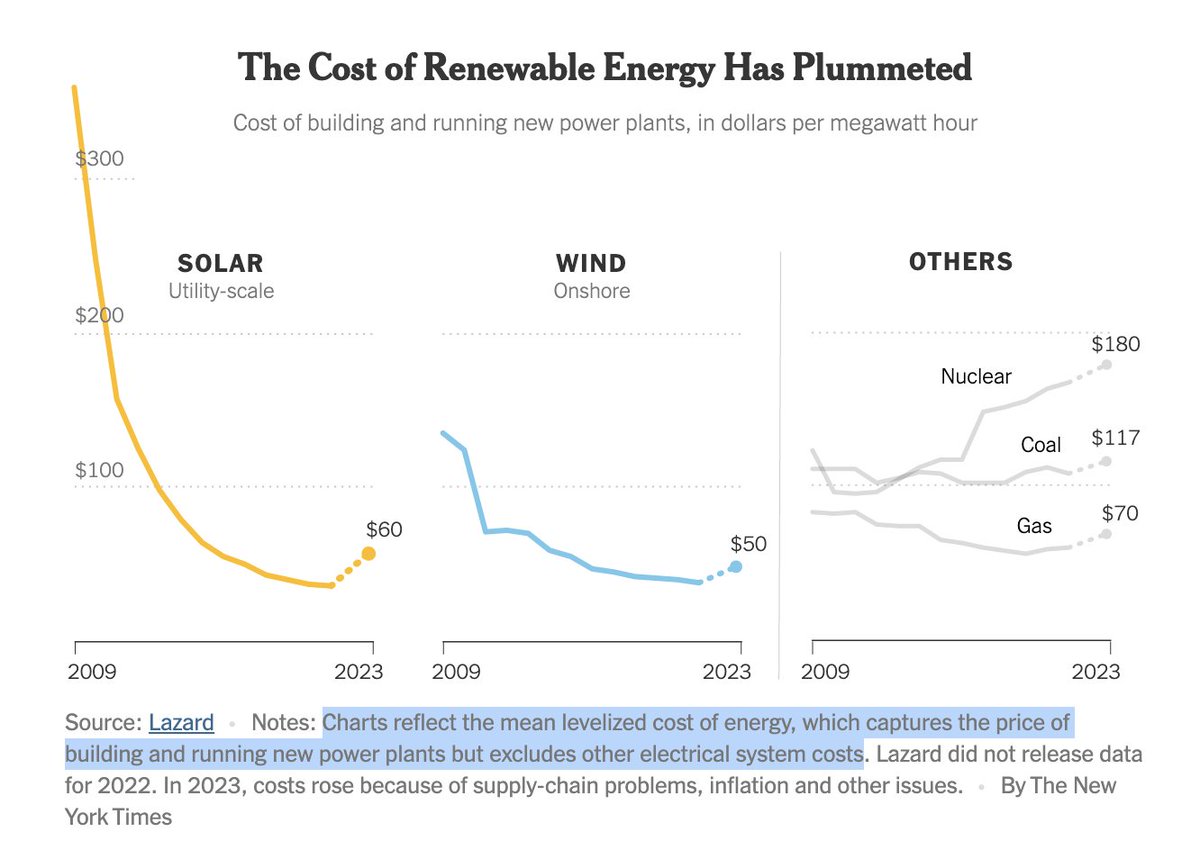
When you hear that the LCOE ("Levelized Cost of Energy") of solar and wind is cheaper than that of natural gas or coal or nuclear—and yet solar and wind somehow still need massive subsidies—don't be intimidated into abandoning your skepticism. LCOE is an easily-debunked scam.
Imagine there were a metric called LCOB—Levelized Cost of Babysitters—that compared the cost of different babysitters in your neighborhood. But there was a catch that made it useless: the organization collecting the metric allowed totally unreliable babysitters to qualify.
Imagine that unreliable babysitters sold themselves by saying: We have the cheapest LCOB—we only charge $15/hour, while reliable ones charge $20. Obviously that would be a scam because in practice if you pay for an unreliable babysitter you also need to pay for a reliable one.
Whether you're comparing babysitters or sources of electricity, reliability is table stakes. And yet LCOE—Levelized Cost of Electricity—popularized by the firm Lazard, explicitly excludes "reliability-related considerations"!
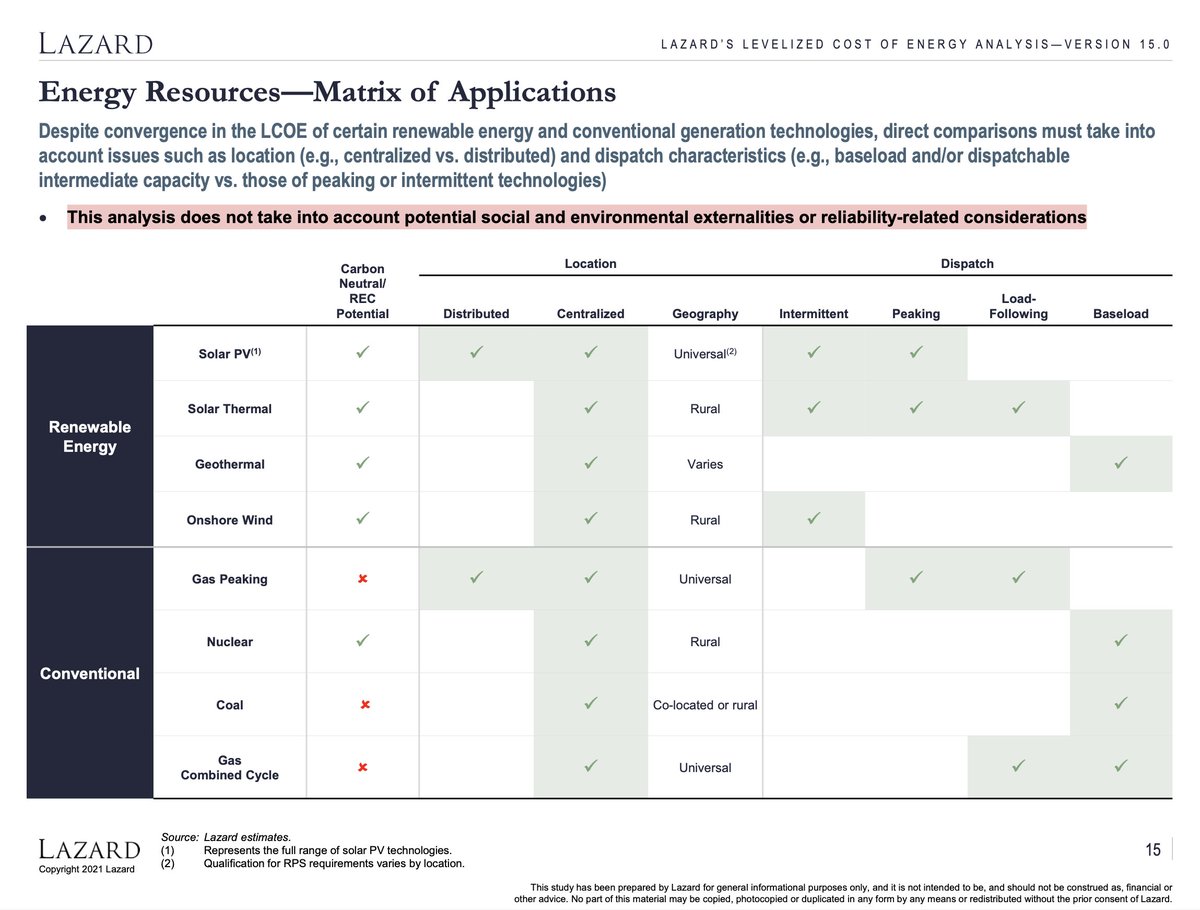
Part of LCOE is reasonable: it compares different electricity sources by adding up the sources' full lifetime costs and dividing this by output. This would work well to compare sources' efficiency—if the sources in question are all required to be reliable. But LCOE doesn't.
By allowing unreliable electricity to qualify as "electricity" or "energy," LCOE wildly understates the cost of solar and wind. In reality, solar and wind need life support from reliable sources. The cost of using them is the full system cost, including life support cost.
The full life-support cost of solar and wind includes the dispatchable power plants that accommodate solar/wind's unreliability—and the high-density long-distance transmission wires needed to connect faraway solar/wind to nearby grids—and various grid-stabilizing expenses.
Solar/wind's life-support costs are large and increase with the % of solar and wind use. At 10%, they can be somewhat affordable. But at 50+% there are huge new costs for transmission, grid-stabilizing, storage, and overbuilding (to maximize solar/wind even during bad weather).
So long as LCOE treats unreliable and reliable electricity sources as equal, it is a trash metric that should not be utilized to compare energy sources. And since it is widely utilized it needs to be deliberately expunged from honest discussions and from policymaking.
What should replace LCOE? Above all an understanding that you can't compare the costs of unreliable and reliable electricity—and that unreliable electricity becomes more expensive at larger scales. Any cost discussion of solar/wind must account for their full, escalating costs.
If we reject LCOE and actually value reliability in cost calculations, it will reveal the common-sense reality that it's not "cheap" to try to power the grid overwhelmingly with unreliable sources.
If you're new to my work, follow me @AlexEpstein for extreme clarity on energy, environmental, and climate issues from a humanist perspective. Also, subscribe to my newsletter, featuring lots of concise, powerful, well-referenced energy talking points. http://alexepstein.substack.co...
@AlexEpstein I get your point, and I agree that it's a very important point. Here's a counterpoint. Suppose there was a technology that allowed electricity generation and loads to be desynchronized. In other words, a battery or something analogous. If such a technology could be implemented
@AlexEpstein The most well known LCOE report has added a firmed cost chart. This is not fully firmed, with only a 4hr battery where battery firming is used California with an assumed 4 hr battery backup gets an LCOE for wind and solar over the highest natural gas LCOE for every type
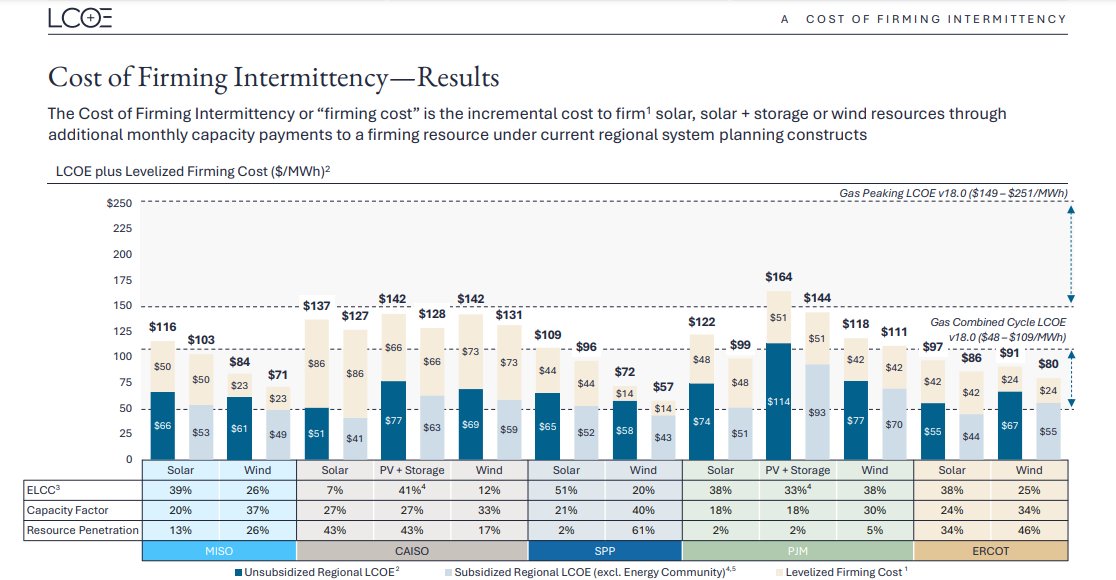
@AlexEpstein @grok is Alex Epstein correct?
@AlexEpstein LCOE is a bigger scam than Net Zero. Wait, both are equally big scams.
@AlexEpstein Change the market then, don’t whine that the rules thermals made no longer work for thermals.
@AlexEpstein It has its shortcomings but its utility too. What would you replace or supplement it with?
@AlexEpstein The difference between time of day LCOE can now be as low as $15/MWh based off the newest battery prices in China. LCOE is certainly not perfect but for an estimate it is not half bad and getting better. The exclusion/inclusion of capital costs is far more important when
@AlexEpstein Remarkable how much has spawned and how much treasure has been spent based on that one little thing
@AlexEpstein As one data point, I signed up for utility solar 7 years ago just to observe the hype personally. Bottom line: running average cost has averaged higher than regular electricity but for a brief blip, now at 1.25x and rising.
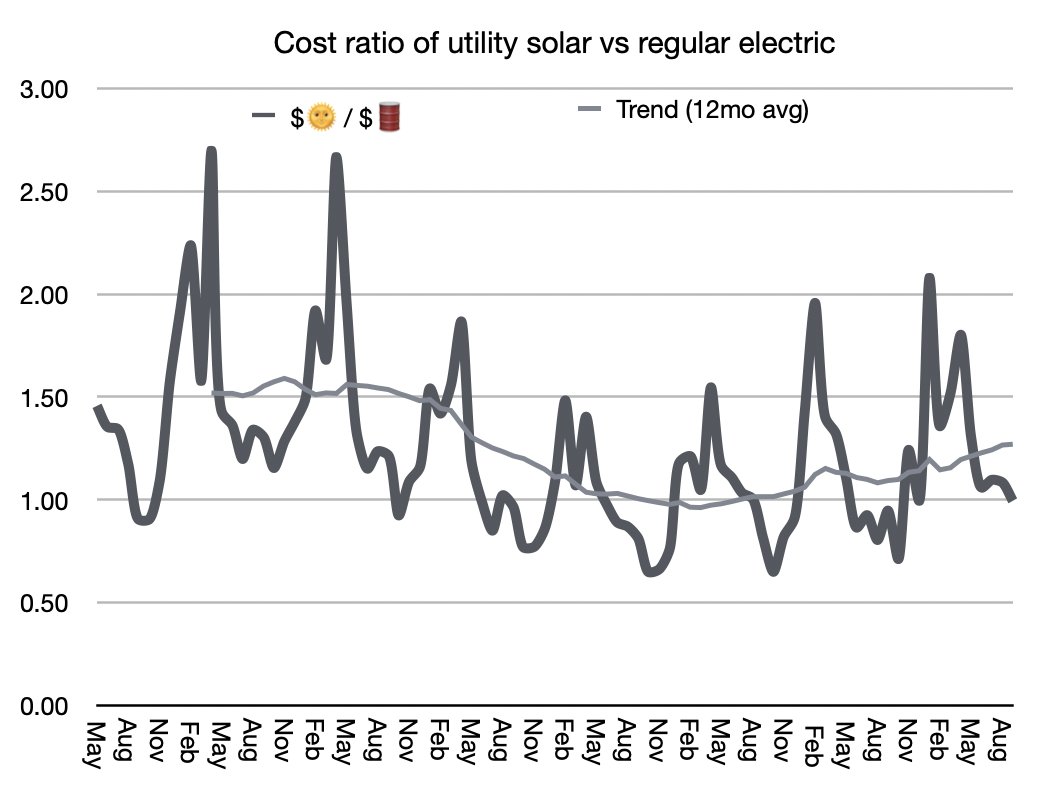
@AlexEpstein Is there a real graph we can use to show reality?
@AlexEpstein LFSCOE(-95) is not perfect, but it's a magnitude better than the ultra flawed LCOE. Perhaps that's what should replace it?
@AlexEpstein I wrote something similar here https://x.com/LoftusSteve/stat...
@AlexEpstein Exactly
@AlexEpstein @epaleezeldin, I hope you’re listening.
@AlexEpstein Lazard does show "Solar + BESS" option now - doesn't it solve the reliability issue?
@AlexEpstein Exactly
@AlexEpstein LCOE is indeed a garbage metric, but for a totally different reason: it uses a discount rate that's much too high, favouring fossil fuels.
@AlexEpstein You should stop posting you are clueless
@AlexEpstein @threadreaderapp unroll