
No Rare Earths = No Defense Sometimes, the smallest elements shape the world’s biggest powers. Thread 🧵
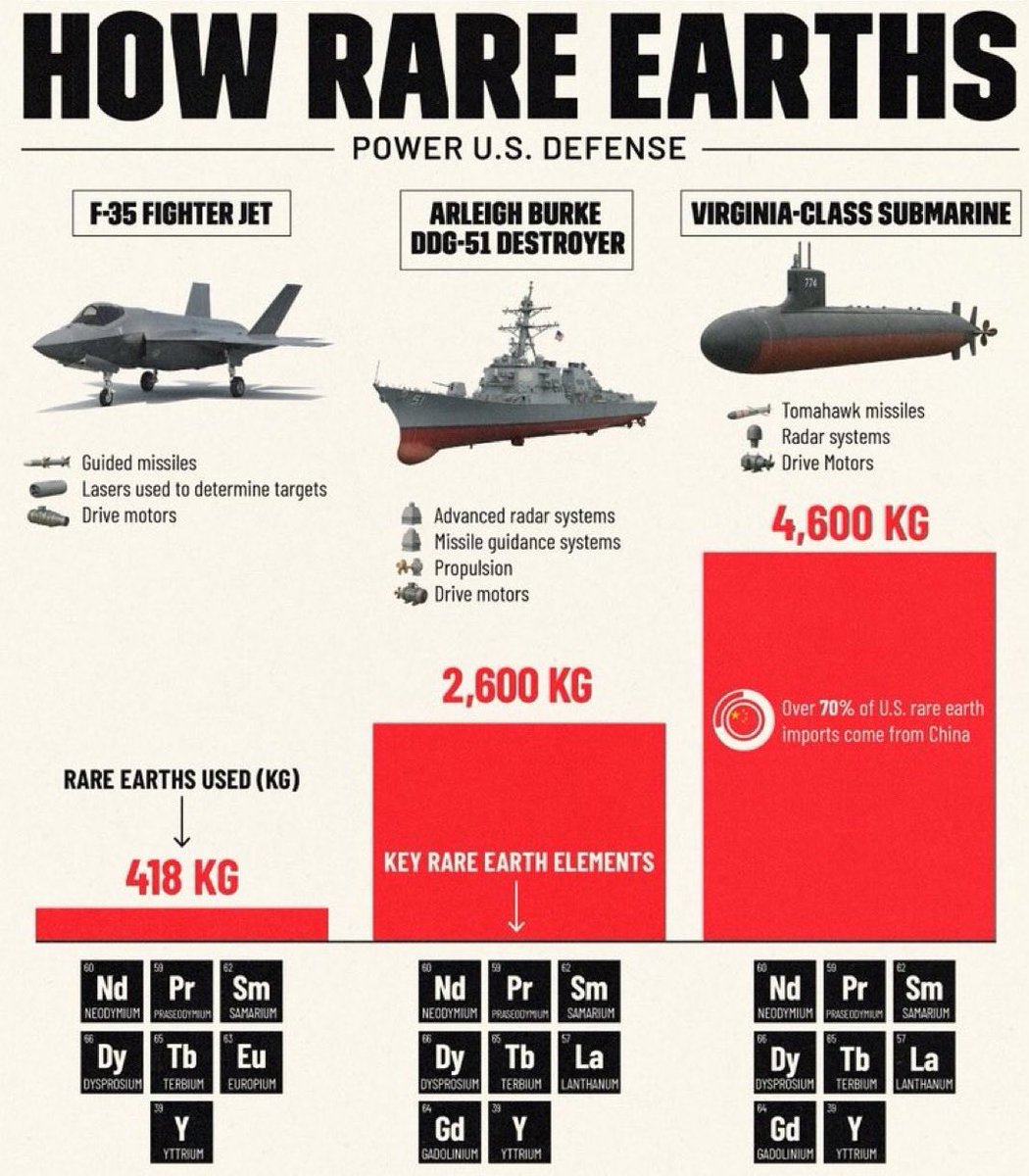
The entire U.S. defense architecture — from F-35 fighter jets to Arleigh Burke destroyers and Virginia-class nuclear submarines — depends on a handful of rare-earth elements that most people have never heard of.
Neodymium, praseodymium, samarium, dysprosium, terbium — they sound academic, but these are the lifeblood of radar systems, missile guidance, lasers, propulsion, and drive motors.
And here’s the uncomfortable truth — over 70% of the rare-earth materials used in U.S. defense systems come from China.
This dependence wasn’t created overnight. Decades ago, Western countries decided that mining and refining rare earths were too dirty, too polluting, and too politically inconvenient.
In the name of environmental responsibility, much of the extraction and processing was outsourced to China — which, at the time, seemed like a rational, even moral, choice.
But geopolitics has a long memory. While the U.S. and Europe moved toward service-led economies and ESG regulations, China saw an opportunity. It didn’t just mine rare earths — it built the entire supply chain around them: refining, magnet production, & component manufacturing.
Today, this control gives Beijing quiet but immense leverage over global defense and technology industries. The irony is sharp — the world’s most advanced defense systems rely on materials refined in the country they are meant to deter.
China’s dominance is not about luck; it’s the result of long-term strategic planning. Starting in the 1980s, Beijing identified rare earths as “the oil of the 21st century.”
It subsidized extraction, invested heavily in processing technology, and allowed the environmental costs to pile up domestically. Western democracies, meanwhile, congratulated themselves for being cleaner — without realizing they were becoming strategically weaker.
Now, West is scrambling to rebuild what it once abandoned. New refineries in Texas, Australia, & Canada are being fast-tracked.
Companies are exploring recycling and alternate sources like seabed mining. But rebuilding a supply chain that took China decades to perfect won’t happen overnight.
larger lesson is clear: environmental idealism without strategic foresight can turn into dependence. The green argument that outsourcing mining was “better for the planet” has aged poorly. It was never just about pollution — it was about convenience, cost, & short-term politics
Rare earths are not just materials — they are the foundation of national security, technology leadership, and geopolitical power. The world called it sustainability. China called it strategy.
Question: As the global energy transition accelerates — with new dependencies on lithium, cobalt, and nickel — is the world about to repeat the same rare-earth mistake all over again?
@IshanTanna1 IREL mines for key rare earth elements in India. But this is only for Indian defense and strategic purpose as cost of mining is way higher than China. Governments usually have 10 years of Samarium Cobalt supply with them.(High power, high temperature applications)
@vinaynagori5 Thank you
@IshanTanna1 That leaves only #nuclear weapons as a deterrent ! Not a good development for the world.
@Prakashukla Hmm.. yes
@IshanTanna1 GMDC
@Alpeshsheth15 Yes
@IshanTanna1 Owais metals
@IshanTanna1 No auto