
Quick little thread with my thoughts on Maro’s blog answer as a professional data analyst and former die-hard Magic fan: https://markrosewater.tumblr.c... #mtg
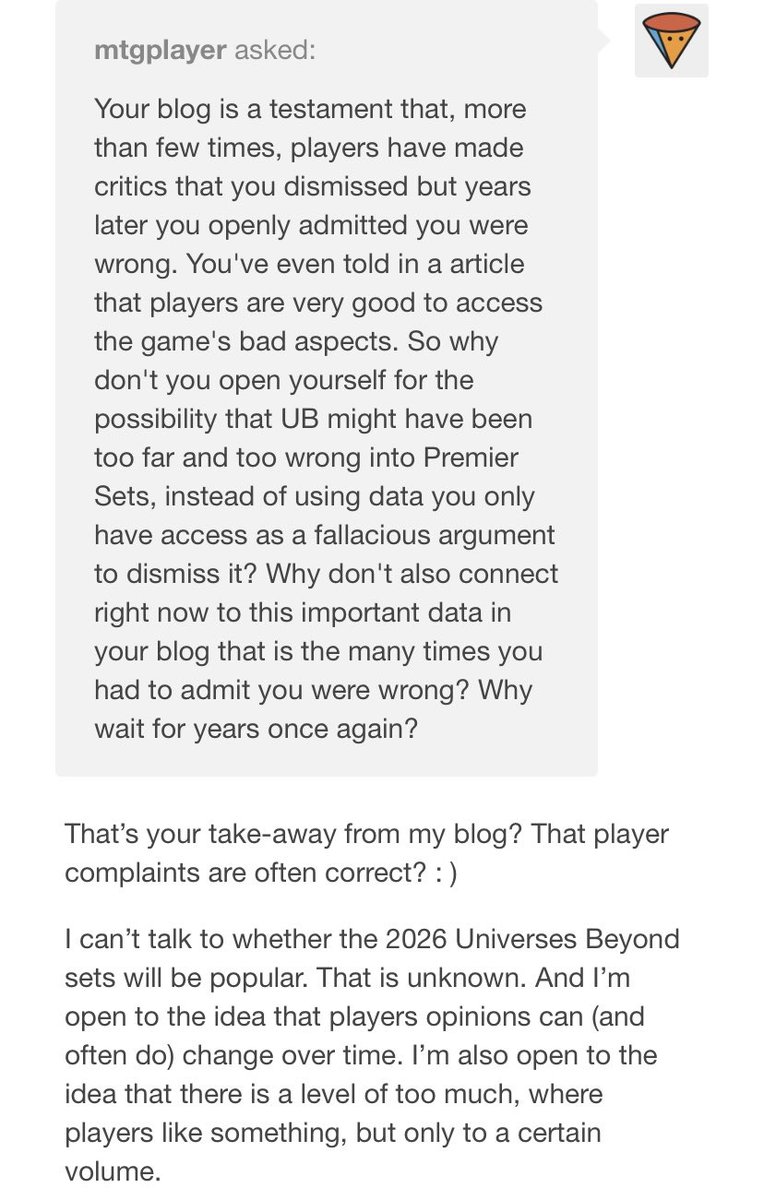


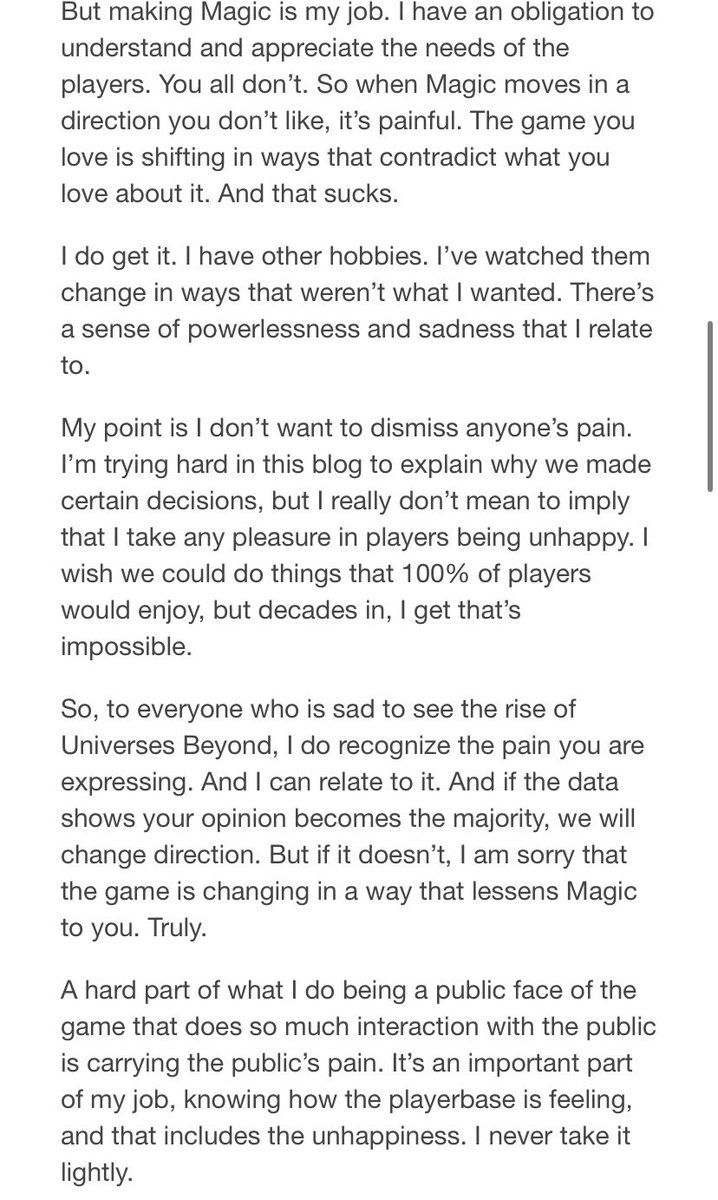
My day job is a business data analyst for an entertainment property. Not gaming, but professional sports - perhaps the only industry that where the decisions we make about our team matter to our fans as much as the decisions game developers make about their games.
Maro’s response on the use of data felt off to me, and I’ll explain my 3 reasons why. I’m optimistic that there are the data people within WotC who understand what I’m going to outline, and it’s just a communication issue going up the chain to leadership.
1. Maro claims a few times that the decisions are based on data. Great! However, in industries like ours, the data we are receiving now from our fans are in response to our decisions made 12-18 months ago. In this case, we HAVE to acknowledge that gap.
I’m not entirely sure what data is being used here (likely surveys and purchase activity), but best case scenario, this data is being collected about fan behavior in 2024 and 2025, which was in response to decisions made by Wizards in 2022 and 2023.
While Maro’s claim is that the data overwhelmingly supports UB, that data is based on UB as it existed internally in 22-23. Because of this long feedback loop, they use data about decisions they made 3 years ago to justify decisions made today (that fans won’t see until 26-27)
We face a similar problem in sports, where fan feedback about issues with the stadium and pricing and giveaways and merchandise can’t be fixed overnight and at minimum take a season to implement feedback. So, how do we accommodate for this feedback gap? That’s where #2 comes in
2) The best analysts know when they can fully lean into the data, and when they can storytell despite the data showing otherwise. Data storytelling is an art just as much as a science. When I put together a report, I can choose whichever points fit the story I’m trying to tell.
For instance, if we are trying to convince a stakeholder about whether or not a halftime show was good, we can say something like “survey satisfaction was up 12% this game for in-game entertainment”, but could also say “bathroom lines were 12% longer this halftime than average”.
Notice how each stat draws opposite conclusions - the first that was pro-halftime show (but not certain because there are other in-game elements that could increase the score) and the other is seemingly anti-halftime show (bc fewer fans cared enough about the show than usual)
When I want to convince an executive of something, I can intentionally choose to use data that supports my argument — whether or not it is valid. And this is why the argument of “we use data” is frustrating bc execs can claim “data-driven decisions” whether it’s good data or not.
I’m not saying that this so-called “data forcefeeding” is happening at Wizards, but it definitely helps justify their decisions to the board/presidents/etc that means budgets and promotions and raises whether or not that’s in the best interest of the future.
3) and that leads me to my last point — even if the data delays weren’t an issue and the data points in a clear direction, there are still times where we should not make decisions even if all the data says so. And these are often for the long-term health of the brand.
For instance, we know from data that demand for certain items we sell at stadiums (like food) are extremely inelastic — essentially they will continue to sell well no matter how they are priced. And yet, teams around the country have fan-friendly pricing (and even free sometimes)
Just because the data supports a raising the hot dog price another $2 doesn’t mean the company is forced to make a price increase - it is their choice to make when they weigh the benefits of the price increase with overall brand health and customer satisfaction.
In a similar way, Wizards is not forced to continue to make Universes Beyond because the data says that it’s good. It’s an active choice that is being made to appeal to that segment of the player base and to earn more money, despite (presumably) taking a reputation hit.
In conclusion, i think it’s kind of yucky to use “data” to justify UB decisions when the data has extremely long feedback loops, the data can be story-told to support any argument, and when the data may be in leading to long-term brand health impacts.
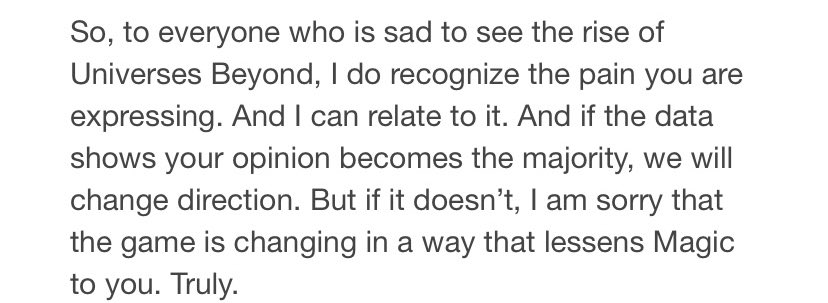
I’ll leave you with this — Maro claims that the decision-making will change at Wizards when anti-UB is the majority. Unfortuantely, by the time their data tells them that, it will be far too late to course correct. Good luck out there ✌️
@MaxPlaysMTG Really appreciate this thread!
@Chosler Thanks Corbin :)
@MaxPlaysMTG @fireshoes Thanks for the breakdown. Whenever “data” is used in business contexts I immediately think of Darrell Huff’s classic “How to Lie with Statistics” and Upton Sinclair’s “It is difficult to get a man to understand something when his salary depends upon his not understanding it.”
@MaxPlaysMTG This thread gives me a lot more concern after seeing that people who avoided Spider-Man were booted from the survey and unable to give the feedback that they didn't like it.
@MaxPlaysMTG I think this feedback loop is a major issue for the current schedule. Final Fantasy was preordered months in advance to levels never seen before and it may have looked like UB is an unstoppable win. Any decisions made between those preorders and Spider-Man are likely wrong.
@MaxPlaysMTG Nice thread. As a data/product person myself I think you did a great job laying it out.
@MaxPlaysMTG I mean, realistically speaking, they're constantly getting feedback, and that feedback still overwhelmingly supports UB, even after the announcements. You're right about the timeline for adjustments, but I feel there's a lot of implications in this thread that the data is wrong.
@MaxPlaysMTG in my mtg community everyone has switched (almost) to premodern. I estimate 20 players aged 30-40, for them it's not magic anymore. And it's not just about UB sets, but also about the incredible pace of new cards being released. They ruined their brand, "yesterday" already
@MaxPlaysMTG @BDEgameowners Please, everyone wallowing in Magic’s bloated corpse come play Flesh and Blood. I worked for CFB, have played Magic for almost 20 years. The game has been molested beyond recognition. @fabtcg is SO FUN! I know it feels like you will lose value and lose friends. You might. But it
@MaxPlaysMTG @fireshoes thank you for this post👌!
@MaxPlaysMTG You were incredibly clear. Thanks for the thread.
@MaxPlaysMTG Such a cool thread. I have some friends that say that taking decisions based on data is always correct, or actually that basing decisions on the vocal majority Is wrong, because people who happily consume the product don't voice their happiness, while Data collects from everyone
@MaxPlaysMTG I just assumed every time they referenced data, they strictly meant sales numbers and nothing more.
@MaxPlaysMTG At the end of the day, MaRo is an important figure at an extremely large company known to use NDA's and Non-disparagement clauses. What he says about the inner workings of the game is 100% regulated to an extraordinary degree, and possibly a solid chance it's scripted entirely.