
In Q2 results, TCS announced a $6-7 billion plan to build out 1-GW AI data-centre network across India. A landmark shift for Indian IT model. Let's decode why this matters 🧵

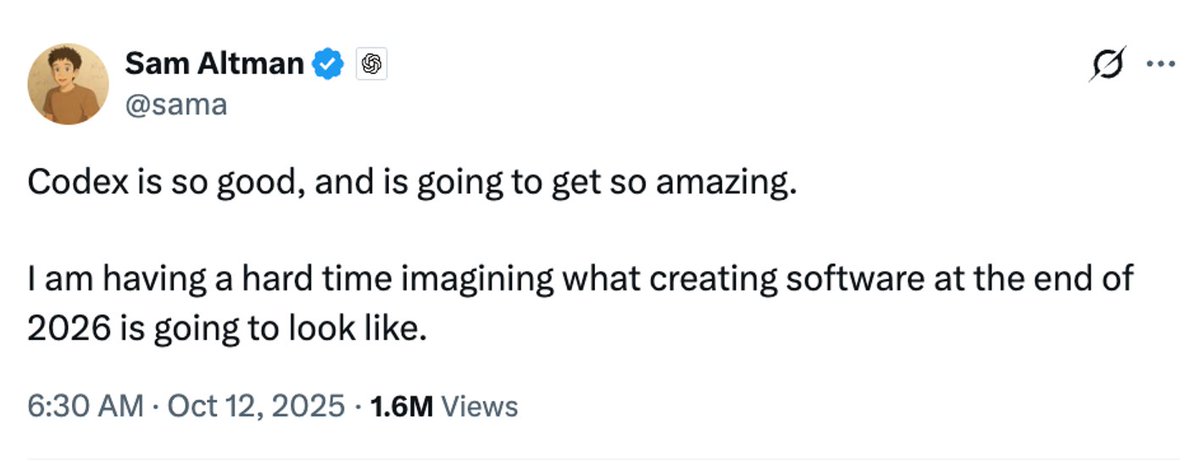
1/ Code to Compute - The Old Model is Breaking. AI disruption is happening fast. Here's what Sam Altman tweeted yesterday
2/ For decades, Indian IT ran on a simple, working formula: Win US projects > hire engineers > leverage cost arbitrage > Deliver application and integration services. Voila 50%+ ROCE! A win-win model and healthy 10-15% growth.
3/ Cut to now - Growth is hard to come and is down to low single digits. Marking TCS's move into DC. Skeptics call this a mismatch. IT services earn ~50 % ROCE; DCs yield 12-15 %. This move shifts TCS from short-cycle, human-hour revenue to long-cycle, yield-driven annuities.
4/ Returns are lower than IT services, but the assets endure longer and anchor growing AI compute demand. A hedge for the future.
5/ The risk: AI tools can already automate 40–45% of coding and maintenance work. That puts 10–13% of IT-services revenue at risk for companies still built purely on manpower.

6/ Globally, the market is rewarding companies that build AI infrastructure, not just provide services. Microsoft, Amazon, and Nvidia have seen their valuations soar thanks to heavy investments in AI hardware and compute. TCS is aligning itself with the new value chain.

7/ TCS will follow a co-location model. This means: ▪️ TCS builds the physical shell: The land and building, connectivity, power, and cooling. ▪️ Clients (like Google, Amazon, or big AI startups) rent the space and bring their own servers. Economics of DC models:

8/ The Untapped DC Opportunity in India. → India generates ~20% of the world's data. → But it has only 3% of the world's data center capacity. This massive gap combined with the Government’s push for Data localisation means a big opportunity in DCs.


9/ And it’s happening just as India’s data explosion hits new highs. 📡 Rising 5G Usage 📱 Streaming and cloud boom 🤖 AI and connected devices India’s data consumption has grown 30x since FY17, and it’s fueling massive demand for data centres.

10/ India’s total Co-location Data Center capacity should rise from 1.7 GW to 8 GW by 2030 — a $30 Billion capex and $8 Billion annual revenue opportunity.
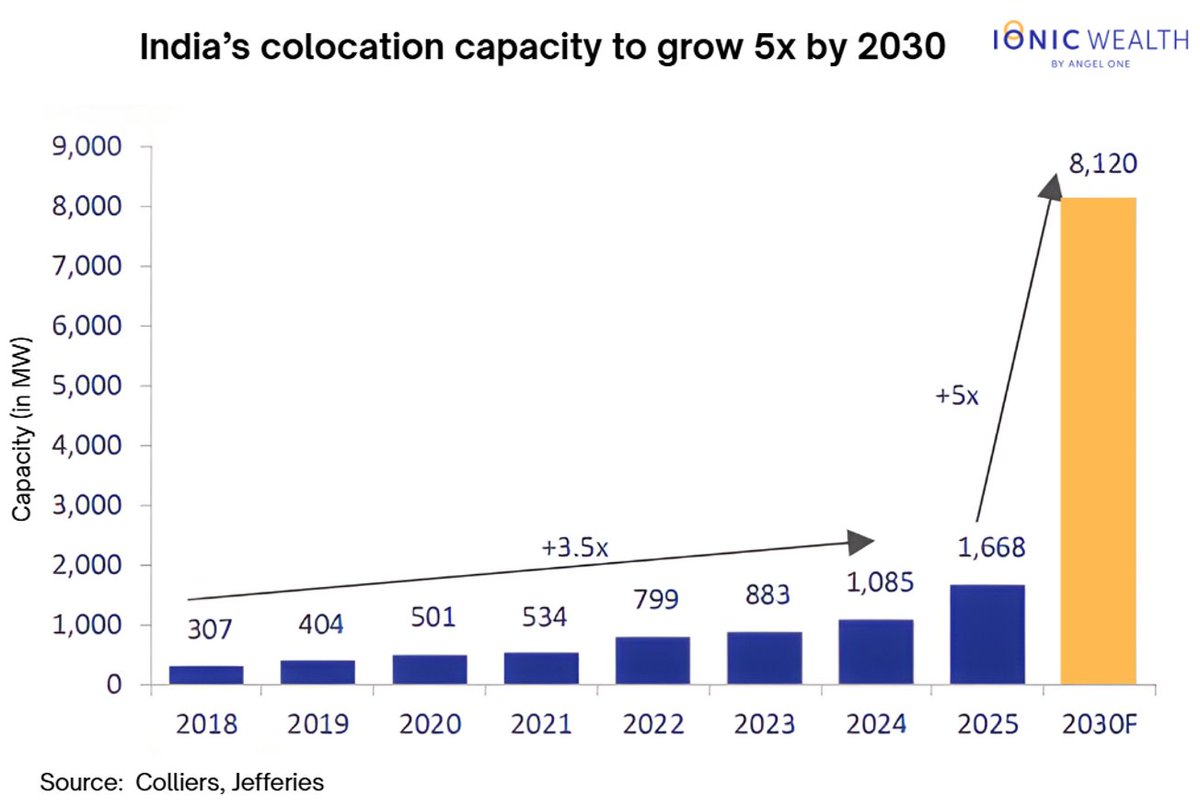
11/ TCS’s 1 GW plan represents roughly one-eighth of that build-out. Peers are adding smaller 100-300 MW capacity. The scale of TCS's ambition can be a competitive advantage as India moves towards data localisation.

12/ It is significantly cheaper to build data centers in India. Lower land, labour, and power costs make India a natural hub for global AI infrastructure.

13/ Data Centers are set to become critical engines of India's growth. Last week, Google announced $10 Billion data center clusters in Vizag, making it their largest in Asia. Also the largest FDI announcement for India in last 3 years.

14/ Policy tailwinds are kicking in. ✅ RBI’s data localisation rules ✅ MeitY’s Data Centre Policy ✅ The India AI Mission ✅ Tax Holidays Together, they’re turning data infrastructure into a national priority, one backed by capital and conviction.

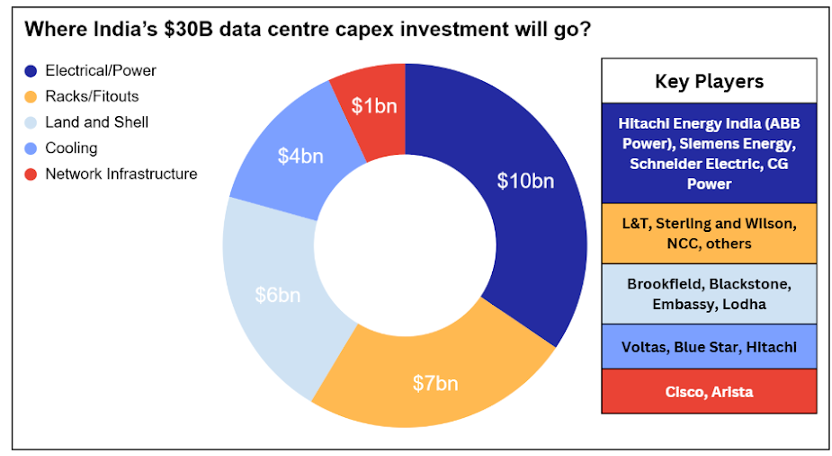
15/ The oncoming data center boom in India is also expected to create proxy downstream winners. Refererence: Architecture of a Data Center. How India's $30 Billion Data Center capex will be apportioned.

16/ Summary: 🔸 TCS's $7 Bn (~Rs 50K crore) 1GW DC capex plan in phases of 150 MW buildouts. 🔸 An optionality and a hedge - Lower ROCEs, but higher growth security This isn't just another project for TCS. It's a defining pivot. A new chapter for Indian IT has officially begun.
17/17 Follow us @ionicwealth and consider sharing it with your network. /End https://x.com/ionicwealth/stat...
@ionicwealth @threadreaderapp unroll
@ionicwealth TCS just made 'AI backbone' the hottest thing in the Indian IT playbook. Watching global giants sweat a little now-this is my kind of tech drama.