
Dr. Rhonda Patrick and Dr. Peter Attia just set the record straight on protein recommendations. It's the best synopsis of "why you should hedge against more protein versus less" that I've heard. My recap 🧵👇
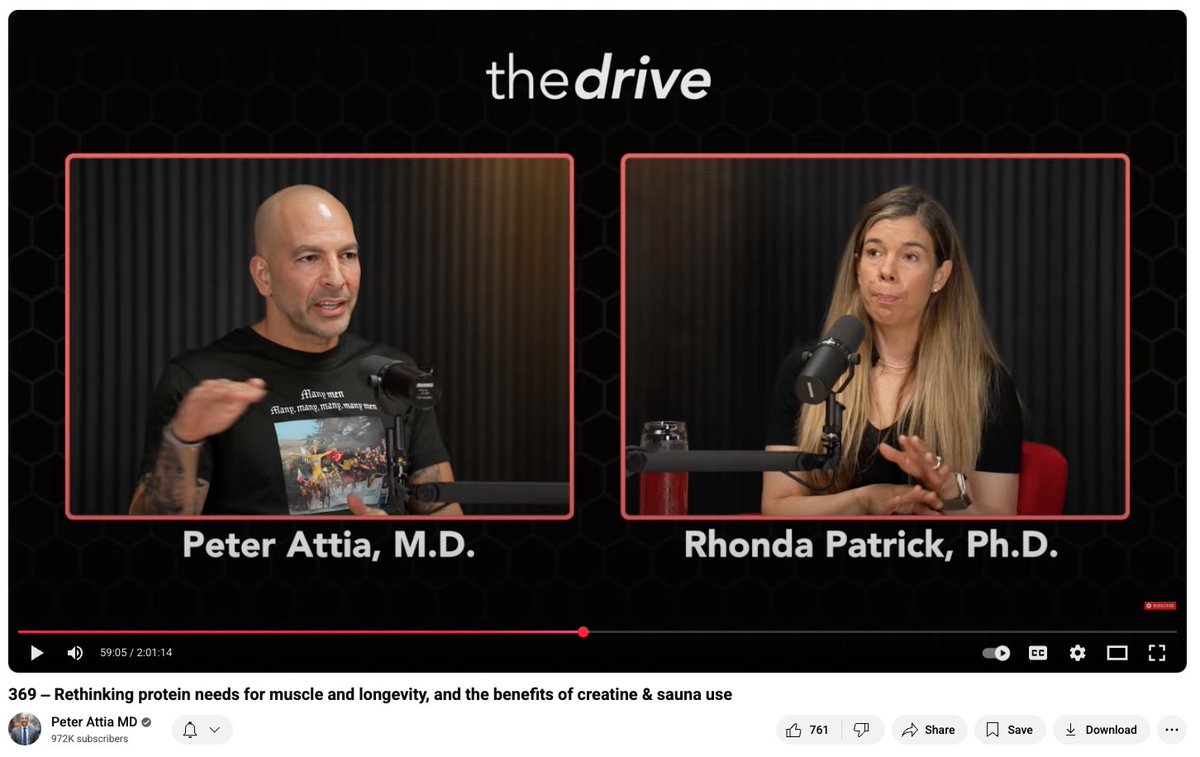
1. The RDA isn’t optimal. It’s the floor, (and it’s too low) The 0.8 g/kg/day recommendation was based on nitrogen balance studies—basically, how much nitrogen you eat versus how much you pee out. It’s a crude, outdated method that doesn’t account for nitrogen lost through skin,
2. Muscle is your amino acid bank account. Don’t drain it You can store carbs as glycogen and fat as, well, fat—but you can’t store amino acids. Your only real “reservoir” is your skeletal muscle, which gets broken down if you’re not eating enough protein. That’s a problem
3. Aging and inactivity cause “anabolic resistance," but protein fixes that As we age, or when we’re inactive for long periods (think sitting, bed rest, travel), the body becomes less responsive to amino acids. You need a higher dose to get the same muscle-building signal
4. The sweet spot? Around 1.6 g/kg/day Meta-analyses looking at people who lift show clear gains in lean mass and strength when total protein intake climbs up to about 1.6 g/kg/day. Beyond that, you still get small benefits, but the curve flattens out—though going higher
5. High protein isn’t dangerous. The data just doesn’t show it Multiple trials have looked at intakes above 2 g/kg/day and found no adverse effects on kidney or bone health. The confusion comes from people misreading creatinine levels, which naturally rise with higher protein or
6). The mTOR and cancer worries are way overblown Yes, leucine and mechanical tension from training activate mTOR, but that’s the point—mTOR in muscle is what drives repair and growth. The “mTOR equals cancer” fear came mostly from mouse studies where mTOR was cranked up
7. Practical takeaway: aim for 2.0, land around 1.6 You don’t need to hit your protein target perfectly every day. But if you aim for about 2.0 g/kg/day, your “off” days will still end up in that 1.6 range, which is where all the benefits kick in. A few easy heuristics: - Use
@B_Holmer I don't think either of them are leaders in the longevity field - despite being smart voices worth listening to and considering. It's telling that those doing the actual research like Barzilai and Longo do not agree with this conclusion about protein, at all. And in fact, warn
@reallyoptimized I don’t think either claim to be “longevity experts.” But Longo, Barzilai, et al., while fantastic researchers, don’t have research that (imo) applies to human longevity. Worms, flies, and mice living longer on protein-restricted diets isn’t analogous to the complexity of human
@B_Holmer I´m guessing you're aiming for that 2g/kg. Mostly animal or mostly vegetable protein? Protein powder supplementation?
@popeyecubs68 Yeah 1 gram per lb. Mix of plant and animal and protein powder not too often. A bar or two per day to help.
@B_Holmer What do you think of Siim Land's take that high methionine consumption can cause problems by raising homocysteine unless it's balanced with glycine?
@toby9638 I have no thoughts on the matter.
@B_Holmer I haven't listened to this podcast as yet but this looks like a great synopsis. The interesting thing is though, if I am are exercising and moving A LOT, it is very easy to hit the 1.6 (sometimes 2gram) recommendation (without trying too hard) or using protein supplements
@JenBuckleyW I totally agree. I will easily surpass 1 g of protein per pound of body weight and I can get there eating regular foods and no protein supplements. So I will do a protein bar or a protein shake most days of the week.
@B_Holmer Great summery Brady, thank you!
@B_Holmer Love this! Thanks for breaking down and distilling!
@B_Holmer No convincing studies showing excess protein is bad. Ok. But are there any studies to suggest more protein is going to make you healthier? No just the same ol’ speculations with no hard evidence to back it up. Listen to nutrition scientists. Not Internet personalities.
@B_Holmer One thing that isn't mentioned enough is that evidence based protein intake recommendations mostly refer to Lean Body Mass. I know you mentioned it for overweight, but even for people between 10-15% body fat, it can be relieving to know that you don't need as much as expected.
@B_Holmer Thanks for the summary
@B_Holmer @PeterAttiaMD where do I get my hands on that shirt?!?