
'Misnaming things only adds to the misery of the world,' this sentence was written by Albert Camus. This is what I had in mind when I was reading the commentary about the repo market this week. 'Bankruptcy,' 'Failure,' 'Crisis... None is accurate. Let's have a repo review : 1/N

The spike in repo rates significantly above the Interest on Reserve Balances (IORB)—averaging 15 basis points (BP) higher—was largely a product of two simultaneous, cash-draining events: Money Market Fund (MMF) behavior and Treasury settlement mechanics.

The Treasury's recent, substantial issuance of new bills created a highly attractive investment opportunity. The MMF’s -major suppliers of cash to the repo market—redirected a significant portion of their available cash to purchase these newly issued, short-term Treasury bills.
This massive demand for the bills resulted in a huge outflow of cash from the MMFs. By using their cash to buy bills, MMFs effectively reduced the supply of cash available for lending in the repo market
When cash supply shrinks, the demand for overnight refinancing remains stable or increases, the fundamental supply vs. demand dynamic dictates that the price of that cash (the repo rate) must rise,
The timing of the rate spike coincided with the settlement date for these newly issued Treasury bills + coupons, which compounded the cash scarcity. Largely because "safe money" is attracted on bills, and banks (both domestic and foreigns) are now marginal lenders on repo.
This large, scheduled transfer of reserves from banks to the Treasury's account at the Fed (the Treasury General Account or TGA) causes a net tightening of cash supply AVAILABLE (not on a absolute basis) across the financial system.
These two features converged on a banking system already constrained by post-2008 regulatory requirements, specifically related to capital and liquidity, moreover, the market financing demand is structurally higher due to the net positions of dealers.
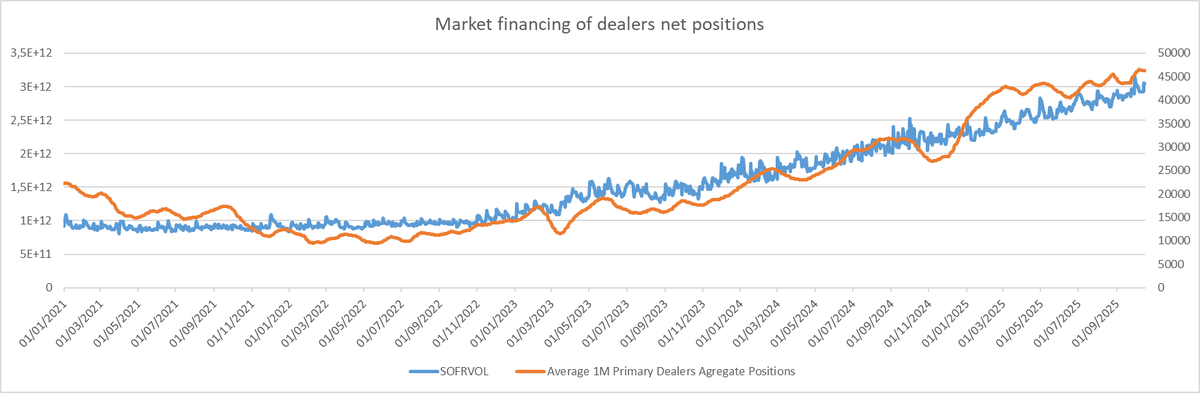
Regulatory requirements limit how much cash-for-collateral intermediation banks can profitably and safely conduct. Banks are hesitant to rapidly expand their balance sheets to accept the lending, and will do it if the opportunity is juicy (spreads with IORB)

This resulted in a scenario where there was: A high collateral demand (dealers refinancing demand). A sudden reduction in cash supply (due to MMF purchases and settlement outflow + TGA rebuilt). A lack of intermediation capacity (banks were unable or unwilling to match the two).

The result was a sudden, acute spike in repo rates, which the Federal Reserve had to address by injecting reserves through temporary open market operations.
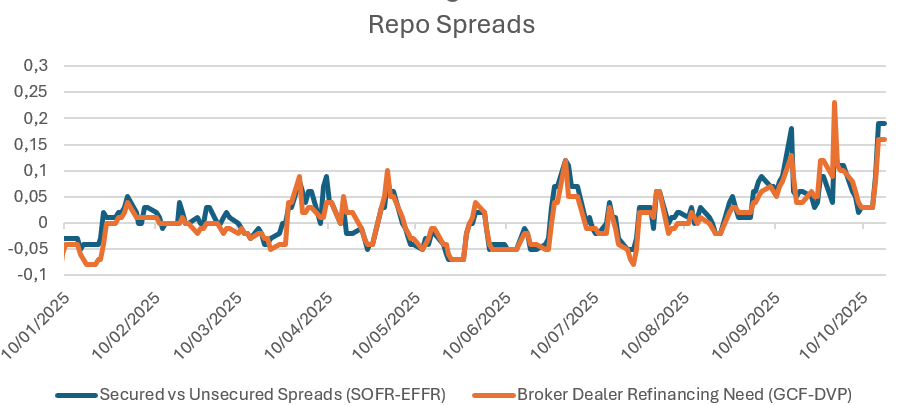
The sudden spike certainly raised a lot of alerts. For two days, everyone became very attentive to the repo market, a market usually considered quite 'boring,' which suddenly became very dynamic for a short time.
People were used to smooth funding conditions because of the huge excess liquidity that remained post-COVID. But now that the RRP is empty (representing the bulk of that excess liquidity), the Fed no longer has any safety buffer to hide the true financing conditions

As soon as the RRP was not a buffer anymore, the first reaction took place on the fed funds market (IMO), that I have already covered last week, but I will emphasize it through another lens, the one of “safety buffer” :
"Two mechanisms regarding the Federal Funds (FF) market must be known. The first is that it’s a 'dead market,' very weak in terms of volume, because over 90% of interbank transactions are secured (collateralized), while FF is unsecured.
The market primarily functions thanks to foreign banks' arbitrage. When the Secured Overnight Financing Rate (SOFR) sees attractive rates, cash will be pulled toward the repo market, and FF volumes will decline consequently.
This activity forces the Effective Federal Funds Rate (EFFR) up, which narrows the crucial FF-IORB spread (the most-watched gauge by Fed policymakers). This is precisely what happened. We can thus imagine that foreign banks' cash is a second safety buffer that was activated
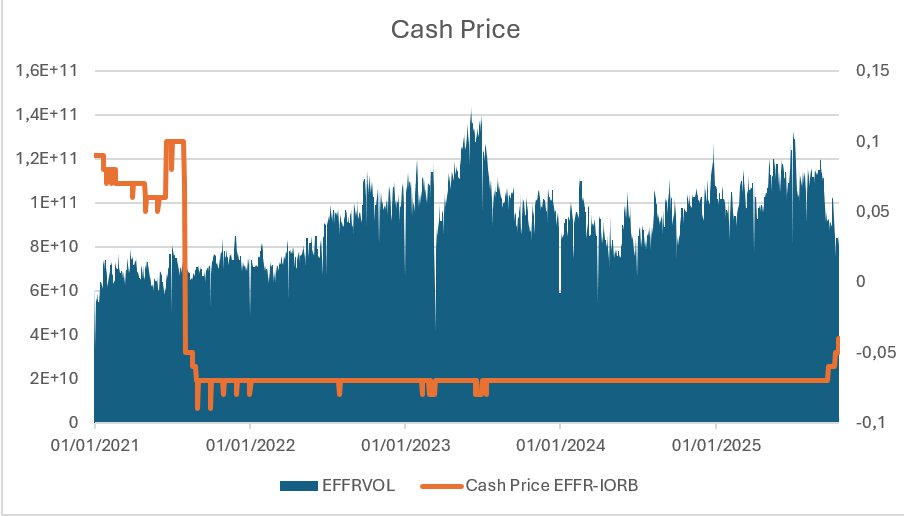
The second mechanism occurs when a bank needs refinancing in the tri-party repo market. They may ask BNY Mellon (the third-party agent) to borrow for them in the federal funds market, which also raises the FF rate.
This is a potential, though less plausible, explanation of what occurred. One thing is certain: every potential pocket of liquidity has been attracted by the repo market. So, is there a real problem? To answer this qst, we must first recall what Lorie Logan declared in August:
'We could see some temporary pressure around the tax date and quarter-end in September. I was encouraged to see market participants using the SRF over the June quarter-end, and I anticipate they will similarly use our ceiling tools, if necessary, in September.
That will allow us to continue gradually bringing reserves to a more efficient level with market rates close to, but perhaps slightly below, interest on reserves on average over time.' This quote was brillantly recalled by @NickTimiraos
Indeed, if you are looking at the Standing Repo Facility (SRF) usage, you might be led to think, 'Okay, there is a real issue here!'" The low volume and short duration of the Fed's repo operation strongly suggests the liquidity pressure was transient rather than structural.

The pressure likely stemmed from specific, predictable events like quarter-end bank balance sheet window dressing, or large Treasury settlements, which cause a momentary misalignment of cash S&D. The immediate return to normal funding rates confirms the quick resolution.
The Standing Repo Facility (SRF) successfully acted as a rate ceiling/safety valve. Its very existence and use prevent a temporary technical issue from spiraling into a systemic crisis by assuring counterparties that cash is always available at a known rate.
Let’s recall an important thing, SOFR is a transaction-based rate that is naturally volatile, especially around reporting dates. Its spikes are a feature, not a bug, in the current liquidity environment. It is a barometer that is gauging liquidity conditions into the repo
The Fed is deliberately continuing QT while using the SRF to manage the consequencesof falling reserves. Back in September 2019, the Fed had no SRF, reserves fell too far, rates spiked violently, and the Fed was forced to make an emergency and politically costly shift.
Whereas in October 2025, as Lorie Logan confirmed, the Fed wants to bring reserves to an "efficient level" through QT. The SRF acts as a control buffer, allowing the Fed to drain reserves without losing control of the overnight rate
The goal is for the SRF to absorb temporary pressure, allowing QT to continue its gradual course, which is allowing the SOFR to spike when there is a pressure. That is leading us to the second point, the interbank system stress, a story or a reality ?
This chart has been shared by the account @deerpointmacro (an excellent analyst whose publishing a newsletter. I really suggest to follow it for everyone interested in finance and economics).

@deerpointmacro This picture shows a sum of FED facilities and the FRA-OIS spread, a very important barometer of credit risk into the banking system. It didn't react significantly to the so-called funding stress that we have seen this week.
@deerpointmacro Let's analyze the other barometers, like Swap Spreads, an interesting indicator of balance sheet constraints by maturity: The 2Y and 5Y spreads are important to watch, as they are most sensitive to shorter-term funding and balance sheet pressures on primary dealers
