
5 South American countries just discovered they're wasting $15-23 billion on duplicate renewable energy infrastructure. A new paper examines the solution:
A new study in Nature Communications examines Argentina, Brazil, Chile, Paraguay, and Uruguay's electricity systems through 2050:
The researchers ran 80 different scenarios testing: • Full vs limited regional coordination • 90% emissions cuts vs no climate policy • Different wind turbine types • Solar tracking technologies They used an open-source model called GridPath to optimise both generation and
Key finding: Deep decarbonisation (90% emissions cut) only increases electricity costs by 5-18%. But, they found that regional coordination massively reduces this burden.

Without coordination, countries massively overbuild renewable capacity. The extra generation costs were $14.7-22.8 billion. However, the cost of just expanding transmission lines instead was $3.5-7.0 billion. That's triple the savings through coordination...
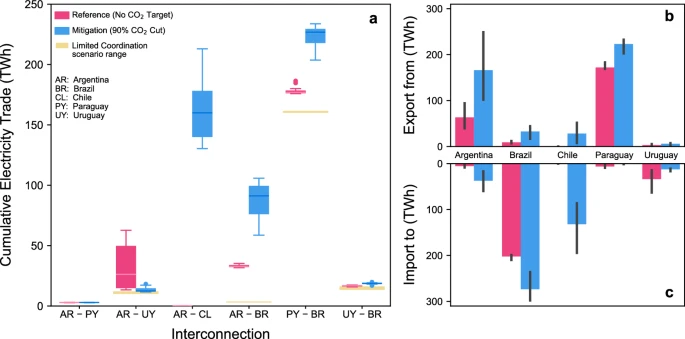
The model reveals fascinating trade dynamics: • Argentina and Paraguay become net electricity exporters • Brazil increasingly relies on imports despite its size • Chile exports solar during the day, imports wind at night Total trade increases substantially under
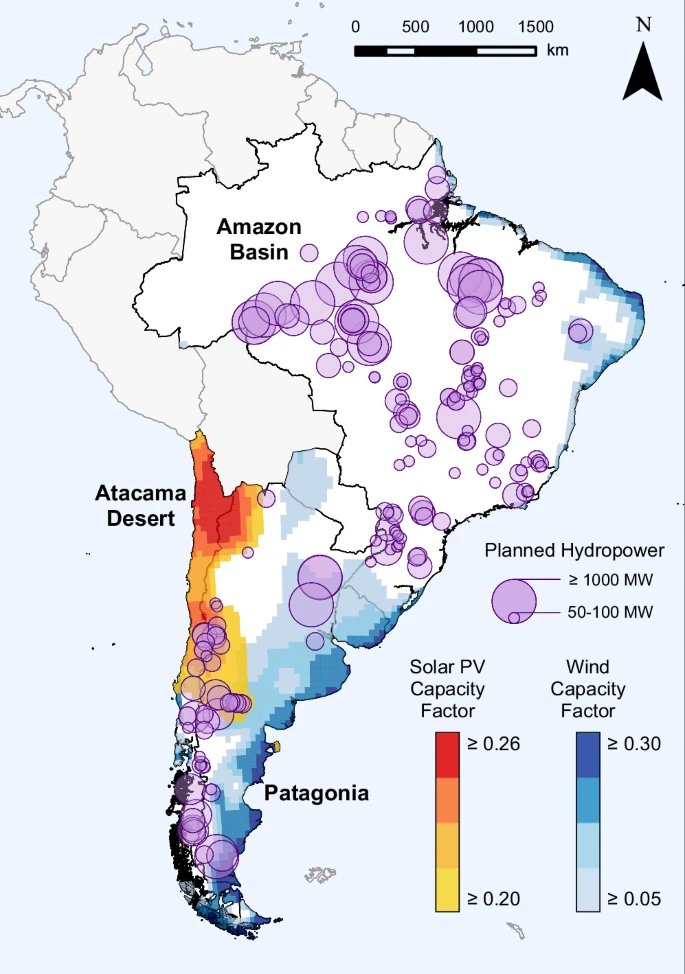
Why does coordination work so well? Different countries have complementary resources: • Chile: Exceptional solar in the Atacama • Argentina: World-class wind in Patagonia • Paraguay: Abundant hydropower • Brazil: Diverse resources but huge demand
Coordination also helps manage renewable intermittency. When Chile's solar drops at night, it imports Argentine wind. When wind is low, hydropower from Paraguay fills gaps. This reduces the need for expensive battery storage and prevents curtailment.
But there's complexity here. Net exporters (Argentina, Paraguay) need more generation capacity, increasing their costs. However, they'd gain revenue from exports and attract infrastructure investment. Individual country outcomes vary even as the region benefits overall.
There's also an uncertainty angle. Under strict climate targets, the flexibility of a coordinated grid actually increases uncertainty about which specific technologies each country will deploy. But this flexibility is precisely what makes the system more resilient.
The bottom line: Regional electricity coordination offers a pathway to affordable decarbonisation. The Mercosur region could achieve 90% emissions cuts whilst saving billions through shared infrastructure. The challenge, as always, is political will and institutional
Interested in getting a short overview of the latest geospatial papers and datasets each week? Subscribe to the Spatial Edge newsletter: http://yohan.so

@yohaniddawela Very interesting! I’m wary of these countries being able to work together, but maybe Itaipu is an example that it’s possible.
@yohaniddawela Great thread 🙏
@yohaniddawela @grok explica fácil
@yohaniddawela Did you consider the geography? And the historical geopolitical differences ... at least among Argentina - Chile - Peru?

@yohaniddawela New [military industrial complex reason for destabilizing Latinamerica] has appeared.
@yohaniddawela Pura mierda.
@yohaniddawela Minimal environmental footprint, super compact, adjustable and steady output.

@yohaniddawela Stop agenda 2030!! We will not pay more just because the burocrats from Europistan wants.. Get out of Argentina!! We produce oil and gas!