
I am on the #EconJobMarket ! My JMP evaluates what happened to these workers⏬ This is a coal mine in Belgium 🇧🇪 in 1907. They are working more than 10 hours per day. Then, the government imposed a maximum 9h workday. What happens to wages and employment? A JMP🧶(1/12)

This question of the wage and employment effects of working time reductions is not new. Yet, there is no consensus in the literature: some papers find positive effects but others find negative effects. (2/12)
There are 2 advantages that my paper has compared to previous papers: 1⃣ It is the one of the first labor regulations: no confounding minimum wage, income tax ... 2⃣ The policy only applied to underground but not aboveground coal workers. Identifying variation! (3/12)
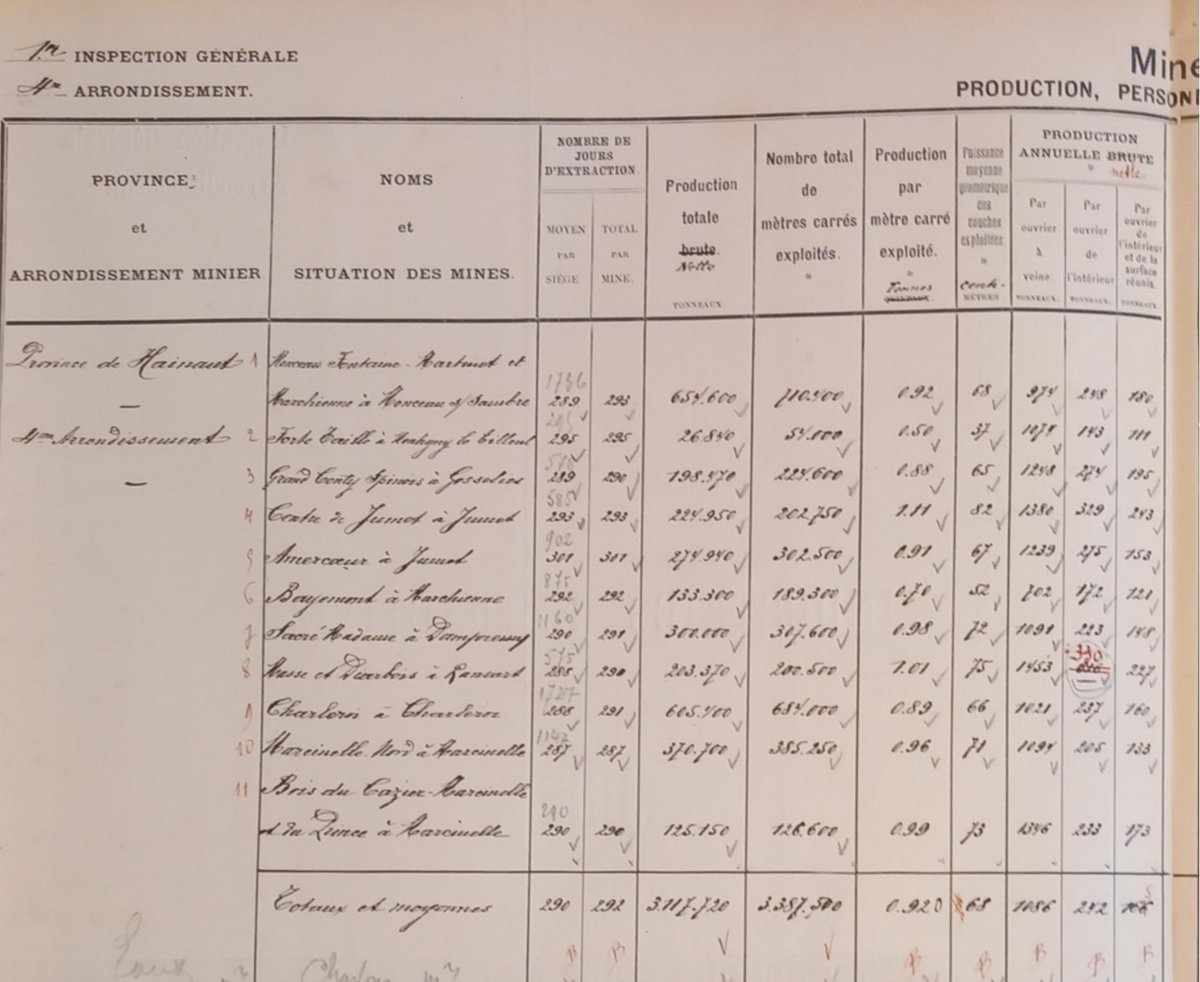
I collected archival data from the Administration of Mines 📜 I have a panel data of the universe for employment and wages per occupation within firms. Here is a picture I took ⏬ I also have a cross-section of hours worked per occupation before the reform. (4/12)
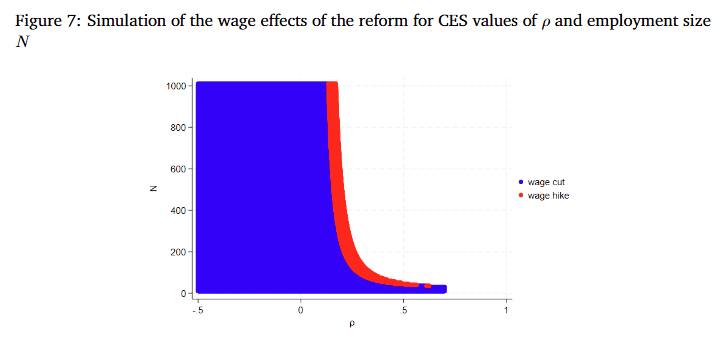
🚩Main results🚩 On average, hourly wages and employment increased. But these effects are completely different depending on firm size! Small firms: 0 employment effect, negative hourly wage effect Large firms: positive effects on hourly wages and employment (5/12)
Then, which model can rationalize this? Let's start by rejecting some models. ❌workers choosing hours. Look at the picture above! ❌competitive wages is inconsistent with wage cuts ❌production input = (jobs x hours) cannot lead to size-dependent effects (6/12)
But then ... what can explain these results? I build a directed search model where ✅Firms choose hours internalizing workers' leisure preferences ✅Firms may have monopsony power ✅Elasticity of substitution between jobs and hours (7/12)
Theorem: wage effects of working time reductions depend on 1- Monopsony power Nice! Rubens & @V_Delabastita quantified it in 🇧🇪 1900s coal mines 2- How the marginal product of jobs varies with hours. 2nd derivatives! CES on jobs & hours rationalize results if ρ>0 (8/12)
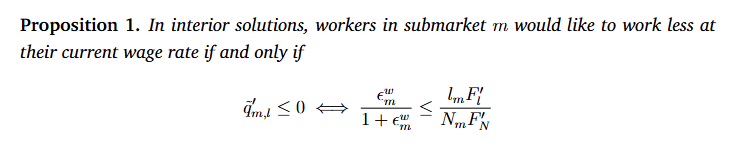
Another cool theorem is: when are workers asking to work less? It is more likely when 1⃣ Monopsony power is large (LHS is small) 2⃣ Marginal product of hours dominates the one of jobs (RHS large) This holds for any monopsony power, technology, preferences. (9/12)
Finally, the paper computes welfare effects with sufficient statistics. It seems that the 1910 🇧🇪 reform improved workers' welfare: positive effects on leisure & employment > (small) negative effect on earnings. Now, for policy today: should we further cap hours? (10/12)
2 policy recommendations: 1⃣ Although monopsony leads to long hours, cutting hours may lead firms to cut wage. So it can backfire! 2⃣ If jobs and hours are production complements, cutting hours will be bad for workers. May be true for some firms? (11/12)
Thanks for reading this thread #EconTwitter . TL;DR : a paper that explains the determination of hours, wages and employment depending on - technology -preferences -labor market power - firm size More about it here [updated frequently] : https://antoine-germain.github... (12/12)
@threadreaderapp unroll
@ant1germain Nice stuff! Can you observe what happens to firm profits?
@pontus_rendahl Good question. I actually observe profits in my data. But I can't isolate any effect: confidence intervals are huge. This most likely comes from the high variance of profits: they sometimes go +200% and - 300% from year to year even within a firm...
@ant1germain Great work and great storytelling, well done and best wishes for the JM!
@ant1germain Very cool paper!
@ant1germain Very interesting! Having grown up in Charleroi, I look forward to reading your paper! And of course I encourage you to apply to Cornell! We have a great labor group :-)
@ant1germain This looks super cool!
@ant1germain Good luck, Antoine!
@ant1germain Really cool JMP! Hope that it lands you a great job.
@ant1germain Nice work, indeed.
@ant1germain very interesting. Good luck.
@ant1germain really nice work!
@ant1germain So cool, best of luck in the JM
@ant1germain Extremely interesting work!
@ant1germain Nice work. Good luck on the job market.
@ant1germain What happens if you don't regulate wages and hours but you do regulate how many people can fit in an elevator?
@ant1germain Why are the Belgian women wearing hijab in this photo?