
1/ What causes us to age — and can science slow it down? Let’s explore the mainstream theories of aging — from evolution’s trade-offs to molecular hallmarks and the new “geroscience” revolution.

2/ Aging has two layers: (A) Evolutionary theories explain why aging exists. (B) Mechanistic hallmarks explain how tissues fail. The geroscience goal? Target shared mechanisms to extend healthspan, not just lifespan.
3/ Evolution’s “why”: • Mutation accumulation (Medawar) • Antagonistic pleiotropy (Williams) • Disposable soma — trade-offs between reproduction & maintenance (Kirkwood) Not competing theories — but complementary lenses on aging.

4/ The Hallmarks of Aging (López-Otín et al.) remain the central framework: 2013 — 9 core hallmarks. 2023 — expanded to 12, adding autophagy decline, chronic inflammation & dysbiosis. They explain how cells and systems fail.

5/ Genome & Telomeres: DNA damage accumulates, telomeres shorten, and cells lose their capacity to divide. Telomere biology connects stress, inflammation & aging — linking molecular wear to systemic health.

6/ Epigenetic Alterations: DNA-methylation “epigenetic clocks” can predict biological age. They’re among our most powerful biomarkers — but the causal story is still unfolding.
7/ Proteostasis & Autophagy: As we age, the cell’s cleanup systems falter. Misfolded proteins accumulate; chaperones and autophagy weaken. Supporting these systems may delay age-related pathology.

8/ Mitochondria & ROS: Free-radical theory has evolved — literally. Mitochondrial ROS act as signaling molecules. Too much or too little is harmful; context is everything.

9/ Cellular Senescence & SASP: Aged cells don’t just stop dividing — they signal. Their secretions (SASP) fuel inflammation and tissue damage. Clearing them (senolytics) is a frontier of geroscience.
10/ Nutrient Sensing & mTOR: Insulin/IGF-1–mTOR pathways link nutrients to growth and aging. mTOR inhibition (e.g., rapamycin) extends lifespan in mammals — proof that aging is modifiable biology.

11/ Dysbiosis Gut microbiome shifts reshape immunity, metabolism & inflammation. This “new hallmark” bridges aging biology with diet and lifestyle.
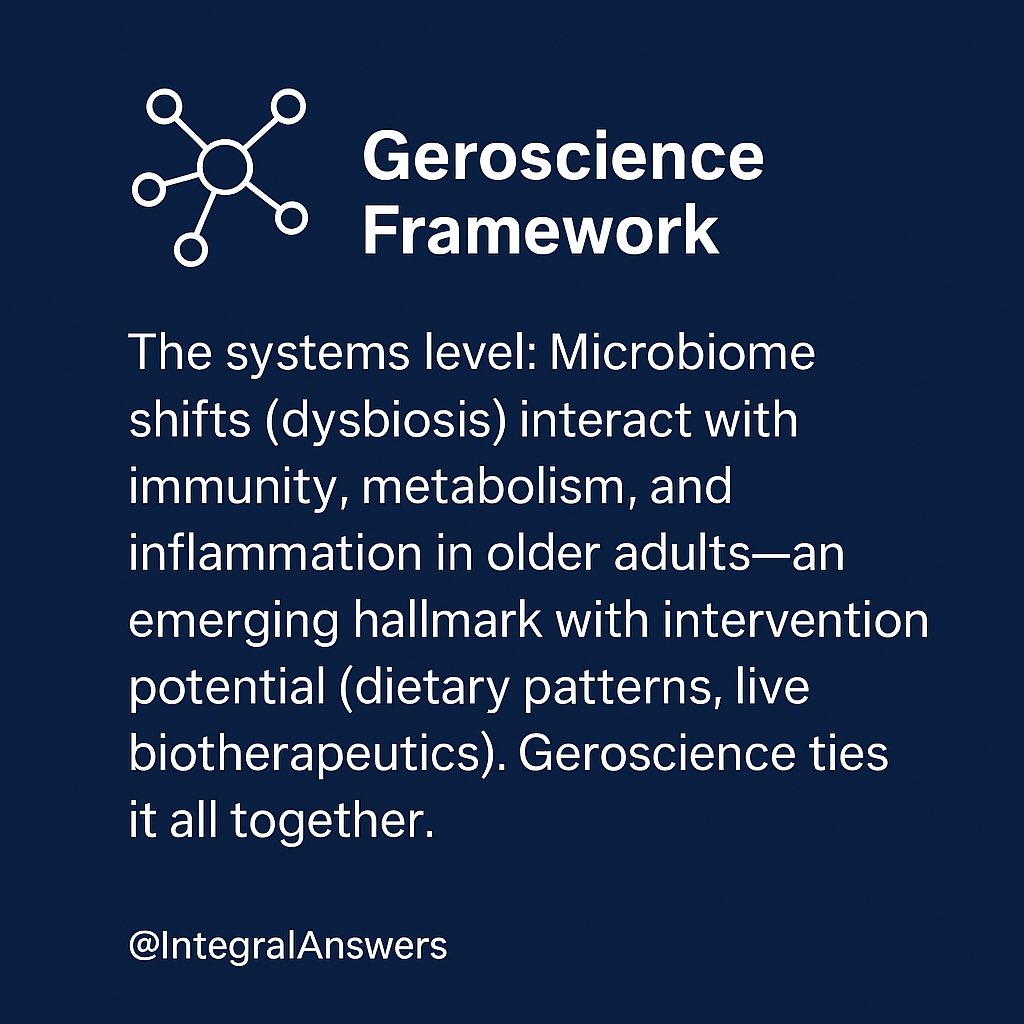
12/ Systems Level Aging Aging isn’t one process — it’s networked. Microbes, mitochondria, immunity & repair systems interact dynamically. Geroscience studies how these cross-talks drive decline.

13/ Geroscience Framework Integrating all hallmarks — from DNA to microbiome — geroscience aims to delay multiple diseases at once. The focus shifts from lifespan to healthspan.
14/ Every claim in this thread rests on peer-reviewed science. #References | @IntegralAnswers

@IntegralAnswers lengthening ones healthspan is #1 to me.
@MarkRid31548165 I think Ai may increasingly play an important role in that endeavor.
@IntegralAnswers Why are you ignoring my replies to your previous thread & blatantly distorting what people say 🤔? https://x.com/TruthingMouse/st...
Dr. Mike Confronting CNN's Doctor | Dr. Sanjay Gupta https://youtu.be/RlWui9w_JzM?s... via @YouTube