
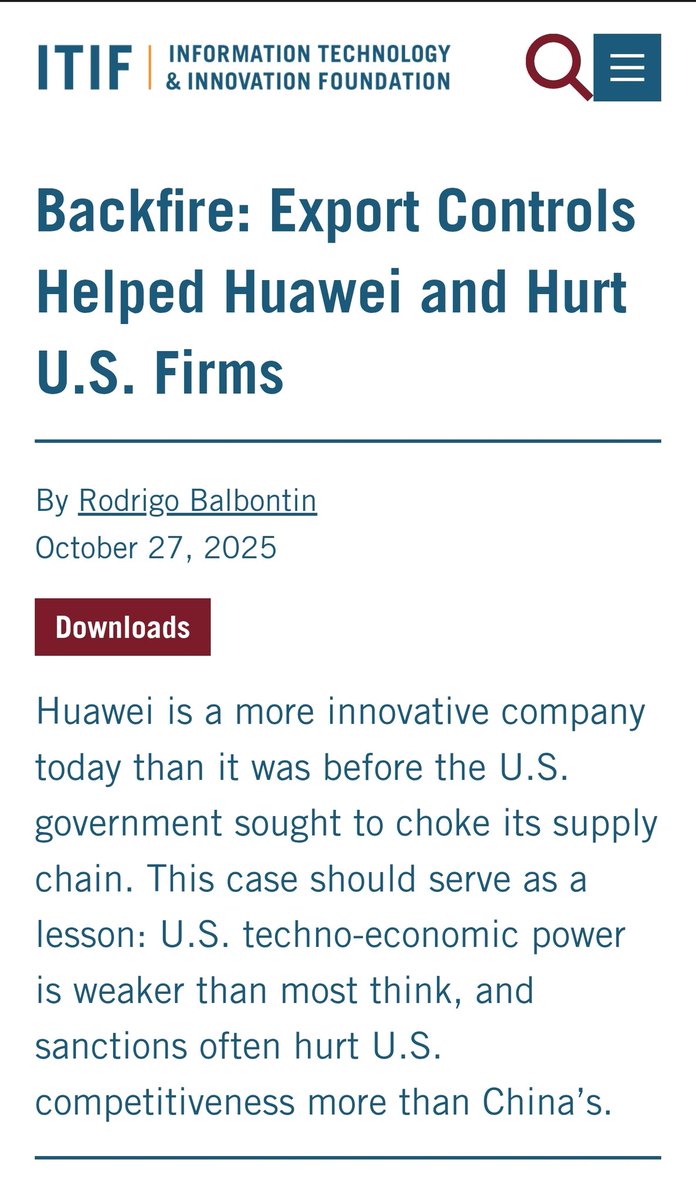
If you weren't convinced yet that the US technology sanctions on China hurt the US more than they did China, please read this incredible report by the Information Technology & Innovation Foundation (ITIF), the world's leading think tank for science and technology policy. They
@RnaudBertrand Maybe it helped Huawei's need for innovation. But to say that it helped them is quite a stretch. They might be the only company in the world who are capable to climb out of the hole they were put in.
@RnaudBertrand Huawei has the support of the CCP. There was no way US companies could realistically compete. Trying to throttle them was an attempt to slow China's efforts to steal tech and rob the West. It was way too late but acting like US companies could truly compete with the power of the
@RnaudBertrand This is a CCP troll account.
@RnaudBertrand Fk China though. Seriously.
@RnaudBertrand Who paid for the report?
@RnaudBertrand semiconductors were always the wrong choke point. china's spending $150b/year on domestic chips while us companies lose their biggest customer. we sanctioned ourselves out of revenue that funds r&d.
@RnaudBertrand the huawei sanctions turned out to be the ultimate strategic own goal where america tried to starve china's tech giant but accidentally taught it to farm nothing inspires innovation like an existential threat .. we pushed them into a corner but essentially handed them the
@RnaudBertrand A perfect example of US sanctions backfiring. They only made China's tech sector stronger and more self-reliant. Hubris indeed.
@RnaudBertrand Nice read... Thanks, Arnaud...
@RnaudBertrand Angell Paradox strikes again. Sanctions are self-harm.
@RnaudBertrand Just reading "The sanctions had zero impact on Huawei's global market share: "it remains the world’s largest telecom equipment manufacturer...", I already see this as a propaganda piece. No one in my circle uses Huawei. 不要当人是白痴。
@RnaudBertrand You didn't mention that the way Huawei was treated made a lot of Chinese people support their homegrown products more. At least that's what I heard a couple of years ago. Huawei actually used the sanctions in their advertisements in China.
@RnaudBertrand Out of curiosity, I checked to see if @huaweibr @Huawei was already available in Brazil. It arrived here, but a cell phone worth the price of a car here. US$ 2.100,00 on sale. The cheapest here. The iPhone, which I don't even like, looks cheap from the side 😳


@RnaudBertrand The second dumbest thing to do in recent times was to force Nvidia to lose market dominance in China. And the first dumbest thing to do was to make the world lose trust in the dollar system by confiscating Russian funds. Third dumbest has been NATO expansion.
@RnaudBertrand The sanction helped Apple, otherwise Huawei would dominate the mobile phone with its innovative design/quality.
@RnaudBertrand China will forge its own path in chip technology, with or without a technological blockade.
@RnaudBertrand The current process underway by the Administration is not the final product. It is a phase of the Hemispheric national security architecture. A shift from >800 bases around the world. It involves NATO and other strategic alliances, mainly Japan and others in SE Asia. Progress
@RnaudBertrand We need to separate from China. The CCP is a malignant entity that seeks to eliminate America and Americans.
@RnaudBertrand Was reading a paper recently where it was said no one wanted to confess that OpenRan has been a failure, Nokia and Ericsson was never prepared and don't have the technical capacity to fill the void left by Huawei infrastructure in Europe
@RnaudBertrand That it backfired is less relevant than the intentions of the empire to destroy the leading Chinese tech company of that time. Imagined if the roles were reversed and China tried to destroy one of the Mag 7 companies.
@RnaudBertrand US sanctions on Huawei were the best global ad campaign they could've asked for. If their products weren't good, why would America bother? Well played, US. 😏
@RnaudBertrand Estupendo análisis
@RnaudBertrand This is one hellofa report, Arnaud. Thanks
@RnaudBertrand After 2018 sanctions, Chinese poured in RD funding into the last few remaining bastions of tech frontiers still led by the west. If you want to bet against that go right ahead.
@RnaudBertrand Merci
@RnaudBertrand Everyone knows it's hurting them, we should let it happen, it's good for the world.
@RnaudBertrand @MartinLZinn Could someone please force Ian Duncan Smith and his band of China bashers to read this report. It’s the US that’s a threat to us all and a good relationship with China is crucial to our economy. Plus we are all spying on each other. Outer Space is crowded with satellites spying.
@RnaudBertrand America has never thought through the consequences of its sanctions — it simply assumed Huawei would collapse and go out of business. We like to believe such decisions are made by the brightest minds, but nothing could be further from the truth.

@RnaudBertrand "the United States needs a realistic, not hubristic, policy approach [to China]." Too bad that that realism is by far the scarcest resource in the otherwise resource-rich USA.
@RnaudBertrand It looks like EU sanctions against Ukraine 😂 Or how to shoot yourself by forcing a resourceful enemy to understand your advantages and use them. False domination through narrative 😏
@RnaudBertrand Backfire is an overstatement. National security > economics, always; it’s the most sensical (even you know this). Why then the author reached the conclusion? Hint: the think tank gets its funding, partially, from US tech companies. You’re welcome.
@RnaudBertrand ITIF is another "nonprofit" funded by CCP for propaganda.
@RnaudBertrand then you shouldn’t let Americans know, and welcome more sanctions.
@RnaudBertrand It's not that they had no impact at all—Huawei indeed went through a tough couple of years. However, the reverse effects of these policies are certainly worth studying .
@RnaudBertrand Does China ban tech products, no Does the US, yes