
1/5 JP Morgan has identified 41 AI-related stocks, 8% of the S&P 500. These stocks now account for 47% of the Index's market capitalization, a new record. The other 459 stocks, 92% of the S&P 500, are 53% of the Index's market capitalization.

2/5 The list of the AI-related stocks

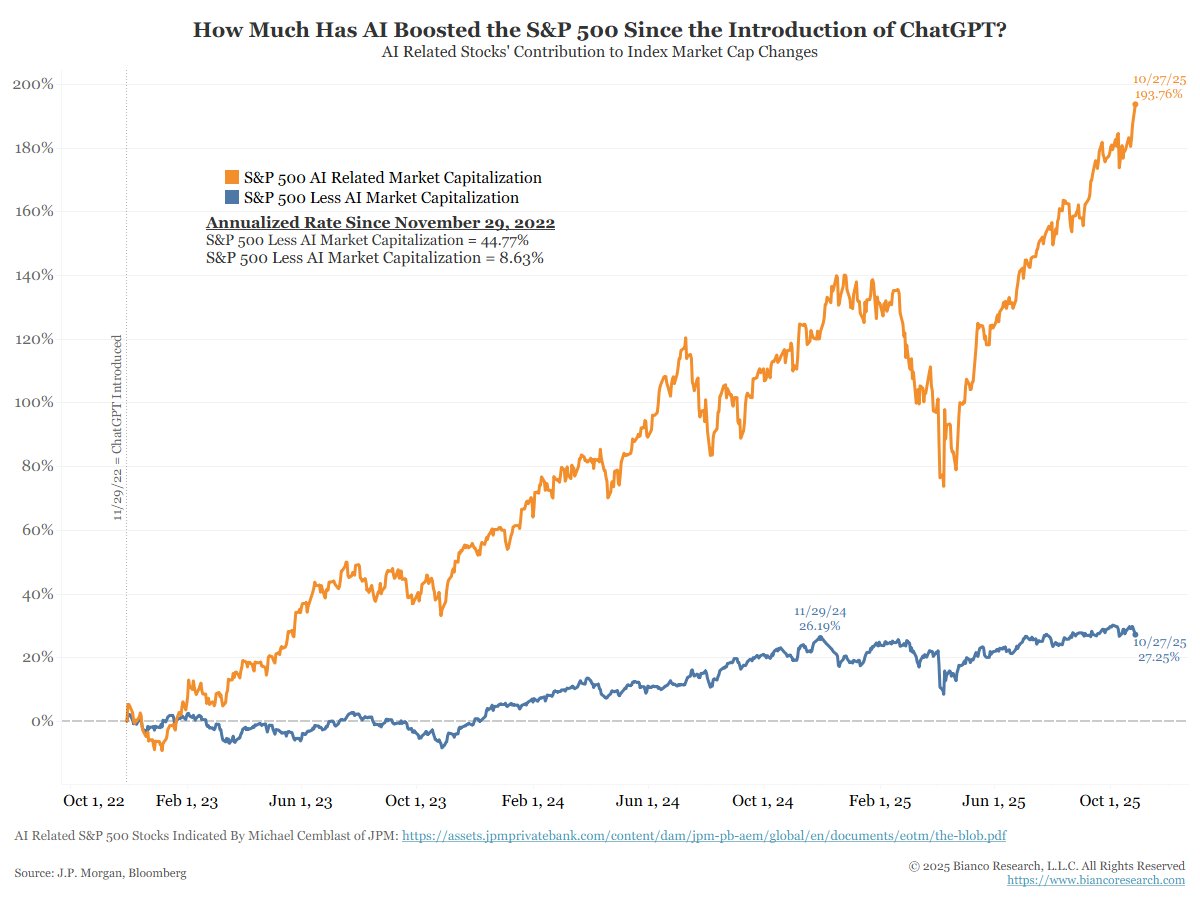
3/5 ChatGPT was released on November 29, 2022. Since this date, these 41 stocks have accounted for 74% of the S&P 500's total increase (blue). The other 25% came from the remaining 459 stocks (orange).

4/5 In raw terms, since November 29, 2022 (ChatGPT start): * 41 AI-related stocks (orange) = 193.76% (44.77% ann.) * 459 non-AI-related stocks (blue) = 27.25% (8.63% ann.) Note the "459" is up less than 1% since last November (11 Months).
5/5 The top 41 stocks in the S&P 500 will always account for around 50% (or more) of the S&P 500's market capitalization. Nothing new here. What is different now, however, is that 47% of the Index's capitalization is based on a single theme: AI. This is unique and represents
@biancoresearch This is a concentration risk in action. 8% of stocks = 47% of market cap means: If AI hype reverses, the entire index suffers. But for long-term investors, this is why diversification matters. Own the whole market (VTI/VOO), not just the Magnificent 7. Let winners win, but
@biancoresearch JPM adds that this AI cohort has driven ~70% of the S&P 500’s 2025 YTD return and now represents ~60% of index capex and ~55% of R&D spend, underscoring how profits, investment, and performance are increasingly concentrated in a surprisingly small slice of the index.
@biancoresearch Can you also look at how much percent of S&P 500 operating income do these 41 stocks generate? The concentration may seem justified then.
@biancoresearch Market cap concentration tells you what's already priced in, not what's coming next. When does consensus positioning become the actual risk?
@biancoresearch 4/ made the S&P 500so hard "to beat" ( original visionaries being J. Bogle and P. Samuelson ). The concern over the high "concentration" of top weightings both within the S&P 500 and the QQQ is drastically reduced by having a 33.3% QQQ weight in the portfolio
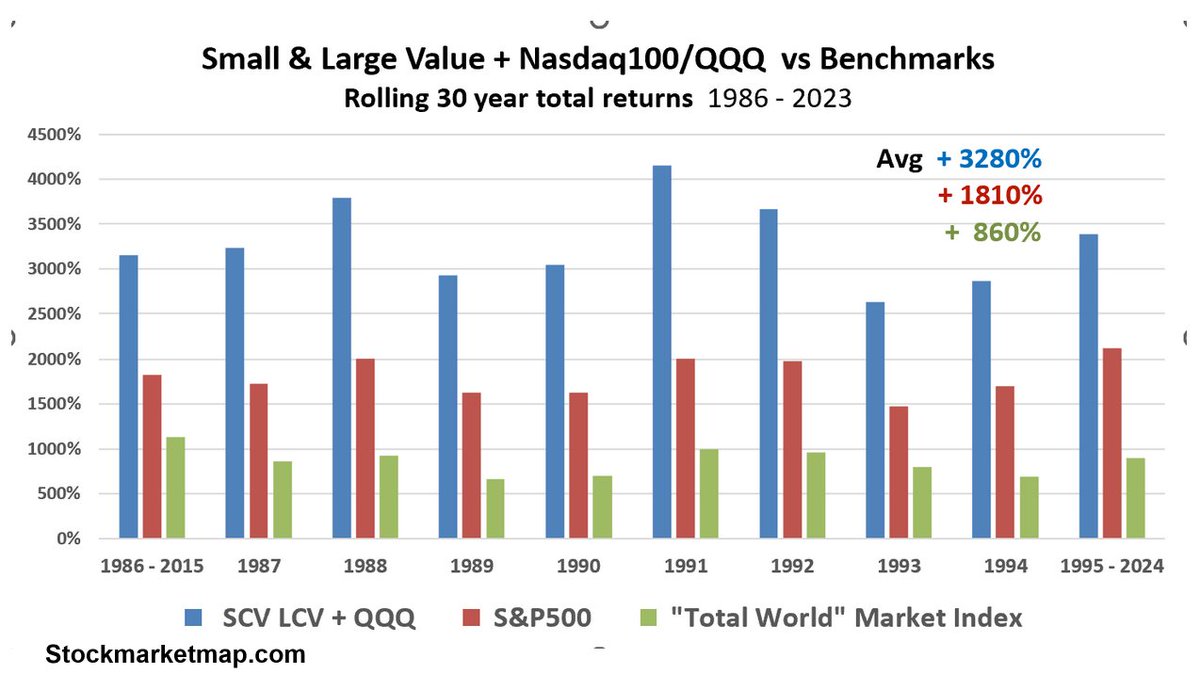
@biancoresearch 1/ Reduce the "concentration risk" of the S&P 500 by "redesigning" it through an equal portfolio weighting of three ETFs using science and academics based principles.
@biancoresearch 2/ Since 1986, a portfolio of small & large "value" stocks (via ETFs) and the Nasdaq100/QQQ has produced almost 2X the returns of the S&P500 and 4X the returns of the Total World Market Index, with equivalent risk, over ten rolling 30 yr periods
@biancoresearch 5/ thus reducing the "top 10" stocks total weightings being 51% of the portfolio presently, down to 18%, as compared to 39% for the S&P 500.
@biancoresearch Looks like 41 AI stocks are throwing a private party in the S&P 500. The other 459 just showed up for free snacks. Thanks JP Morgan for the exclusive guest list!
@biancoresearch @threadreaderapp unroll
@biancoresearch My strategy plan ⬇️ Show more
@biancoresearch 3/ see Chart 1 in "Stock Market Investing “Cheat Sheet”" within "E-Books & Studies" tab at stockmarketmap .com . This portfolio exploits the size, value, and quality returns factors ( E. Fama ) and the "capitalization weighting" attribute of the QQQ ( the same attribute that has
@biancoresearch So 8% of stocks = 47% of value = bubble, or are we calling it " AI premium" now?
@biancoresearch That concentration is wild — AI really is becoming the new market gravity pulling everything around it.
@biancoresearch Thank you for sharing and keep up the good work.