
Twenty years ago, Capitec was a small bank serving South Africa’s taxi-rank economy. This year, it became the country’s most valuable bank, up more than 100,000% since listing. How did a bank built for the poor outperform giants that served the rich? I went back through two

Capitec had another strong start to the year, with income up 27% and earnings (profit) up 26% compared to the previous half-year. Part of the growth was due to the acquisition of Avafin, a fintech company operating in North America and Europe. However, even adjusted for that,

Before digging further, we need to lay the foundation to understand why Capitec has sustained so much growth over the last twenty years. It all can be underpinned by one principle. Serving the underserved.
The best customers are the ones who have a big problem that is being ignored by the market. In the early 2000s, when Capitec started, lower-income South Africans who needed affordable unsecured microloans were the ignored segment. Traditional banks had viewed this segment as

Capitec was “cheap” at 22% month (which was still about 984% per year), but even they recognised that the amounts were excessive and that the way to be successful was to “reduce prices, help the customer and beat the competition.” The issues with the high cost of credit, as well

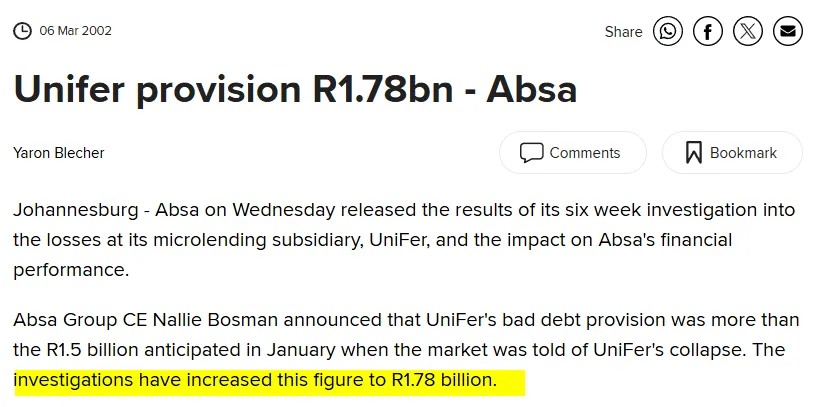
It wouldn’t be accurate to say that banks completely overlooked this segment. The best example is of the ABSA. In April 2000, ABSA acquired a majority stake in UniFer, one of the leading third-party microlenders paying over R1 Billion, in what was its first significant
What also played a part was that the traditional banks were doing well enough. As shown below in 2002/2003, the big four banks controlled 75% of the retail lending market. To target the microlending space would have required increased focus and more aggressive cost discipline to
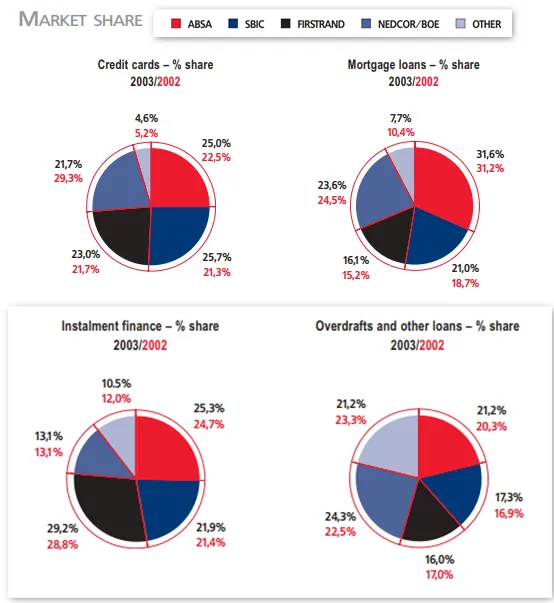
In addition, the unsecured microlending business was still small. For ABSA, microlending was less than 3% of its loan book, even after acquiring one of the largest players. With all these factors, the natural approach for any bank would have been to focus on what it already
Large, established companies frequently get beaten out by new entrants that focus intensely on niche segments, which the larger company considers secondary. An example is Coca-Cola and the energy drink segment. While Coca-Cola remains the world’s dominant soft drink company, it

Capitec did the same thing. They were all in on this underserved segment and could build their business and strategy entirely around it, including adopting a lower-cost digital-first structure. They summed it up well in one of their early annual reports: We remain on track to

What happened next was magical and will help us analyse their current financial results in more detail and draw lessons that can be applied to any business, especially those in Africa. Since there is so much to unpack, we will need to pause for now. Part 2 will be coming next
Thanks for reading! I write on the finance & strategy behind the most important companies in Africa and the World. Follow me @tmukogo for more. Please comment on / repost the below tweet! I would love to get your feedback!
@tmukogo Thanks Tinashe a great read as usual. I am currently reading TJ Strydom’s Stalking Giants: The Story of Capitec , an inspiring journey of a peanut farmer who ventured into money lending, starting with the humble practice of keeping customers’ ATM cards and PINs as collateral.
@OkaPhusisa Thanks! Just bought the book yesterday since so many people ave recommended it since I wore this. Wish more books like this were written.
@tmukogo Thanks for this analysis. I never really noticed this bank. I thought its a non entity. It's not visible in SADC so I thought its a small player.
@tmukogo R2 billion from selling betting vouchers.
@tmukogo I bookmark before reading. 🫡
@tmukogo Taxi rank economy you say? This probably played a big role.🤞 https://x.com/SABCNews/status/...