
🧵 A Unifying Theory for Understanding Autism Autism remains one of neuroscience’s biggest conceptual challenges. A recent framework — the Pathogenetic Triad — offers a way to integrate its biological, cognitive, and genetic complexity.
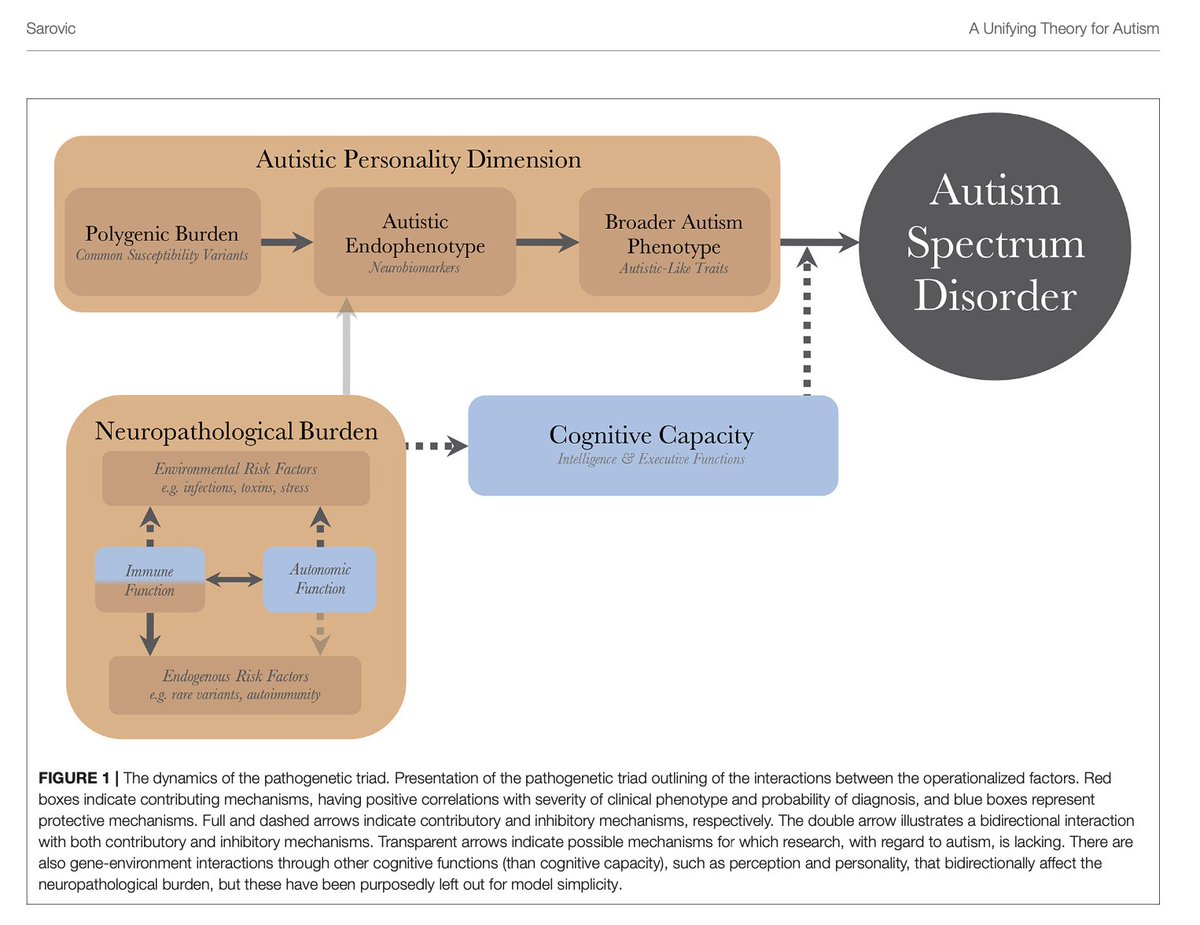
1️⃣ The Pathogenetic Triad, proposed by Darko Sarovic (2021), suggests autism results from the interaction of three dimensions: – Autistic Personality (AP) – Cognitive Capacity (CC) – Neuropathological Burden (NB)
2️⃣ Autistic Personality (AP): a stable, non-pathological set of neuropsychological traits — attention to detail, preference for structure, sensory sensitivity — distributed across the population.
3️⃣ Cognitive Capacity (CC): the brain’s compensatory resources — intelligence, executive function, flexibility — that modulate how these traits are expressed.
4️⃣ Neuropathological Burden (NB): biological factors disrupting neurodevelopment — rare mutations, inflammation, prenatal stress — which can weaken cognitive compensation.
5️⃣ When a strong AP combines with low CC and high NB, an autistic behavioral phenotype may emerge. If CC remains strong, the same traits may manifest without reaching diagnostic criteria.
6️⃣ The model explains the heterogeneity of autism: – high-functioning vs. syndromic cases – comorbidities like epilepsy or anxiety – variability in outcomes across development
7️⃣ Genetically, it distinguishes: 🧬 common variants→ shaping the autistic personality ⚠️ rare variants→ adding neuropathological risk Together, they determine where an individual lies on the spectrum.
8️⃣ The Pathogenetic Triad reframes autism not as a single disorder but as a dynamic interaction between personality, cognition, and biology. A step toward a mechanistic, integrative neuroscience of neurodiversity.
🔚 Could this “triad” framework help redefine how we study and understand autism? 📖 Sarovic, D. (2021). A Unifying Theory for Autism: The Pathogenetic Triad as a Theoretical Framework. Frontiers in Psychiatry. https://doi.org/10.3389/fpsyt....
💬 This theoretical model aligns closely with what we observe in neuropsychology practice, both in children and adults: individual variability shaped by the balance between cognitive strengths, masking abilities, and neurodevelopmental vulnerabilities. Together, these factors