
Mughal omen paintings are my favourite genre. Commissioned to bridge the gap between dreams/ aspirations & reality, they drew on the belief that pictures could unlock the world to come. This logic undergirded many works, most famous being, Jahangir shooting Malik Ambar’s head. 🧵
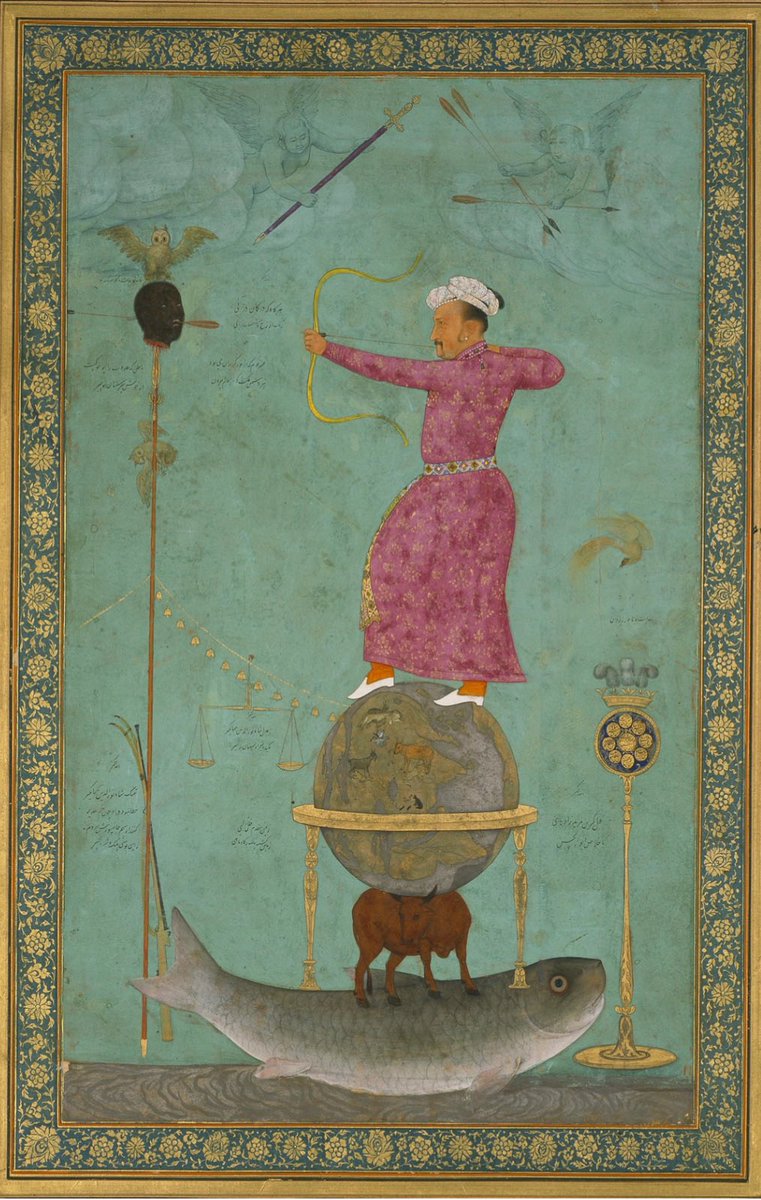
Commissioned in 1620, the painting depicts angels handing a sword & arrows to Nur al-Din Jahangir (“the light of faith” & “the seizer of the world”) who stands at the center of the globe. Behind him, humā, the bird of good fortune, hovers above the imperial crown.
Adorned with white feathers, the crown rests atop a medallion with disks set against a blue background. The central one bears Jahangir’s name, surrounded by those of his paternal ancestors: his father Emperor Akbar, grandfather Emperor Humayun, and great-grandfather Emperor Babur
The list extends to include the Mughal emperors’ Timurid ancestors, reaching back to the founder on the dynasty, Timur. An inscription between the huma, the bestower of divine favour, and the crown reads: “Your nine generations were crowned by God”.
On the right side of the painting, Jahangir is shown aiming a bow and arrow at an impaled head, whose mouth has already been pierced by one of his arrows. Unlike the bejewelled turban on Jahangir’s head, a live owl sits atop the javelin impaled head.
A dead owl hangs from the hooks of javelin’s blade. Inscriptions around these 2 owls read: “The face of the night-coloured rebel has become the abode of the owl,” & “Your enemy-overthrowing arrow put the “Ambar’s owl, who was fleeing from the light, outside of the world.”
These statements advance a mix of reality and its manipulation. They tell us that the impaled head of the dark-coloured rebel belonged to ‘Ambar (literally, ambergris—a grey-black aromatic substance), who was an embodiment of the owl.
The association between the owl and the defiant Malik ‘Ambar is repeated in Jahangir’s memoir. An army general of Abyssinian origin, MA was enslaved & employed at the enemy court of Ahmednagar. MA’s military prowess prevented the Mughals from capturing his patron’s territory.
Frustrated by his foe’s formidability, Jahangir described their clashes as battles between the armies of light and darkness—a play on his and ‘Ambar’s epithets— and referred to ‘Ambar’s stronghold, the city of Kharki, as the owl’s nest.
🦉 conveyed ill omen of adversity and destruction in the Persinate world. Concomitantly, ‘Ambar was portrayed not only as the enemy of the Mughals but also as a representative of the dark forces of evil. By killing him, Jahangir rid the world of chaos.
Now, for a twist in the tale. The Mughals were never successful in capturing or killing ‘Ambar. While the narrative presented in the painting might seem at odds with this fact, it was not completely devoid of historical reality, at least not as it was understood during the period
The above-described scene relates to an event from Jahangir’s memoirs. Describing the campaign against ‘Ambar in 1617, the emperor wrote: “I was…with some noblemen.. an owl flew over the roof of one of the buildings and alighted…
It was so scarcely visible that most of the men were unable to make it out. I called for my gun, took aim in the direction they pointed to, and fired. The ball hit the ill-omened bird like a decree from heaven and blew it to pieces.”
The portrayal of the dead owl and Jahangir’s gun, which can be seen leaning against the javelin in the painting, represents this incident.
The remaining ensemble constituted an act a metaphysical plane with Jahangir using the medium of visuals to reverse the ill effects of the owl’s presence in the royal abode by casting a curse on his arch-nemesis.
This incantation is expressed through the live owl on ‘Ambar’s head with the dead owl dropping alongside blood from his severed neck, articulating Jahangir’s image as the god-sent benefactor of a just and peace.
For more on this painting read: Robert Skelton, Azfar Moin, and Divya Cherian’s works.
@nehavermani The Malik Ambar one is my favourite Mughal miniature of all time. We were discussing it in class just this week (in relation to the history of Sidis in India). Thanks for this incredible thread!