
Here's a probability problem that stumps almost everyone: A person has two children. You are given that at least one is a boy born on a Tuesday. What is the probability that both children are boys? The answer is NOT 1/2 or 1/3. Let's break it down: 1/5
Your first instincts are probably 1/2 (the "other child" is a 50/50 flip) or 1/3 (from the simpler "at least one boy" problem). Both are wrong. The key is that the "Tuesday" information, while seemingly irrelevant, changes the sample space and the "at least one" condition. 2/5
Let's define the full sample space. There are 2 genders & 7 days, so 14 "types" of children (e.g., G-Mon, B-Tues, etc.). For two children, there are 14 x 14 = 196 total, equally likely combinations. We need to find P(Both Boys | At least one B-Tues). 3/5
Let's find the denominator: P(At least one B-Tues) = 1 - P(Neither is B-Tues) = 1 - (13/14)\times(13/14) = 27/196. Now the numerator: P(Both Boys & at least one B-Tues) = P(Both Boys) - P(Both Boys & no B-Tues) = (7/14)^2 - (6/14)^2 = (49-36)/196 = 13/196. 4/5
So, the final probability is: P(Both Boys | At least one B-Tues) = Numerator / Denominator = (13/196) / (27/196) = 13/27 The answer is 13/27! A tiny, "irrelevant" piece of information (Tuesday) subtly prunes the sample space and changes the result. 5/5
@probnstat @paulg This is just bullshit. The probability in this case depends on why a person is giving me this specific information. If the «born on Tuesday» feature is selected in advance of knowing anything about the family, then the 13/27 is correct, but if the one giving the info has decided
@probnstat I don't think this works... first, you are given that the probability of a boy on Tuesday is 1, but later calculate it to 13/14. Second, these aren't independent - the state of 'being a boy' is in both - so can't just do straight multiplication.
@probnstat Visual explanation
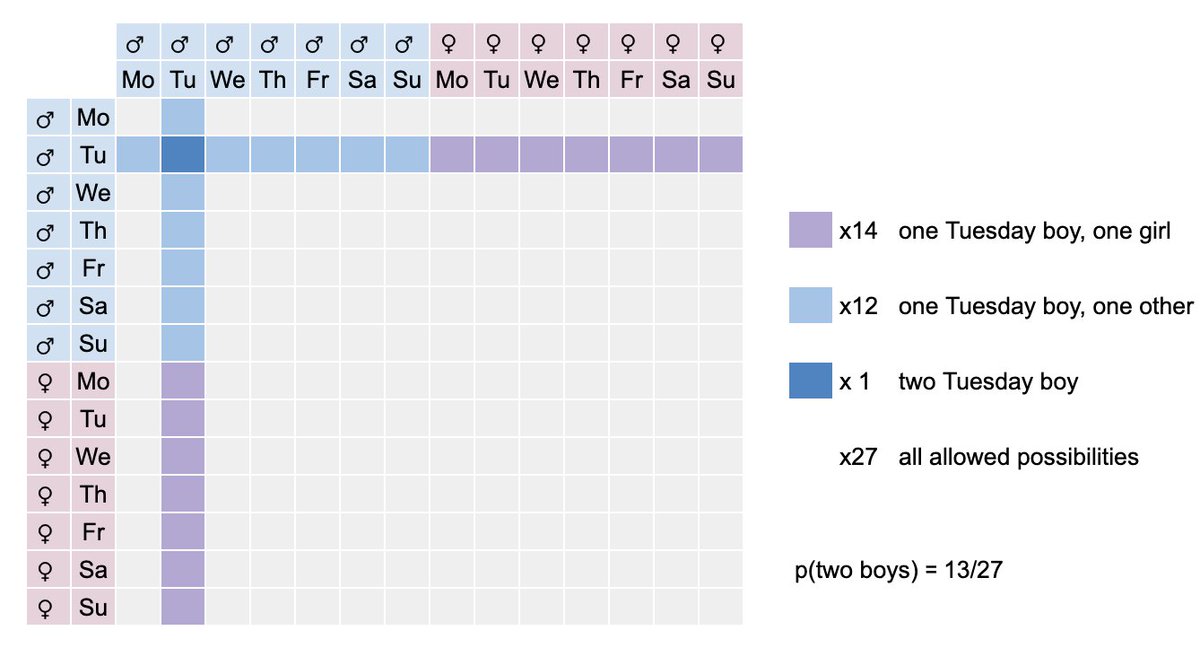
@probnstat Nice one! Also great to see the keyboard vikings summoned by probability theory
@probnstat @paulg Interesting. Add a random detail( born on Tue) and the odds of both kids are boys jump from 33% to ~50%. Conditioning in disguise...
@probnstat These Replies illustrate the point that if there is more than one way to interpret a question, people will find it. 🎁
@probnstat Fuck this 1/5 in the first tweet made me think I am going insane
@probnstat This is 💩 You are not answering your own question “what is the probability they have two boys”. You are answering: “the prob they have two boys and one of them is born on a Tuesday”
@probnstat So, very close to 1/2.
@probnstat @grok is this right? Isn't the Tuesday an irrelevance? Also the stats are different once you have one gender aren't they?
@probnstat @paulg This only works assuming that the Tue info does indeed change the sample space - if we start thinking about all the families with boys born on Tue rather than just boys. But if we treat it as some random extra bit of info... As we obviously will in practice... Then 1/2.
@probnstat @paulg @grok considering that the question is just “what is the probability that both are boys, why the Tuesday detail is anyway relevant?
@probnstat Think lottery tickets: “boy on Tuesday” is a rare winning ticket. A two-boy family holds two tickets; a mixed family holds one. So among families where at least one ticket wins, two-boy families show up more than the naive 1/3 answer.
@probnstat very counter-intuitive. almost seems to suggest knowing vs no knowing retrospectively changes the size of the population; or, there's some finite probability that a child is born on a day that is not in Mon..Sun. whacky.
@probnstat It's only confusing because it depends on a contrived context in which this information is obtained e.g., "is one a boy born on a Tuesday" -> "...yes". If you are simply provided the day it's irrelevant.
@probnstat Yes, the key point is that adding “born on a Tuesday” isn’t an irrelevant embellishment: it changes the sample space. We’re no longer talking about all families with 2 children and at least 1 son, but about those with 2 children and at least 1 son who was born on a Tuesday.
@probnstat This one is very cool. In practice, the assumption that all 14 outcomes are equally likely doesn’t quite hold, but that doesn’t make this demonstration any less cool 😄
@probnstat https://x.com/DrYohanJohn/stat... It's that time again
@probnstat This is only true if the fact-giving process is checking for boy+Tues specifically. If the fact-giving process is set up to provide a gender+day pair, then it's 1/2.
@probnstat Not true, there are two possibilities for 2 tuesday boys, not one. Either the first boy is the one assured by the sentence, and the other is a randomly selected tuesday boy, or the second boy is the one assured by the sentece, and the first was randomly selected.
@probnstat I am sorry but this is a bit ridiculous. Though you are welcome to make it even more ridiculous by making that Tuesday fall on Feb 29th.
@probnstat Probability cracks me up. And drive me crazy. It’s problems like this one, or that annoying question about the game show w/ three doors. I’m above average when it comes to math (math minor, MBA, MA Econ after dropping out of a PhD programme). But Prob/Stats still confounds me.
@probnstat Is this BS @nntaleb ?
@probnstat Wow. Eye opener.
@probnstat Still 1/2
@probnstat You already have 100% chance one is a boy and 50/50 the other so it is the combo of those for the two boys and Tuesday was not part of the question…
@probnstat The sex of the second child is an independent event, not reliant upon the sex of the first nor Tuesday. Therefore 1/2.
@probnstat @paulg Pay attention to the question! It asks ONLY about gender. If you start calculating based on anything that was not asked about (e.g. day of week, time of day, temperature, ambient music at time of birth, …) then you have not understood the question.