
The Laws | Games For Children In Plato's last dialogue, he implies that adults must learn like Egyptian children do for a strong civilization. «In that country arithmetical games have been invented for the use of mere children, which they learn for amusement.» — Plato, Laws

Before we start playing these games meant for Ancient Egyptian children, let us divide the relevant portions twofold: 1) Number vs Logistics 2) The Games ===== a) Dividing Apples b) Boxers and Wrestlers c) Mixing Bowls
1) Number vs Logistics In our philosophy, the study of number is not to be confused with the study of logistics. Logistics is defined as the theory which deals with numerable objects, i.e. classified as a productive science in Aristotle's threefold division of the sciences.

Number, erstwhile, can be succinctly described as the theory which deals with harmony (e.g. form and number). The study of unity, duality, triads; arithmetic, geometry, music; and their parts in creation, and sustaining the universe, etc. The games were meant to teach both.

2) The Games ===== a) Dividing Apples Plato describes how Egyptian kids are introduced to the art of calculation through a simple game. In this game, the kids are asked to divide the same number of objects ('apples' or 'garlands') into greater or smaller groups.

As an example, if given 12 apples, they will be able to divide them into two groups of 6, three groups of 4, four groups of 3, six groups of 2. The purpose was to teach them about how to identify divisors in numbers. [Logistics] Or, to teach about unity and division. [Number]


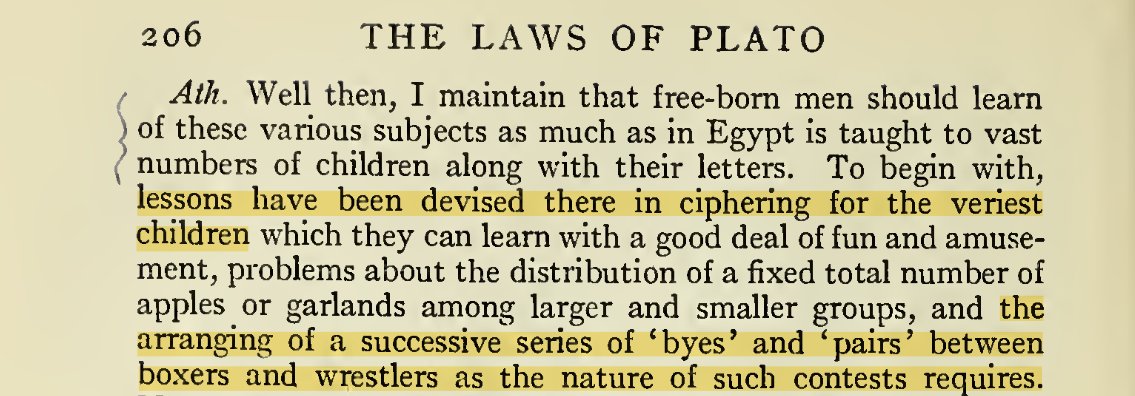
b) Boxers and Wrestlers In this second game, the kids are asked to arrange a successive series of boxers and wrestlers to either sit out or be paired together, so a competition may be done. The concept is adjacent to the idea of Round of 16, Quarters, Semis, Finals in sports.
In dividing the boxers and wrestlers, the kids will discover three different kinds of groups (see: Euclid’s Elements, Book IX, propositions 32–34); A has sit outs, B has sit outs after a few rounds, C has no sit outs. A = {2(2k + 1)} B = {2n(2k + 1)} (n > 1) C = {2n} (n > 1)

c) Mixing Bowls In the third game, the kids are given three bowls, one with (x) gold tokens, another with (y) silver tokens, and a third with (z) bronze tokens. To these, (s) tokens of other metals were added. After mixing the bowls (S), they are asked to determine the amounts.

The outline for the game is shown as follows; which thus leads us to the formula of: S = s / 1 - ( 1/p + 1/q + 1/r ) To find S, the kids had to calculate the least common multiple (LCM) of 1/p + 1/q + 1/r, ergo to determine if p, q, and r are prime to one another.
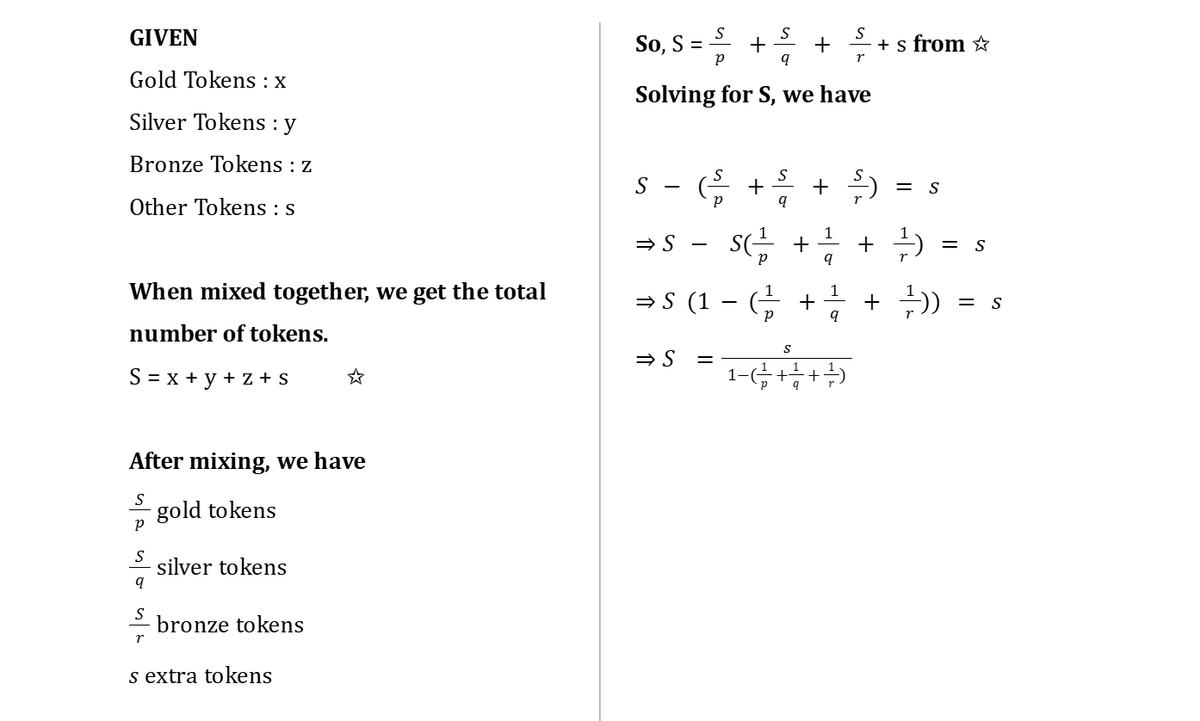
If p, q, and r were prime to one another, then their least common multiple (LCM) is simply the product of pqr (p · q · r). For example, given that p = 2, q= 3, and r = 5, then their LCM is 2×3×5=30. Once found, S can be solved, and once S can be solved, so can the no. of tokens.


3) "The Fourth Game" I tricked you. There is one more game. The games are meant to teach children of the importance of duplication and dimidiation; not merely logistics, but theology too. Plato's Timaeus is placed under the sign of Neith (-Athena), the Egyptian goddess of Saïs.

Who is Neith-Athena? Without the temple of Neith in Saïs, let us go to the temple preserved at Esna in Upper Egypt where Saïs's theology is referenced. She is described as: "Father of fathers, mother of mothers." "Two-thirds of her are masculine, one-third of her is feminine."


In the Rhind Papyrus, there is a particular problem regarding the double of an elementary fraction (1/n) for odd numbers (where: n = 3, 5, 7, ...). An Egyptian boy who has played games knows he has to choose a number N such that 2N > n, which is to be multiplied to the fraction.

In 2/3 = 1/2 + 1/6, we have the foundational equation of the 2/n table in Egyptian mathematics. And to our 'fourth game', we have found the meaning of the words: "Two-thirds of her are masculine, one-third of her is feminine". What is known by 2/3 = 1/2 + 1/6, is this:
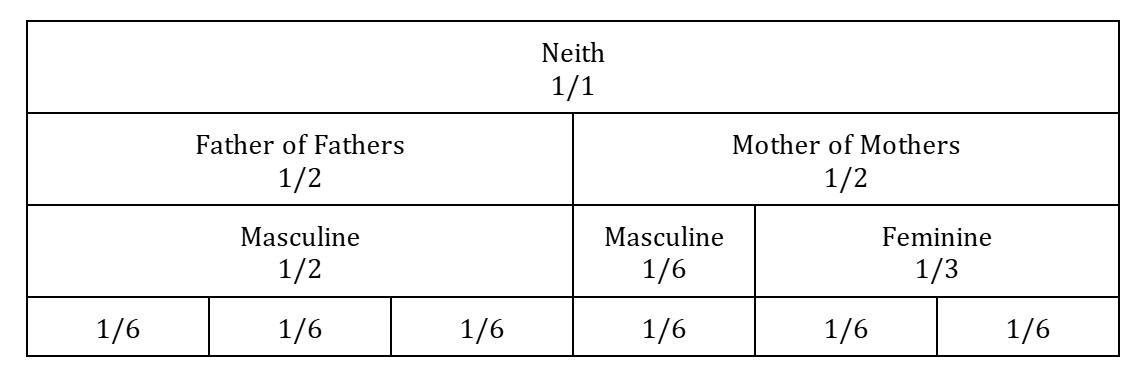
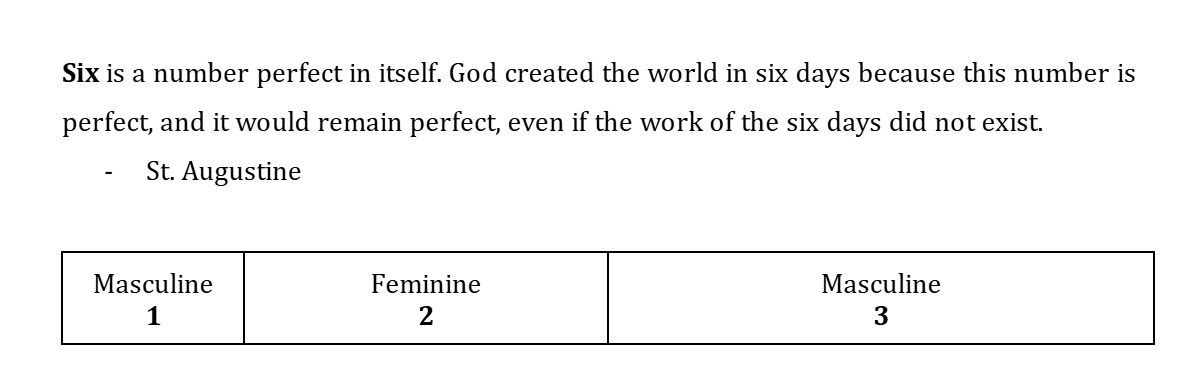
In the philosophies of antiquity, it is said that odd numbers are masculine, and even numbers are feminine. If we consider the whole table by 1/6, and check for the numerator; we find that 1/2 and 1/6 are 3 and 1 (odd - masculine), and 1/3 is 2 (even - feminine).

Therein, we have a succession of the first three natural numbers whose sum is six, which begins with the masculine (1), proceeds through the feminine (2), and returns to the masculine (3).
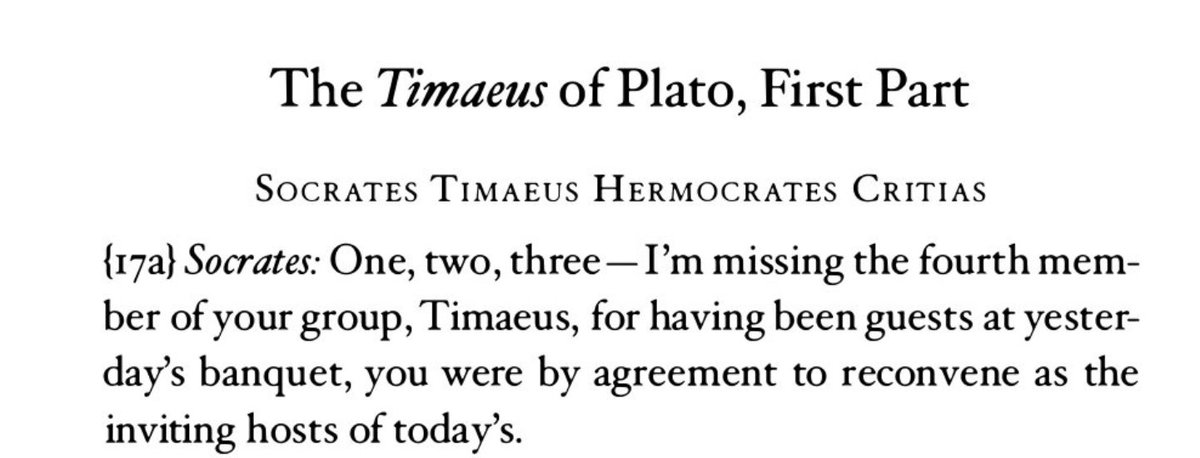
And returning to Plato, it is known in his Timaeus, that he begins with the words: One, two, three.
@kateofleninka @MB40988 is this why you're posting logic questjons nowadays?
@kateofleninka It's a more abstract game, but I can kind of see why the Soviets pushed chess so hard