
In the late 1920s, a young Indian woman boarded a ship bound for Germany to do her PhD. Her name was Irawati Karve. And she was about to take on one of the most dangerous ideas of her time. Thread. 1/12

Her academic supervisor in Berlin, Eugen Fischer, was a leading figure in medicine and physical anthropology — and a member of the Nazi Party. His influence ran deep. Even Adolf Hitler read his textbook while in prison and used those ideas to build the Nazi racial doctrine. 2/12

Fischer claimed that white Europeans were inherently more intelligent than Africans — because, their skulls were asymmetrical in ways that allowed greater brain growth. 3/12

In Berlin, at the Kaiser Wilhelm Institute for Anthropology, Human Heredity and Eugenics (KWI-A), Irawati Karve was trained in craniometric techniques and racial-anthropological frameworks. 4/12

Fischer asked his new young Indian student to study 149 skulls and prove the theory. The skulls included specimens from German colonies in East Africa and New Guinea. 5/12

The work was tedious, technical. Karve followed the assignment exactly as instructed, comparing each sample with scientific precision. After rigorous craniometric analysis, Karve found no consistent correlation between skull asymmetry and race or intelligence. 6/12

Her research showed no link between skull shape and intelligence. And she didn’t step back. She wrote her observation clearly in her final dissertation, fully aware that her findings directly contradicted her supervisor’s beliefs. 7/12

No surprise. When she presented her findings, Fischer was not pleased. She had disproved the very idea her supervisor was famous for. 8/12
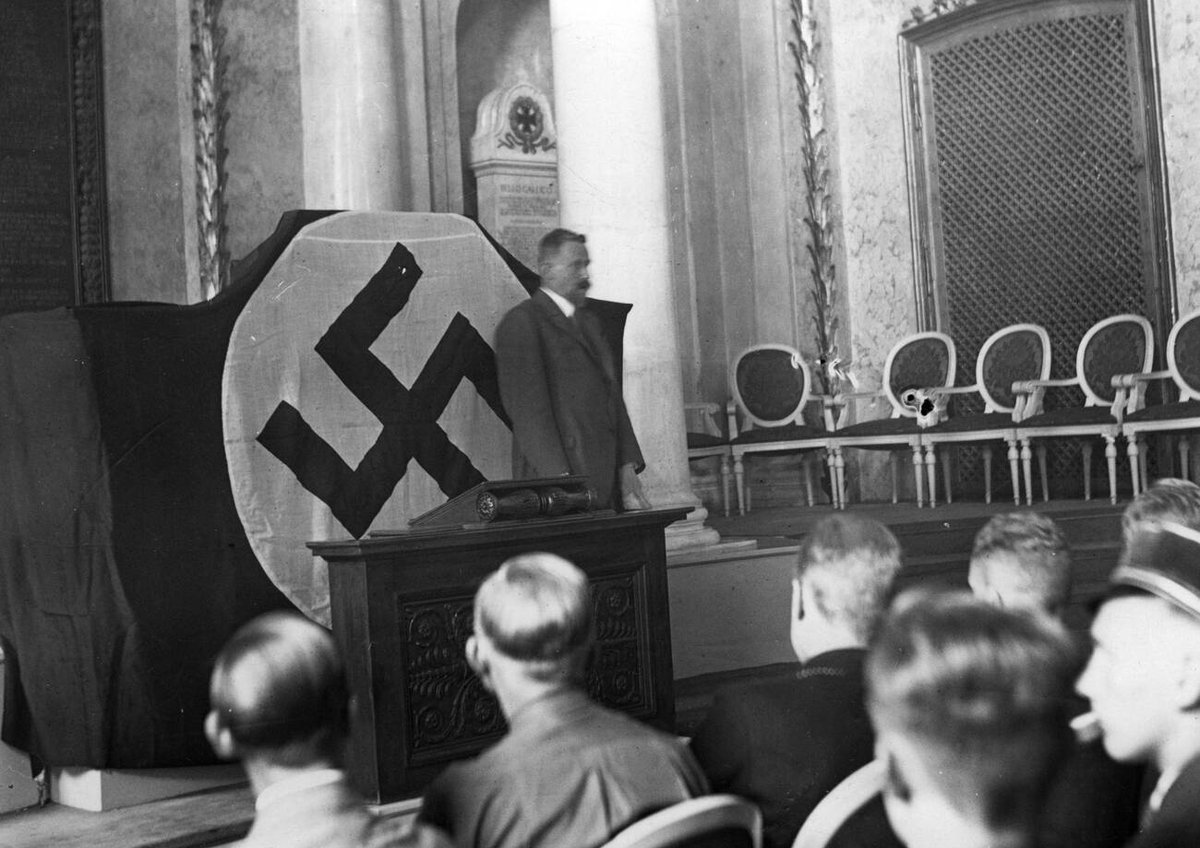
In a German lab in the late 1920s, a young Indian woman had just dismantled one of the core assumptions of racial science, using evidence. It was a quiet but decisive refutation of one of the central claims of eugenic science. 9/12
Fischer passed her, but with the lowest grade possible. Karve returned to India in 1931 and went on to become a pioneering figure in Indian anthropology. 10/12

Her Berlin years matter not only for what she found, but for where she found it, in a centre of racial science, during a period of rising Nazi ideology - and by a woman of colour. What makes her story remarkable isn’t just her scholarship, but her integrity. 11/12

Even today, when many blindly follow the authority of institutions, Karve’s example stands out. She went against the tide of Nazism, right at its core. At a time when race science shaped global policy, Irawati Karve chose evidence over ideology. 12/12
Barbosa, Thiago Pinto, and Urmilla Deshpande Barbosa, Thiago Pinto, and Urmilla Deshpande. Iru: The Remarkable Life of Irawati Karve. New Delhi: Context/Westland Books, 2023. Barnes Review “Debunking Myths About National Socialism.” The Barnes Review. Accessed October 31, 2025.
@Paperclip_In Same as the author of 'Yuganta'?
@CSYogananda Yes !
@Paperclip_In What a heroine!
@aditya_gan3500 Indeed ! And we loved your handle name.
@Paperclip_In Thanks for this vital information debunking the theory of Racial superiority based on skull measurement, Iravati Karve must be honored for this amazing theory 🙏
@kirty_kochar She is amazing !
@Paperclip_In This reminds me of Vaibhav Singh questioning vishwaguru, everything is a master stroke-where as he is pro India IT cell went after him for this.
@Paperclip_In Loved the write Well done