
Nick Lardy has an excellent new paper out reviewing China's progress in building up a social safety net, particularly its pension system. He thinks the consensus view that a weak social safety net is pushing up savings and pushing down consumption is outdated. I agree! 1/
In fact I've been making this argument for literally a decade (the receipts: my blog post titled "the death of the precautionary savings hypothesis" is dated April 2015). Those paying attention know China started boosting public spending on the social safety net around 2006. 2/
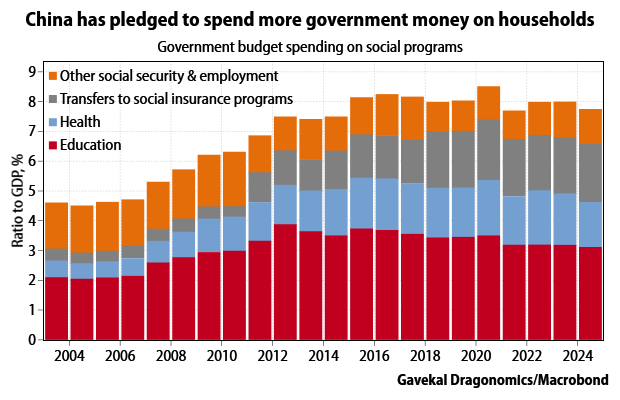
The single most important change was the creation of the "resident" pension program in 2012, which extended income support in old age to those outside the privileged minority of SOE/large urban employees. This has led to substantial gains in government transfers to households. 3/
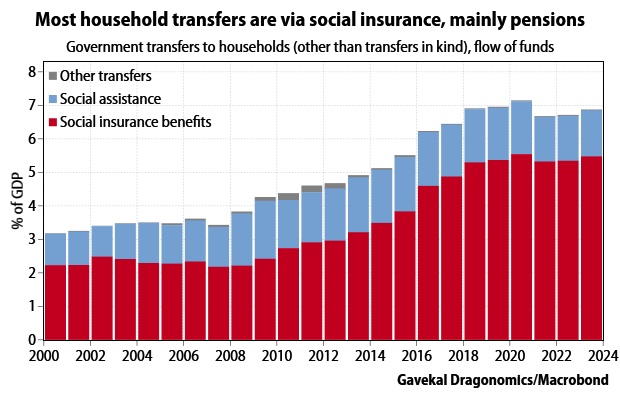
These days China's social-safety net is pretty decent by middle-income-country standards, and in some cases (like those pensions for former SOE/gov't employees) arguably overly generous. 4/
The view that Chinese society is wracked by insecurity made sense in the 2000s, in the aftermath of the massive SOE layoffs of the 1990s and before the government had built a new benefits system. It doesn't make sense today, when social insurance at least touches most people. 5/
Public spending on benefits as a % of GDP has already doubled, but a lot of economists keep saying that the government needs to expand spending on social benefits in order to get the household savings rate down. That spending will expand anyway as society ages. 6/
It just doesn't make sense to think that the social problems of the 2000s are still determining the household savings rate in the 2020s. We should look to more proximate causes, which I think are actually quite obvious. 7/
In my view the main drivers of the persistently high household savings rate are now cyclical rather than structural. Households are cautious because the job market has been weak and uncertain for at least four years (six if you count the pandemic). 8/
The key to "boosting consumption" therefore is not the social-safety net but traditonal macro: China needs macroeconomic policies that tighten the job market and move it closer to full employment. That's what will reassure households. 9/
Here is the link to Nick's piece, which I hope will move the debate in a more productive direction:
The discussion is not about how China’s social policies could become better, as of course they could, but whether they are so uniquely awful as to create massive distortions in household behavior. Many people formed this view 20 years ago and have not updated