
1/N This is a thread on how a geometric formula discovered by the ancient Indian mathematician Brahmagupta already contained the central object of modern descent theory: a genus-one curve underlying elliptic curves - over a millennium before descent theory itself was formalized.
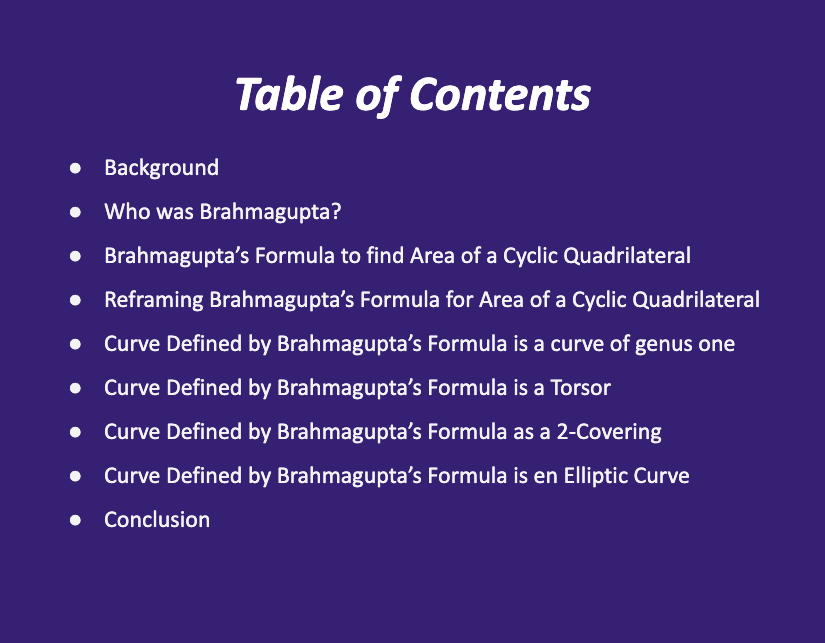
2/N This is a long thread, so feel free to get comfortable - perhaps with a beverage of your choice. To help you jump to sections that interest you, a table of contents follows below
3/N Before diving in, it’s worth understanding why this topic matters and why it is interesting.

4/N More than a thousand years before modern mathematicians formalized descent theory, the Indian (Hindu) mathematician Brahmagupta wrote down a piece of geometry in which its central object - a genus-one curve without a chosen origin - appears directly.
5/N In modern mathematics, especially in modern algebra and number theory, we are trained to begin with abstract structures: groups, rings, and fields.
6/N These objects are introduced axiomatically and studied for their internal properties, often before any concrete examples are considered.
7/N Geometry, when it appears, is frequently treated as something that comes later-a helpful way to visualize algebraic ideas that are already in place, rather than a source of structure in its own right.
8/N This way of organizing mathematics is powerful and efficient, but it also encourages us to forget that many of these abstract frameworks originally arose from geometric relationships, not the other way around.
9/N Brahmagupta was not attempting to define new algebraic structures. He was studying a classical geometric problem-the area of a cyclic quadrilateral-and deriving an exact relation between its side lengths and its area.
10/N That relation, now known as Brahmagupta’s formula for area of cyclic quadrilateral, expresses the square of the area as a product involving the semiperimeter and the side lengths.
11/N Yet the relation he obtained does something remarkable. When read not as a numerical recipe but as an equation relating variables, it defines a smooth algebraic curve of genus one.
12/N Crucially, this curve comes with no distinguished point, no identity element, and no operation. It is geometry before groups.
13/N In modern terms, such an object is called a torsor: a group-like space in which differences between points make sense, but no point is singled out as zero.
14/N Torsors play a central role in descent theory, where one studies genus-one curves that become elliptic curves only after an additional, non-canonical choice is made. What descent theory formalizes abstractly, Brahmagupta’s formula realizes concretely.
15/N This is not a claim about historical anticipation or hidden intent. Brahmagupta did not “know” descent theory, just as Euclid did not “know” vector spaces. The point is structural.
16/N Certain mathematical objects arise naturally from geometry itself, long before the language needed to classify them exists. Brahmagupta’s formula gives such an object outright: a genus-one curve that precedes the group law that modern mathematics would later impose on it.
17/N Seen this way, the surprise is not that ancient mathematics resembles modern theory, but that some of modern theory had to wait more than a millennium for a vocabulary to describe what ancient Indian geometry had already produced.
18/N Brahmagupta stands as one of the most original mathematical minds the world has ever witnessed.
19/N Brahmagupta was one of the greatest scientific minds of the early medieval world, active in the seventh century at a time when mathematical astronomy was a central scientific discipline across India.
20/N From this Indian tradition - already rich in arithmetic, geometry, trigonometry, and planetary theory-many foundational methods and results were later transmitted to the Islamic world and, in turn, helped shape the mathematical and astronomical sciences of medieval Europe.
21/N Working at Ujjain-then one of the major astronomical centers of the world - Brahmagupta wrote on arithmetic, algebra, geometry, trigonometric computation, and planetary theory with a level of generality and precision that would not become standard elsewhere for centuries.
22/N His most influential work, the Brahmasphuṭasiddhānta (628 CE), is a systematic treatise that integrates mathematics and astronomy into a coherent computational science.
23/N In Brahmasphuṭasiddhānta, Brahmagupta gave general methods for solving quadratic equations, articulates consistent rules for operating with zero and negative numbers
24/N Brahmagupta also developed interpolation techniques for astronomical tables, and uses sine-based (jya) procedures and tabular methods to support practical computation in astronomy.
25/N What distinguishes Brahmagupta from many contemporaries is his insistence on relations rather than cases: he formulates identities meant to hold universally, allowing geometric configurations & astronomical quantities to be treated through algebraic structure (continued...)
26/N This approach allows geometric problems to be expressed algebraically, and algebraic relations to be treated independently of any single numerical example.
27/N In this sense, Brahmagupta’s work occupies a position remarkably close to what we would now recognize as structural mathematics.
28/N Equally important is the afterlife of his ideas. Brahmagupta’s astronomical and mathematical results were translated into Arabic within a century of his death and became the source of the foundational corpus of Islamic astronomy.
29/N Khalif Abbasid Al Mansoor ( 712 CE - 775 CE) was the second Abbasid caliph. He is known for founding the 'Round City' of Madinat al-Salam, which was to become the core of imperial Baghdad.
30/N Khalif Abbasid Al Mansoor invited a scholar named Kanka from Ujjain, India in 770 CE to teach the Arabs the Hindu system of arithmetic and astronomy.
31/N The primary text that Kanka (Hindu scholar) was using to teach the Arabs was the book Brāhma-sphuṭa-siddhānta by Brahmagupta (composed no later than 628 CE).