
The best way to improve sleep isn't melatonin, blue-blocking glasses, or sleep apps. It's called CBT-I. It's a set of behaviors that can cut sleep onset latency, increase deep sleep percentage, and reduce nighttime awakenings in adults with insomnia. Learn how it works:
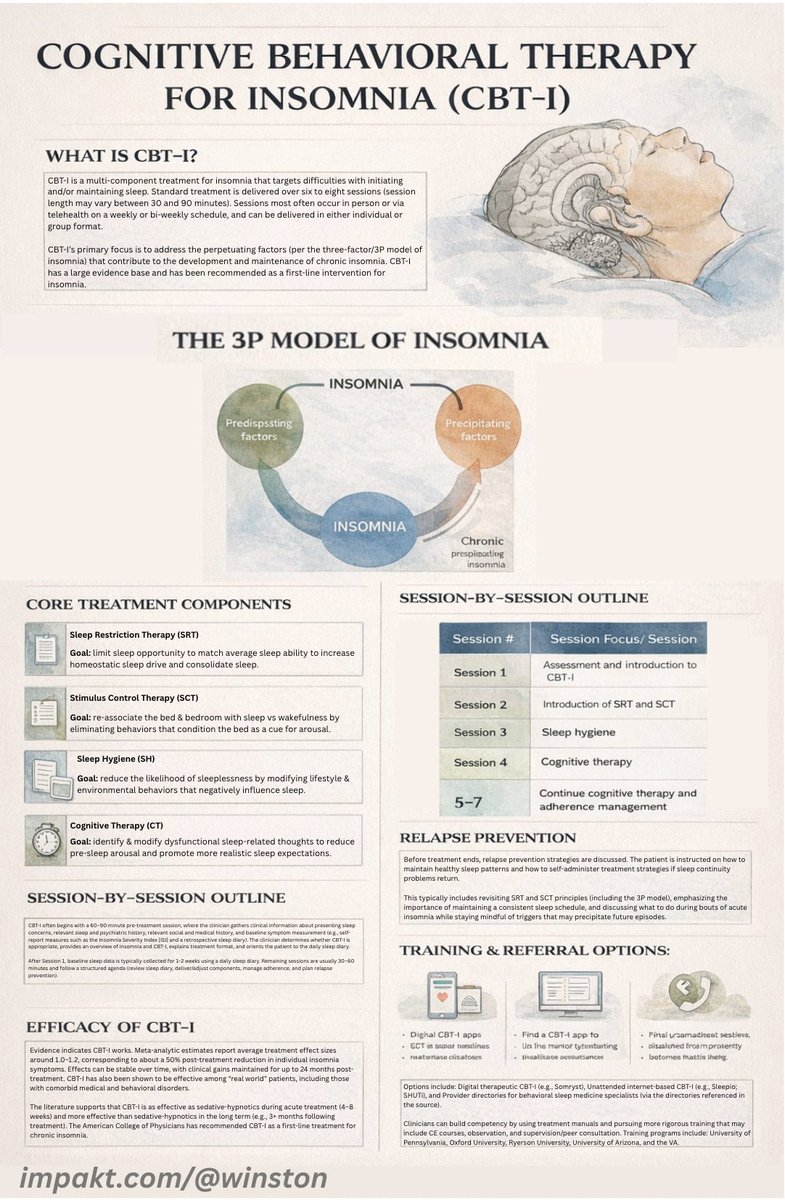
CBT-I isn't a supplement or a gadget. It's a structured program that retrains your brain to associate your bed with sleep instead of stress, scrolling, or lying awake. Meta-analyses show it works better than sleep medication, with year lasting effects. Here's how it works:
Component #1: Sleep Restriction You deliberately limit your time in bed to match how much you're actually sleeping. If you're in bed 8 hours but only sleeping 6, you shrink your "sleep window" to 6 hours. This builds sleep pressure.
Why it works: Most insomniacs spend too much time in bed trying to force sleep. This trains your brain that beds are for lying awake. You want to create a slight sleep debt - just enough to make falling asleep easier and deepen sleep quality. After 1-2 weeks, you expand the window gradually.
How to do it: Track your actual sleep time for one week (not time in bed, actual sleep). Calculate your average. That's your new sleep window. Ex: • If you average 6 hours of sleep, set your window to 6 hours • Pick a consistent wake time (say 6:30am) • Count backward: bed at 12:30am, wake at 6:30am No naps or exceptions for the first 2 weeks.
Component #2: Stimulus Control Your bed should mean one thing: sleep. Not Netflix, not scrolling, not worrying about tomorrow's meeting. This retrains the association between your bed and sleep through classical conditioning. The rules are strict, but they work.
The 6 rules: 1. Only go to bed when actually sleepy (not just tired) 2. Get out of bed if you're awake for 15+ minutes 3. Use the bed only for sleep (and sex) 4. No reading, phone, or TV in bed 5. Wake up at the same time every day 6. No daytime naps If you can't sleep: Get up, go to another room, and do something boring until you're sleepy again.
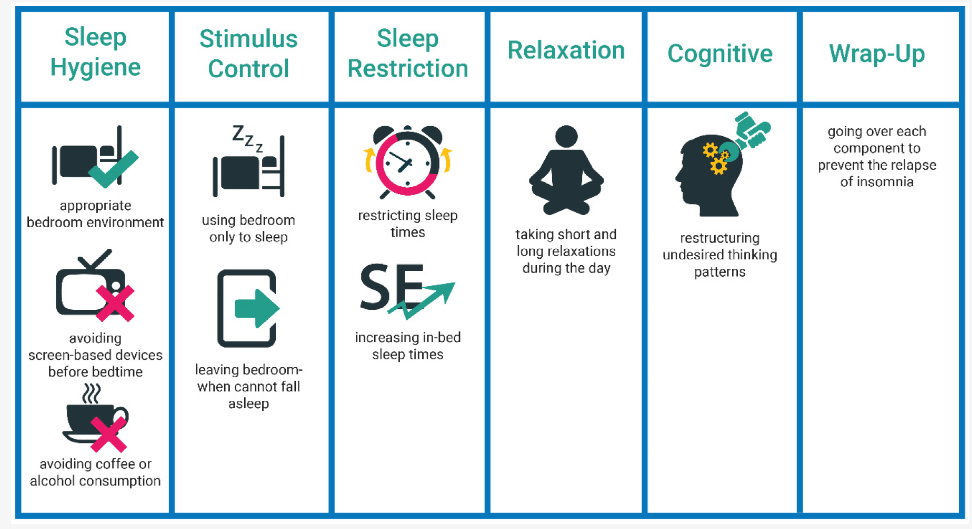
Component #3: Sleep Hygiene You've heard the basics: dark room, cool temp, no caffeine. But CBT-I emphasizes the ones that matter most. Here's what the data supports: • Room temp 65-68°F • Pitch darkness (or eye mask) • No caffeine after 2pm • No alcohol within 3 hours of bed • Exercise earlier in the day (not within 3 hours of sleep)
Component #4: Cognitive Restructuring Most insomniacs catastrophize about sleep. - "If I don't sleep tonight, I'll ruin tomorrow." - "I'll never be able to fix this." - "I need 8 hours or I can't function." These thoughts create anxiety. And anxiety blocks sleep. CBT-I teaches you to challenge these beliefs with evidence.

How to reframe: Catastrophic thought: "I need 8 hours or I'll be useless." Reframe → "I've functioned fine on 6 hours before. One night won't ruin me." Catastrophic thought: "I'll never fall asleep." Reframe → "I'm awake now, but sleep always comes eventually. Stressing makes it take longer." Write these down and use them when your mind spirals at 2am. Sounds woo-woo but it works.
CBT-I has been tested in over 100 randomized controlled trials. Results: • 70-80% of participants see significant improvement • Sleep onset time drops by 20-30 minutes on average • Total sleep time increases by 30-60 minutes • Effects last 2+ years after treatment ends The American College of Physicians recommends it as first-line treatment for chronic insomnia.
Most programs run 4-8 weeks. You'll feel worse the first week (because of sleep restriction). Week 2-3 is when you start seeing real changes. By week 6-8, most people have rebuilt their sleep architecture. This isn't supposed to be a quick fix, but a permanent one.
PS - want to get paid while getting fit? I built an AI coach that guides your reps, corrects your form, and pays you $100+ for each premium member who joins through your link. (Completely free to use) Check it out → @Winston class="text-blue-500 hover:underline" target="_blank" rel="noopener noreferrer">http://impakt.com/@Winston
I hope you've found this thread helpful. Follow me @winston_zin for more. Or subscribe to my science-backed newsletter of health hacks: http://bit.ly/42awCMJ Like/Repost the quote below if you can:
TL;DR CBT-I is the most effective insomnia treatment: • Sleep restriction: limit time in bed to actual sleep time • Stimulus control: bed only for sleep, leave if awake 15+ min • Sleep hygiene: cool, dark, consistent schedule • Cognitive work: challenge anxious sleep thoughts Takes 6-8 weeks. 70-80% success rate. Effects last years. Better than any supplement or device you'll try.
Btw - I built an AI coach that helps you exercise from home with no equipment needed. It watches your form, tracks your reps, & builds custom workout protocols based on your goals. And it even PAYS you while you get fit. Check it out here: @Winston class="text-blue-500 hover:underline" target="_blank" rel="noopener noreferrer">http://impakt.com/@Winston (It's free)
@CEO_DOCTORS Agreed!