
The Day Burma Left India, 197 Million Rupees Moved With It. A thread 🧵
1/ Most Indians know Burma was once part of British India. Few ask a simple question: When Britain separated Burma in 1937, was it only a political decision? The archival record suggests there was a major monetary and financial dimension too.
2/ The official explanation focuses on administration, governance and Burmese nationalism. Fair enough. But when you open the actual Government of India Act 1935, something unusual appears.
3/ Open the Government of India Act 1935. Look at Sections 158-160. Parliament wasn't discussing elections. It was legislating for: • Monetary relations • Taxation • Trade between India and Burma Follow the money.
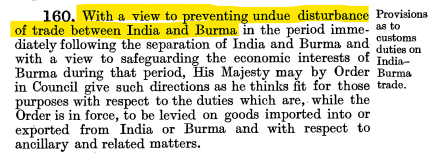
4/ Then Parliament debated how to prevent: "undue disturbance of trade between India and Burma." Not politics. Trade. Commerce. Economic disruption.
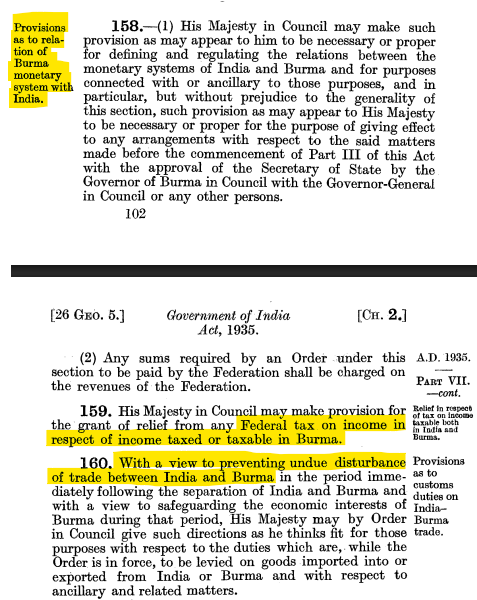
5/ The same debate contains another remarkable phrase. Britain created special provisions for: "safeguarding the economic interests of Burma." Economic interests. Not merely constitutional arrangements.

6/ At this point the question changes. We are no longer asking: "Why was Burma separated?" We are asking: "What financial arrangements had to be redesigned because of separation?"
7/ The answer becomes clearer when we look at internal monetary planning documents. Years before separation was implemented, British officials were already discussing: • Separate note issuance • Currency reserves • Central banking • Trade financing • Exchange management
8/ One British proposal estimated Burma would require roughly: "one-ninth" of the Indian currency system after separation. Officials even calculated how much reserve backing would move to Burma.

9/ The proposed transfer included: • Silver coin • Silver bullion • Gold reserves • Government securities Total value: 197 million rupees. This was not merely a border adjustment. It required redesigning part of the monetary architecture.

10/ Even more interesting: Officials argued Burma needed an "elastic" monetary system capable of expanding and contracting according to trade and harvest cycles. Their focus was currency management. Not electoral boundaries.
11/ Notice the pattern. The archives keep returning to the same themes: • Currency • Trade • Taxation • Reserves • Financial settlements Money appears everywhere in the separation process.
12/ The evidence points in one direction. Britain did not treat Burma's separation as a simple constitutional exercise. It treated it as a monetary, commercial and financial reorganisation of the Empire.
13/ The archives show Parliament legislating for: • Monetary relations • Customs arrangements • Tax treatment • Trade protection • Reserve transfers Before and after separation. Money was not incidental to the process. It was central to it.
14/ The border was the visible outcome. The financial reorganisation underneath it was the real project. Once you follow the money, Burma's separation looks very different from the version taught in textbooks. My Digital Yagna Jayatu Sanatan
CC @colkt ji @Manik_M_Jolly ji