
Ruben Amorim's current game model is flawed. Mikel Arteta's game model is, and always has been, elite. This is one of the most poignant threads I have ever written... A tactical breakdown of Arsenal vs Manchester United 👇

Amorim wants his centre backs to step out and press players dropping between the lines, but: Situation #1) De Ligt doesn't want to jump. Rice is found. Situation #2) Maguire doesn't want to jump. Havertz is found. Situation #3) Mazraoui doesn't want to jump. Ødegaard is found.


What's the issue here? Why aren't United's centre halves jumping to press Arsenal's players between the lines? Let's look at Arsenal's build-up and United's high press. First, it's important to acknowledge that Arsenal build in a variety of shapes and United defend in a 5-2-3.
The reality of the situation is that Arsenal bypassed United's press with incredible ease due to simple build-up mechanisms. For example, here we see Partey drop into the first line of build-up to create a 4v3. United are aggressively high but are outnumbered on the first line.
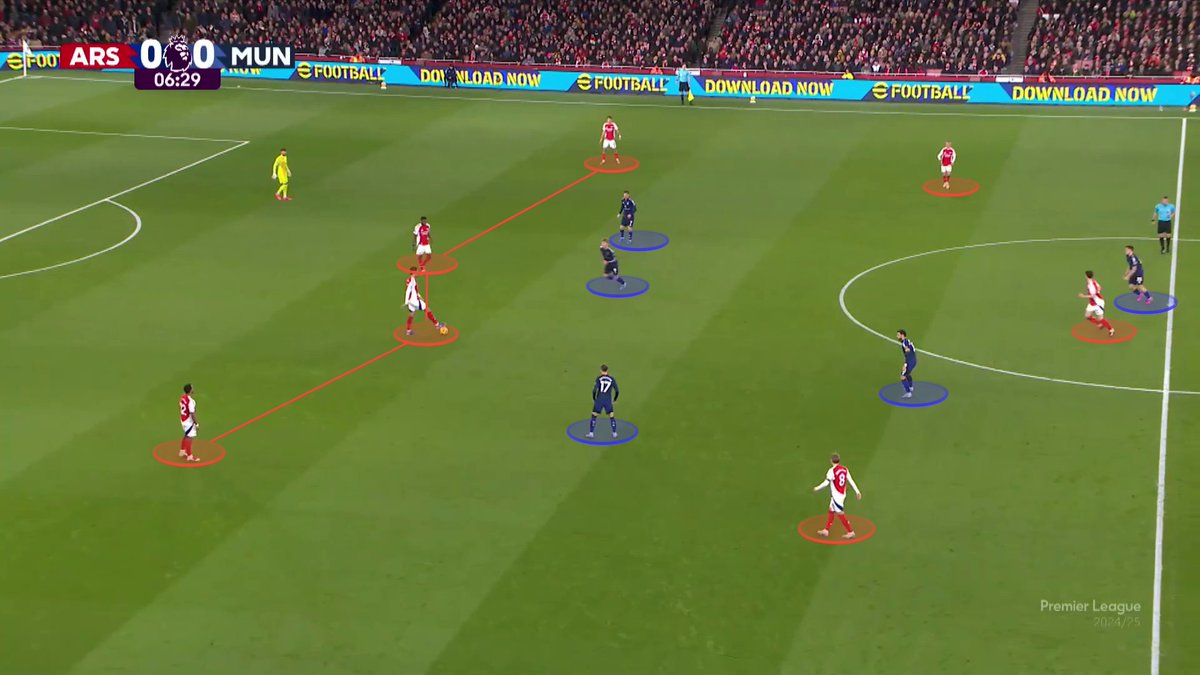
In another example we can see Raya create that 4v3 in the first line for Arsenal. But the advantage I'm currently referring to it 1 singular player. Arsenal, however, had an advantage of up to 8 players versus United's initial lines of pressing which consisted of 5 players.
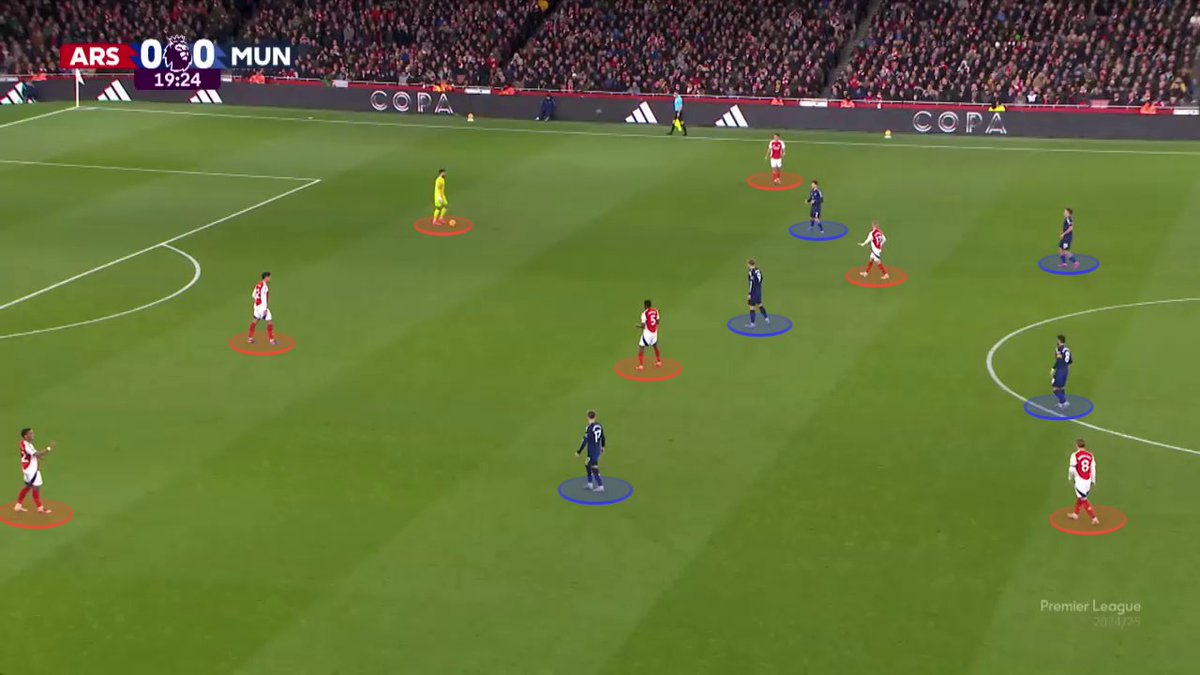
We can see an example of that 8v5 here. Ødegaard and Rice drop from high to low and Raya is a situational centre half - they provide Arsenal with a +3 advantage in the build-up. Football is a numbers game and Arsenal consistently overloaded United's first lines of pressure.
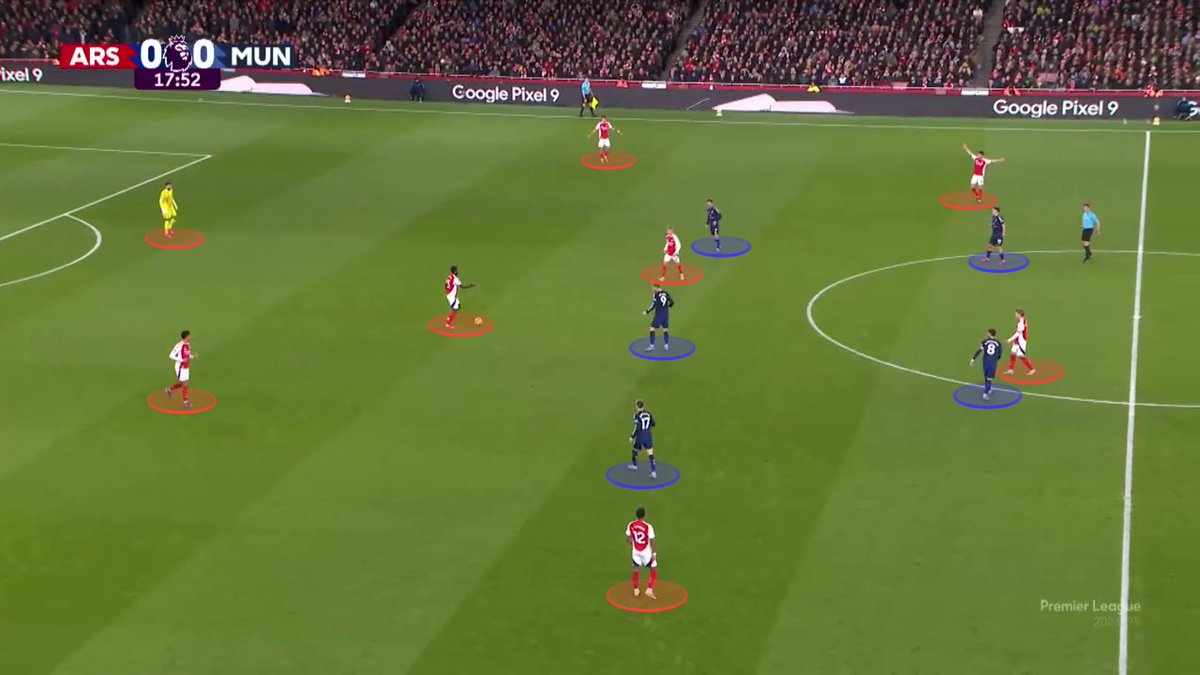
When United did try to apply pressure, they often struggled. Here we see Arsenal play out to the left-hand side. Rice interchanges with the inverted Zinchenko and Ugarte is overloaded because De Ligt isn't doing what Amorim theoretically expects of him which is pressing the #8.
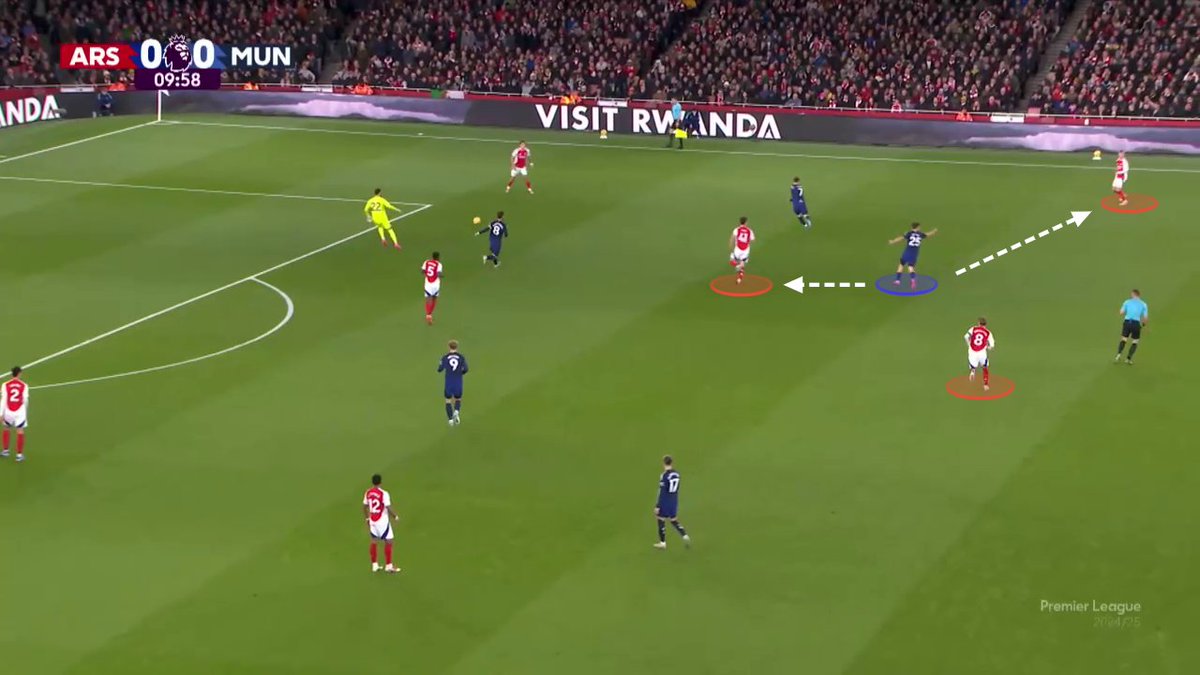
At the bottom of that very same picture, we can see Ødegaard. Again, we don't see Mazraoui anywhere near him. Once again, United's centre half has not jumped and Arsenal have spare men behind United's initial lines of pressure. It allows Arsenal to play through easily.
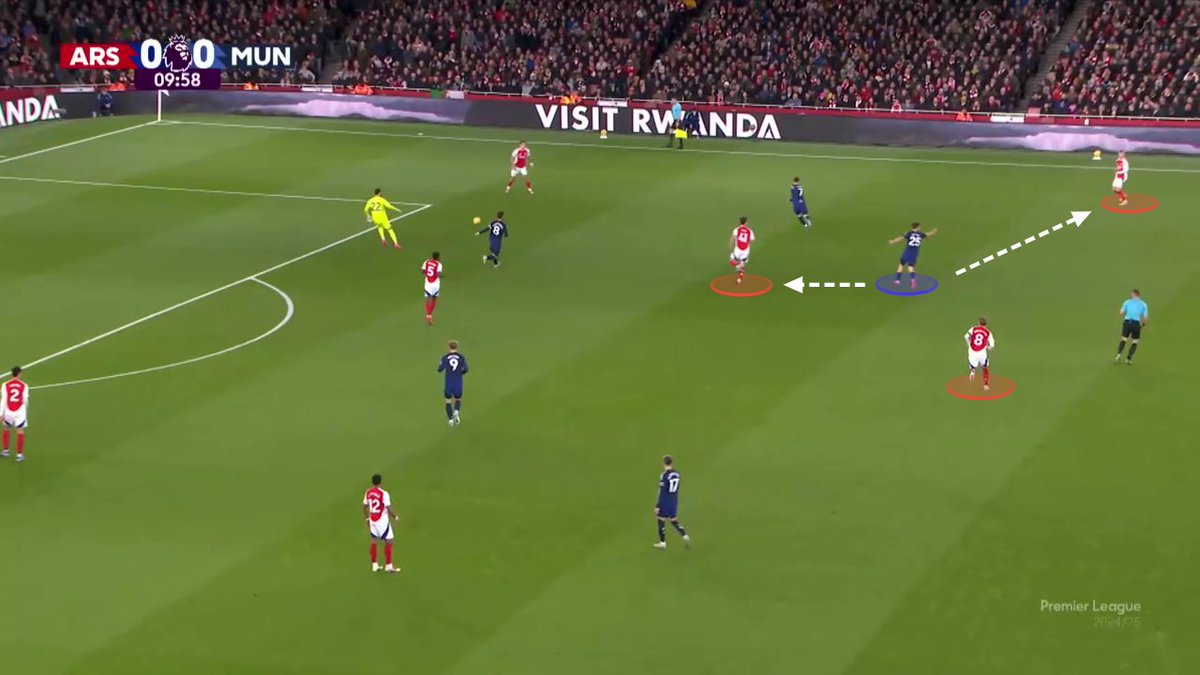
I have countless examples of where one of Manchester United's most tactically intelligent and mobile players in Mazraoui does not press Ødegaard dropping from high to low. I could make an entire thread on it. So, what does that suggest? It tells me the tactic is too passive.
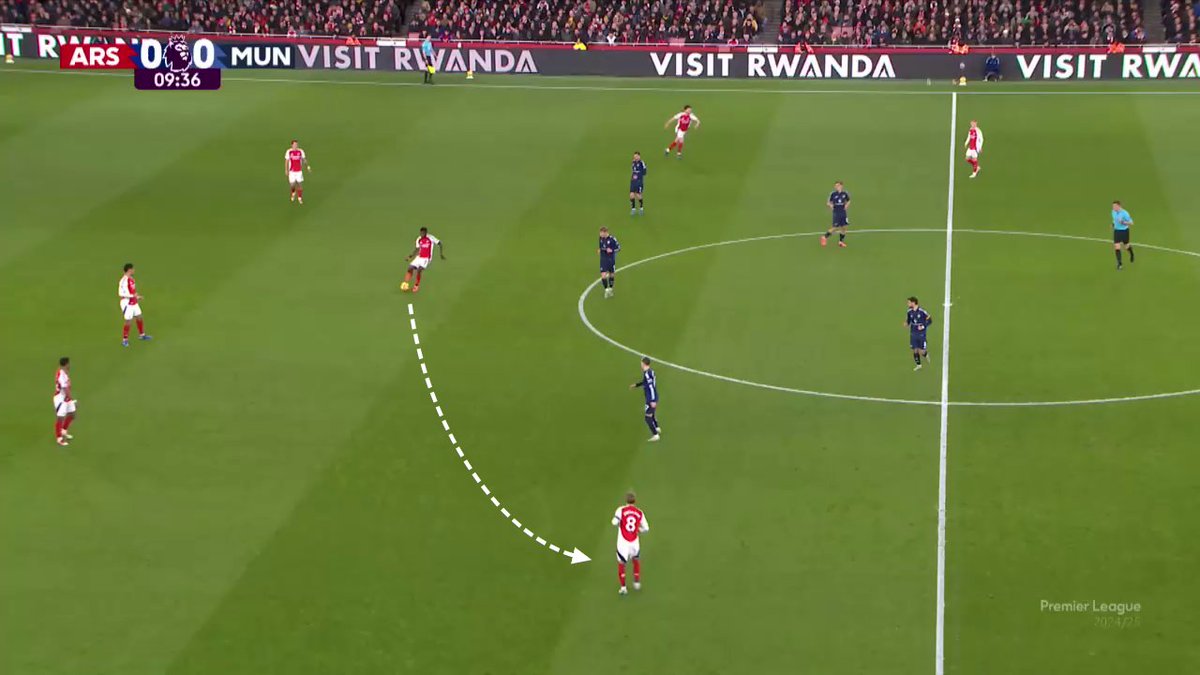
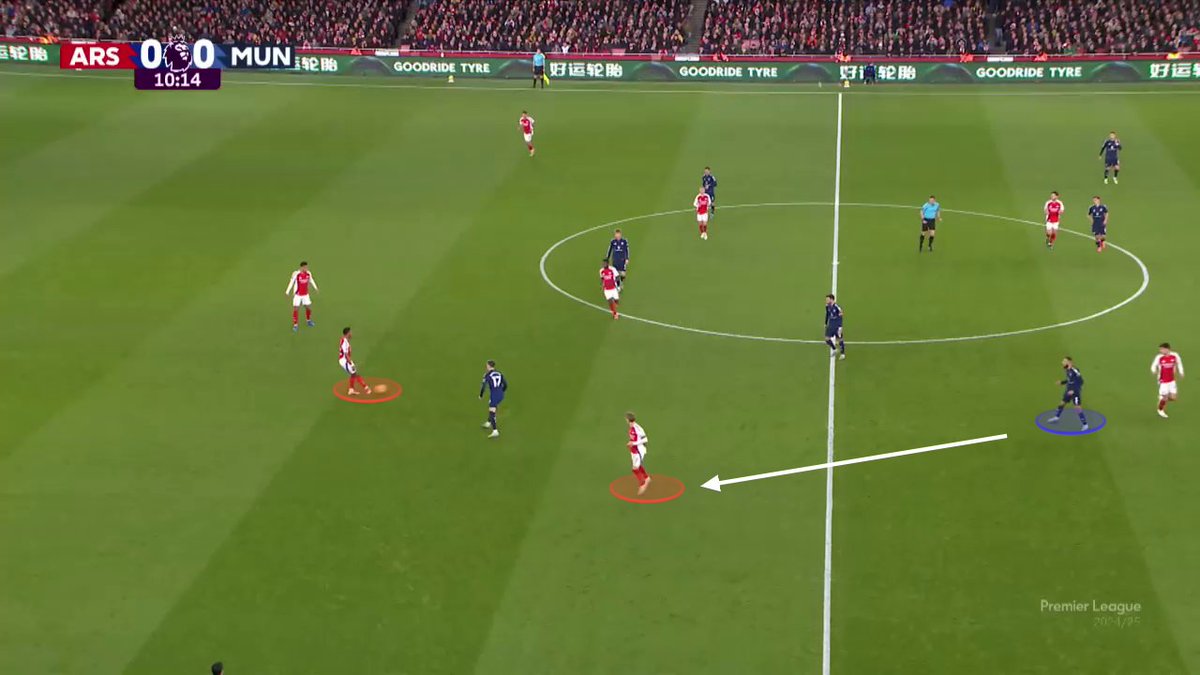
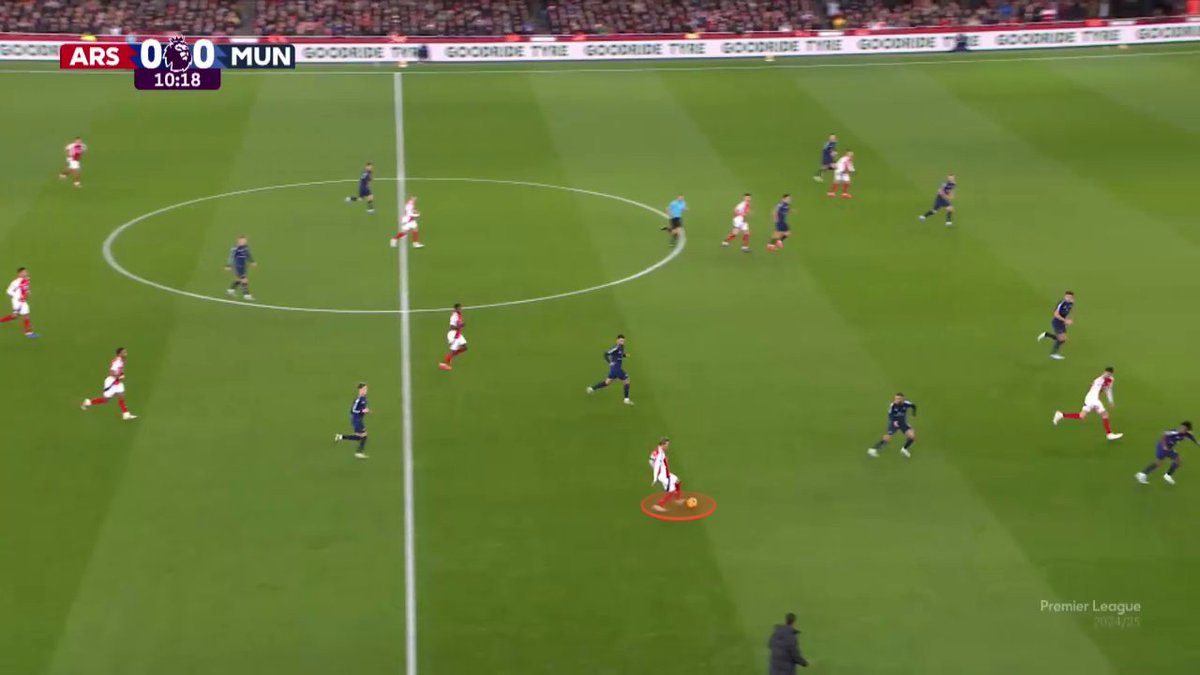
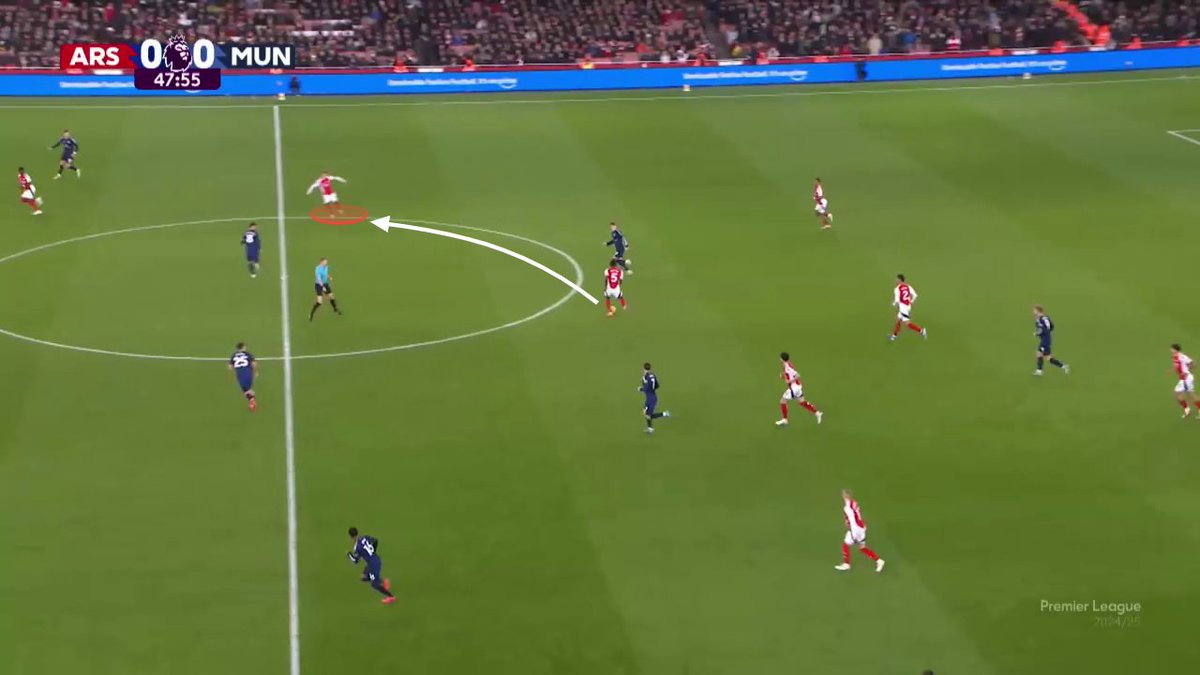
And, see, many people would see the holes within United's block in these types of moments and think about how exploitable their press can be when the centre backs don't jump, and they are right to. However, the implications are worse than that. It allows easy possession overall.
Let's take a look at some examples of that. Here, Raya can clip to Timber or play a pass to Saliba. Why? Because although Timber is a fullback and Amorim's wingbacks often press this high, Timber's fluid positioning prevents them from doing so. He clips over and uses the 2v1.

Mason Mount works hard to backwards counter-press, but Timber can simply recycle to the vacated Saliba. All of a sudden, Arsenal have all day in possession to carry the ball forwards and to start an attack. See, the fluidity of Arsenal is very important to talk about as well.

If Timber and Zinchenko were consistently pinned as deep-lying fullbacks in traditional fullback zones, United's wingbacks could reliably get up to them to apply pressure, but both Timber and Zinchenko invert. So United's wingbacks are left pinned in the last line with wingers..
United's wingbacks can't jump against Arsenal's fullbacks, and their centre backs can't jump against Arsenal's dropping movements in central areas. This means that instead of putting pressure on the ball, the front 5 are overloaded either behind them or in front of them.

Defending with 5 in the last line prevents teams from getting reliable pressure on the ball against elite technical teams. It is a very clear flaw within the tactic. It makes it easy for teams to overload Amorim's system in the initial phases as players drop from high to low.
OKAY, with this in mind, we should have expected to see Arsenal wipe the floor with United in possession from the first until the last minute, right? But that wasn't the case.. Why? Because Arsenal were uncharacteristically poor technically, but they raised the level 2nd half.
As soon as the 2nd half started Arsenal came out all guns blazing and as a consequence of their ability to sustain pressure due to the clear overload in the build-up, they dominated proceedings. It's also really important to talk about narratives surrounding Arsenal's defence.
This idea that Arsenal sat back behind the ball in cautious fashion is a complete and utter fallacy. Guys, please. Arteta's Arsenal are one of the most aggressive pressing teams in the world but to press you MUST be good with the ball too. 1st half, they were not, and suffered.
Let's take a look at Arsenal's tactical intent in the press. Here we see United in their 3-2-5 high build and Arsenal in their 4-4-2 block. The idea is clear & simple in this moment, but 'step-up pressure' was consistently applied. Arsenal wanted to press really aggressively.

We can see an example of that here which we saw countless times throughout the game. When they feel the moment is right, one of the front 3 press their designated man in United's back 3. This is the cue for the rest of the block to jump and to lock on in man-to-man fashion.

Arsenal combined defending compactly in the deep defensive moment with defending with incredible aggression in the high press moment, and they sustained that throughout the game despite being poor technically in the first half which meant they sat more than they would have liked.
As for United's approach in possession, there is no doubt that there are impressive elements to it & it is also key to note that Amorim improved United's build-up structure from goal kicks. Instead of the middle centre half being redundant in the pivot, United built differently.

The structure was similar, but De Ligt pushed out to right back which allowed Maguire to build centrally alongside Mazraoui. This let United build with two natural midfielders in the pivot as opposed to a centre back awkwardly positioned with his back to goal in that area.


However, on the back-pass, Maguire occupied positions like this which essentially made him redundant whilst blocking the passing lanes into midfield. Instead of splitting either side of Onana, his positioning on the back-pass had little-to-no benefit.. This remains a concern.

I have also talked about other issues with Amorim's style in the past, not just centred around the build-up with the centre half inverted or the likelihood of the press getting overloaded. Although the 3-2-5 is great, the fact that wingbacks are reliant to play high is an issue.
Those very same wingbacks are often also pinned into the last line in the defensive moment. For them to get up the pitch, they have to travel from low to high. That takes time and it requires United to hold possession to get into their ideal attacking structure.
The difference between that and a back 4, for example, is that the wingers are already high. Oh, and the sheer fact that they are wingers in the attacking moments - not wingbacks. I know Amorim plays guys like Diallo there, but not on both sides. One is very firmly a wingback.
And this idea of using automatisms and up-back-and-through patterns in the build-up makes a whole lot of sense, but the Premier League is so damn good, man. I say this because most teams are incredible physically and tactically. This means they are prepared for set patterns.
What makes City, Liverpool, Chelsea, and Arsenal so hard to play against is their fluidity. Sometimes the fullback inverts, sometimes they are on the outside. Sometimes the #8 drops from high to low, sometimes they stay high. They are hard to prepare to play against.
Amorim's current style, on the other hand, is rigid. The automatisms can work to a really good standard if implemented correctly, but they are predictable in an incredibly tactical league. The reality of the situation is despite Amorim's overall qualities, his model is flawed.
In every phase there are issues: Build-up, when sustaining pressure, when pressing high, when defending in the mid-block, even when transitioning because they are 5 defenders back as opposed to 4 which means there is 1 less player for the transitional moment. Issues everywhere.
@Tactx_ Thank you mate.